
Use-case matchups
| Need | Better fit | Why |
|---|---|---|
| Complex automation, multivariate tests, and advanced segmentation | Campaigner | Campaigner is stronger for sophisticated email marketing operations. |
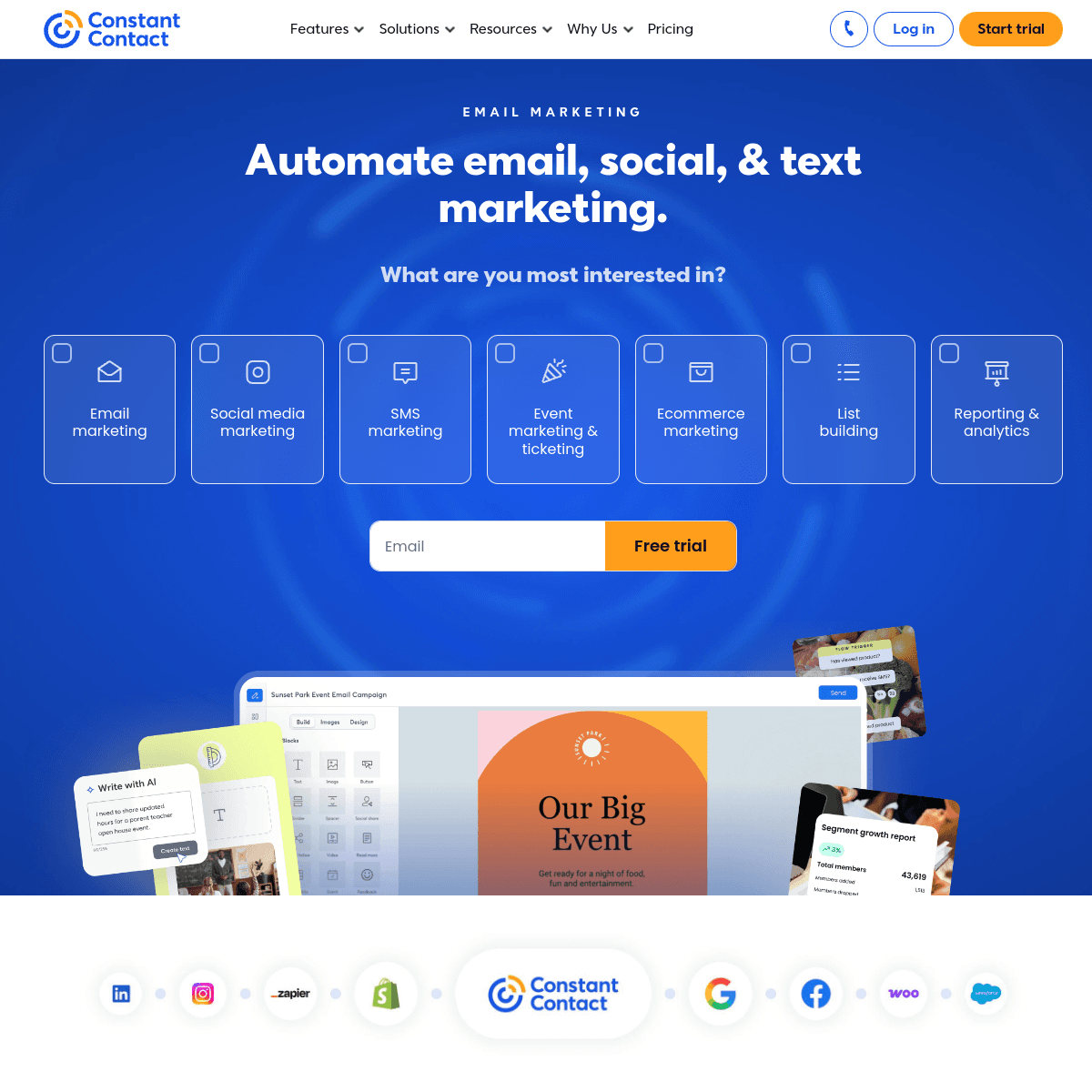
| Beginner-friendly email, phone support, and event marketing | Constant Contact | Constant Contact is easier for small teams and includes event workflows. |
| SaaS lifecycle and transactional email | Sequenzy | Sequenzy is better when Stripe and product events drive messaging. |
| E-commerce automation and testing depth | Campaigner | Campaigner has the stronger automation and ecommerce testing model. |
| Nonprofit, local business, or event-driven organization | Constant Contact | Constant Contact's support and RSVP/event tools matter more for those teams. |
Best Fit by Small-Business Workflow
Best email marketing tool for advanced testing and segmentation
Campaigner fits teams that have enough campaign volume to benefit from complex automation, multivariate tests, ecommerce triggers, and advanced segmentation. It is stronger when marketers want to optimize campaigns through testing and targeting rather than relying on beginner-friendly templates.
Best email platform for events, nonprofits, and local businesses
Constant Contact is the better fit when phone support, beginner hand-holding, event workflows, RSVPs, fundraisers, or local-business campaigns are central. Choose it when the team values guidance and event operations more than advanced testing depth.
Best email platform for SaaS lifecycle and transactionals
Sequenzy fits when Stripe and product events drive messaging more than event marketing or advanced ecommerce testing. It is more relevant when transactional email and lifecycle campaigns need one subscriber record.
Pricing reality
Campaigner and Constant Contact have different value drivers. Campaigner costs more because it sells advanced automation, multivariate testing, segmentation, and template depth. Constant Contact costs less and focuses on ease of use, phone support, event management, social tools, and simpler email workflows.
Do not compare only plan price. Compare contact count, automation depth, event needs, phone support value, SMS, template requirements, ecommerce integration, migration work, and whether advanced Campaigner features will be used weekly.
Review signals
The structured review data on this page keeps sourced snippets from G2, Capterra, and Trustpilot. Campaigner reviews emphasize automation depth and multivariate testing, with price and support access as cautions. Constant Contact reviews emphasize event marketing, reliability, and usability, with dated UX and basic automation as cautions.
Migration checklist
| Step | What to confirm |
|---|---|
| Contacts and consent | Export contacts, lists, tags, segments, custom fields, unsubscribes, bounces, complaints, and consent history. |
| Events and RSVPs | If leaving Constant Contact, preserve event registrations, RSVP history, ticketing records, surveys, and social campaign assets. |
| Advanced automations | If leaving Campaigner, document multivariate tests, dynamic content, segmentation rules, triggers, and ecommerce workflows before simplifying. |
| Templates | Move email templates, saved blocks, brand assets, images, merge fields, and mobile rendering tests. |
| Integrations | Reconnect ecommerce, CRM, payment, event, social, analytics, and Zapier/API workflows. |
| Sender setup | Reverify SPF, DKIM, DMARC, branded links, sender identities, reply-to addresses, and unsubscribe behavior. |
| Reporting | Export campaign, automation, event, test, and deliverability reports before closing the old account. |
Decision checklist
- Do you need advanced automation or a tool a non-technical team can run?
- Are events, RSVPs, phone support, and guided help central to the workflow?
- Will Campaigner's multivariate testing and segmentation improve results enough to justify the price?
- What separate tools are needed for transactional email, SMS, or Stripe-triggered workflows?
- Would SaaS lifecycle and transactional email make Sequenzy the better fit?
Real-World Experience: Who Actually Wins?
I've tested both platforms extensively, and here's what you need to know beyond the feature comparison.
Campaigner is legitimately powerful. The automation builder lets you create complex workflows that would require custom code in most platforms. I built a multivariate test with 5 subject line variants and 3 content versions (15 combinations) in about 20 minutes. The reporting showed me exactly which combination performed best for different segments. If you're an e-commerce brand running sophisticated campaigns, this level of control matters.
But you pay for that power. At $179/mo for 10k contacts, it's expensive. And the interface feels like it was designed for marketing agencies, not founders. I spent 30 minutes trying to figure out how to add a simple automation trigger. The learning curve is real.
Constant Contact is the opposite experience. I had a campaign designed and sent within 10 minutes of signing up. The editor is intuitive, templates are easy to customize, and everything just works. When I couldn't figure out how to segment by location, I called support and they walked me through it in 5 minutes. That level of support matters when you're learning.
The tradeoff is limited automation. You can build basic welcome series and drip campaigns, but anything requiring branching logic or sophisticated triggers won't work. For newsletters and simple automation, it's great. For complex customer journeys, it's limiting.
For SaaS companies, both platforms miss the mark. Neither integrates natively with Stripe, so you can't trigger emails based on subscription events (trial ending, payment failed, churn). You'd need to set up Zapier workflows or build custom webhooks, which adds complexity and cost. Learn more about email marketing automation purpose-built for SaaS.
Where Campaigner Actually Wins
Let's be honest about Campaigner's strengths:
Multivariate testing is legitimately enterprise-grade. Most platforms offer simple A/B testing (2 variants). Campaigner lets you test multiple subject lines, sender names, and content versions simultaneously. For high-volume senders optimizing conversion rates, this is worth the cost.
Template library is massive. 900+ professional templates covering every industry and use case. If you're a marketing agency sending campaigns for multiple clients, you'll find templates that match each brand. Constant Contact's 200+ templates are fine, but more limited.
E-commerce automation is sophisticated. Product recommendations based on purchase history, abandoned cart workflows with dynamic product images, post-purchase upsells - it's all built in. If you're running a Shopify or Magento store, Campaigner handles complex e-commerce flows that Constant Contact can't match.
Segmentation is granular. You can segment by any field, combine conditions with AND/OR logic, and create dynamic segments that update in real-time. Constant Contact's segmentation works for basic use cases but lacks the depth for advanced targeting.
Where Constant Contact Actually Wins
Ease of use is unmatched. I onboarded a non-technical client who built and sent their first campaign in under 20 minutes. The editor is drag-and-drop simple, and the interface doesn't overwhelm you with options. If you're not a professional marketer, this matters more than advanced features you won't use.
Phone support is a game-changer. When I needed help with deliverability, I called support and spoke with someone in 2 minutes. They reviewed my account, identified the issue (missing DKIM authentication), and walked me through the fix. Campaigner has support, but it's less responsive and not available by phone on lower tiers.
Event management is built in. RSVP forms, registration pages, ticketing - it's all included. If you're a nonprofit, membership organization, or local business running events, Constant Contact's event features save you from needing a separate tool like Eventbrite.
Social media tools extend your reach. You can publish posts to Facebook and Instagram directly from Constant Contact, track engagement, and repurpose email content as social posts. Campaigner doesn't include this, so you'd need a separate social media tool.
Honest Limitations of Both Platforms
Neither platform offers transactional emails. If you're a SaaS company sending password resets, receipts, or account notifications, you'll need a separate service. That means managing two platforms, two sets of analytics, and potential deliverability issues from split sender reputation. Check out how transactional email works.
Neither integrates natively with Stripe. SaaS companies rely on subscription events to trigger emails (trial ending, upgrade, churn). Both platforms require Zapier or custom webhooks, which adds complexity. Sequenzy's native Stripe integration handles this automatically. See our Stripe integration guide for details.
No AI email generation. You're writing all copy and designing all layouts manually. This takes time, especially if you're not a copywriter. Sequenzy's AI generates complete email sequences based on your goal, saving hours per campaign.
SMS is expensive. Campaigner charges +$45/mo for SMS. Constant Contact includes SMS on higher plans. Neither offers the value of platforms like Brevo or dedicated SMS tools.
Migration Considerations
Moving from Constant Contact to Campaigner makes sense if you've outgrown basic automation. Export your contact list (CSV), import into Campaigner, and rebuild workflows. Budget 1-2 weeks for migration if you have complex automations.
Moving from Campaigner to Constant Contact is usually a downgrade in features but upgrade in usability. Works well if you're simplifying your marketing stack or don't need advanced automation.
Moving to Sequenzy from either works best for SaaS companies. We import your contacts, help you set up Stripe integration, and provide templates for common SaaS sequences (trial conversion, onboarding, churn prevention). Most migrations complete in 2-3 days. Read our platform comparison for more.
Migration notes
| Step | What to confirm |
|---|---|
| Contacts and consent | Export contacts, lists, tags, segments, custom fields, unsubscribes, bounces, complaints, and consent history. |
| Events and RSVPs | If leaving Constant Contact, preserve event registrations, RSVP history, ticketing records, surveys, and social campaign assets. |
| Advanced automations | If leaving Campaigner, document multivariate tests, dynamic content, segmentation rules, triggers, and ecommerce workflows before simplifying. |
| Templates | Move email templates, saved blocks, brand assets, images, merge fields, and mobile rendering tests. |
| Integrations | Reconnect ecommerce, CRM, payment, event, social, analytics, and Zapier/API workflows. |
| Sender setup | Reverify SPF, DKIM, DMARC, branded links, sender identities, reply-to addresses, and unsubscribe behavior. |
| Reporting | Export campaign, automation, event, test, and deliverability reports before closing the old account. |
Pricing Reality Check
At 10k subscribers:
- Campaigner: $179/mo
- Constant Contact: $80/mo
- Sequenzy: $49/mo
Campaigner's price includes advanced features most businesses won't use. If you're running multivariate tests and complex automation, it's justified. For most small businesses, you're paying for features that sit unused.
Constant Contact's $80/mo is fair for what you get: easy-to-use platform, phone support, event management. Not the cheapest option, but the support and simplicity have value.
Sequenzy at $49/mo specifically targets SaaS companies. You get Stripe integration, AI email generation, and transactional + marketing email in one platform. SMS is only a paid add-on and the landing page template library is smaller, but if those aren't priorities, it's the best value. See our full pricing breakdown.
Final Recommendation
Choose Campaigner if you're:
- Running sophisticated e-commerce automation
- Testing multiple campaign variables regularly
- Managing large template libraries
- Comfortable with complex marketing tools
Choose Constant Contact if you're:
- New to email marketing
- Need phone support and hand-holding
- Running events and want built-in RSVP tools
- Prefer simplicity over advanced features
Choose Sequenzy if you're:
- A SaaS company using Stripe for billing
- Want AI-generated email sequences
- Need transactional + marketing email together
- Looking for the best pricing with SaaS-specific features
Both Campaigner and Constant Contact are solid platforms for their target audiences. The best choice depends on your technical comfort level, budget, and specific use case. For SaaS companies, neither is ideal - that's why we built Sequenzy. Check out our feature comparison to see if we're a better fit.
The Event Marketing Divide
Constant Contact's built-in event management is a genuinely unique capability among email marketing platforms. Creating event invitations, managing RSVPs, sending reminders, and following up with attendees all happen within the same platform as your email marketing. No separate Eventbrite subscription, no integration middleware, no data synchronization issues.
Campaigner has no event functionality. Organizations running frequent events - chambers of commerce, professional associations, educational institutions, religious organizations - would need to pair Campaigner with a separate event platform at additional cost and complexity. For these organizations, Constant Contact's event tools are not a nice-to-have; they are a core workflow requirement.
The event capability matters most for a specific audience segment. Most businesses do not run frequent events, making this feature irrelevant to their comparison. But for the organizations where events are a primary engagement channel, Constant Contact's native event tools provide genuine value that no amount of automation sophistication from Campaigner can replace.
Two Dated Interfaces, Different Reasons
Both Campaigner and Constant Contact have interfaces that feel behind the times, but for different reasons. Campaigner's interface is dense because it exposes enterprise-level complexity - dozens of menu options, nested settings, and advanced configuration panels. The datedness comes from information overload. Constant Contact's interface is dated in a simpler way - it looks like a 2018 web application because it largely is one, but the simplicity that comes with age also means fewer confusing options.
For non-technical users, Constant Contact's dated simplicity is actually preferable to Campaigner's dated complexity. You can find what you need in Constant Contact within a few clicks. In Campaigner, the same task might require navigating through three layers of menus and understanding marketing automation terminology.
Neither platform has kept pace with the design standards of newer competitors like MailerLite, Flodesk, or Loops. SaaS companies evaluating either platform for subscription email campaigns should consider whether the interface friction of these older platforms is acceptable when modern alternatives like Sequenzy offer cleaner workflows with AI-powered sequences built for subscription businesses.
The Support Gap as a Business Decision
Constant Contact's phone support is not just a feature checkbox - it is a fundamental business model difference. The company invested heavily in human support infrastructure because their target market (small businesses, nonprofits, local organizations) needs it. These users are not professional marketers. They need someone to answer questions like "why did my email go to spam?" or "how do I add a button to my template?"
Campaigner's support model assumes users are technically capable. Email support and documentation are the primary channels. Phone support exists on higher-tier plans but is not the emphasized experience. This works for marketing teams with dedicated email specialists. It fails for small business owners wearing every hat in the company.
The support cost is embedded in the pricing. Constant Contact's $80/month partially funds their support team. Campaigner's $179/month funds feature development rather than support infrastructure. Neither approach is wrong - they serve different customer needs. But the support gap means that Constant Contact users who switch to Campaigner for advanced features often miss the human assistance they relied on for troubleshooting and strategy.









