
Overview
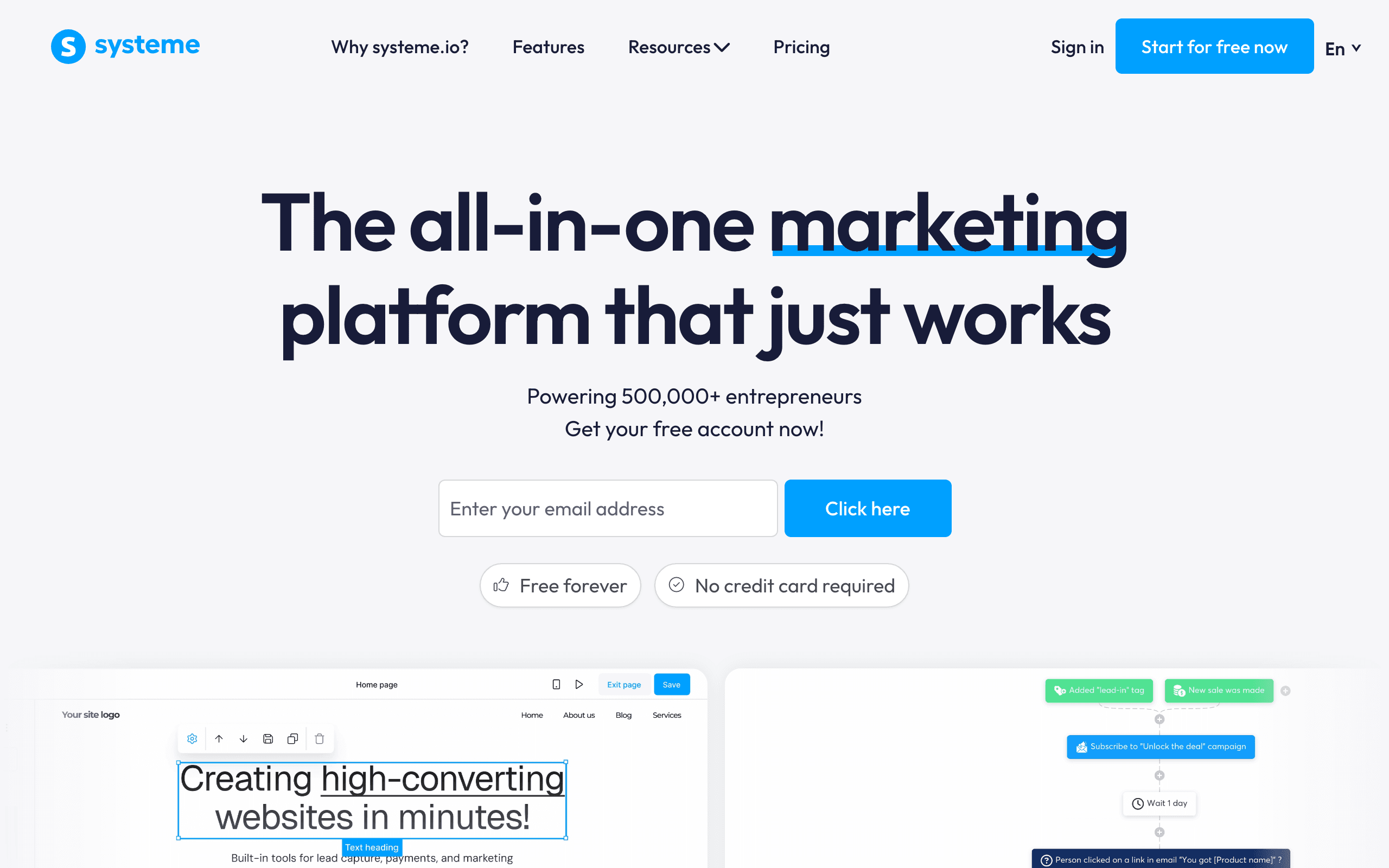
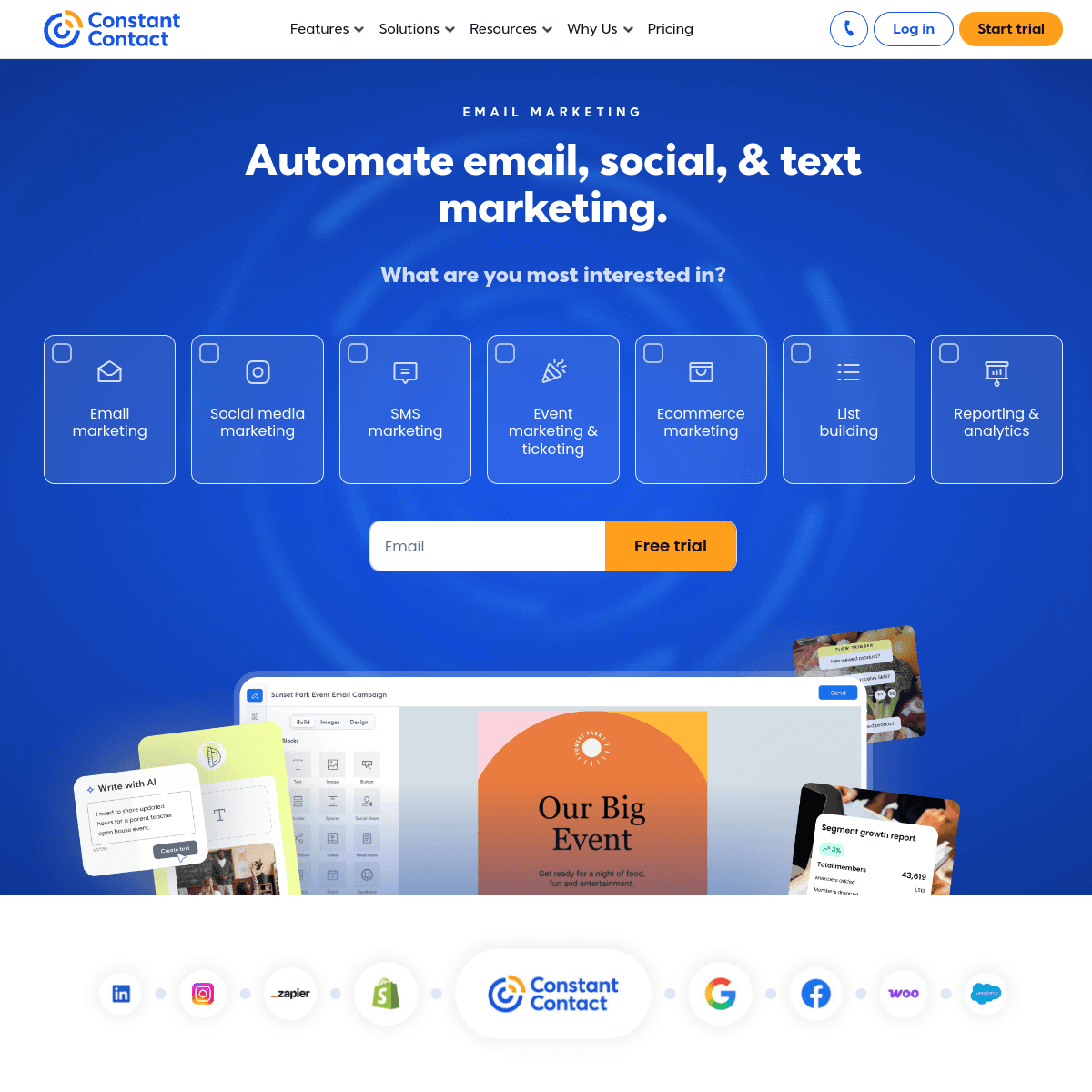
Systeme.io and Constant Contact serve different needs. Systeme.io is a all-in-one marketing platform with funnels, courses, and email. Constant Contact is a established email marketing with event tools.
The All-in-One Proposition
Systeme.io bundles email, sales funnels, online courses, membership sites, and a blog into one platform, free for up to 2,000 contacts and $27 a month beyond that. Constant Contact costs more at roughly $80 a month and skips funnels and courses entirely, offering event marketing, RSVP tools, and social media posting instead. Solopreneurs and course creators who would otherwise pay for several separate tools get more out of Systeme.io's bundle, while businesses running live events may prefer Constant Contact's specialized features.
Constant Contact focuses on event marketing and social media tools. While Constant Contact does email well, Systeme.io bundles more tools under one roof.
The Trade-off: Breadth vs Depth
Systeme.io's email marketing features are functional but basic compared to dedicated email platforms. If you need advanced automation, beautiful templates, or sophisticated segmentation, Constant Contact will likely do a better job at event marketing.
Pricing
Systeme.io offers a genuinely generous free plan: 2,000 contacts with unlimited emails. Paid plans start at $27/month. Constant Contact costs ~$80/month. For pure email marketing, Constant Contact may offer better value. For an all-in-one platform, Systeme.io is hard to beat on price.
For SaaS Founders
Billing events are the gap here, since neither Systeme.io nor Constant Contact offers SaaS-style billing triggers. Sequenzy's Stripe integration can start emails when a trial ends or a payment fails, and its AI sequences can draft the flow alongside transactional messages. Plans are priced by emails sent each month, and the full list is on pricing.
Support Quality: A Real Differentiator
Constant Contact's phone and chat support is genuinely helpful, staffed by people who understand email marketing. For small business owners who are not technically inclined, being able to call someone and get help setting up a campaign has real value.
Systeme.io support is primarily through email and community forums. Response times are reasonable but the lack of phone support can be frustrating for users who prefer human interaction. For businesses where support accessibility matters, Constant Contact's advantage is tangible.
Event Marketing: Constant Contact's Unique Feature
Constant Contact includes event marketing tools with RSVP management, registration pages, and event-specific email campaigns. No other email platform in this comparison offers dedicated event tools. For businesses that host events, workshops, or webinars regularly, this built-in capability saves the cost of a separate event tool.
Systeme.io has webinar functionality built in but focuses on automated webinar funnels for selling rather than event management with RSVPs and attendee tracking.
Long-Term Platform Stability
Constant Contact has been in business for over 30 years. Systeme.io launched in 2018. For businesses planning their email marketing for the long term, platform stability and longevity reduce the risk of forced migration. Constant Contact is unlikely to disappear. Newer platforms carry more uncertainty, though Systeme.io has grown rapidly and appears stable.
The $53/Month Gap That Defines the Decision
Systeme.io's free plan gives you 2,000 contacts with unlimited emails. Constant Contact's cheapest option for similar contact counts starts around $30/month. At 10,000 contacts, the gap widens to $53/month ($27 versus $80). That is $636/year, which for a solopreneur represents meaningful operating budget. Systeme.io also bundles sales funnels, course hosting, and a blog that would cost $100-200/month separately.
But Constant Contact's higher price buys you email marketing maturity that Systeme.io lacks. Templates that render correctly across every email client, deliverability infrastructure refined over three decades, and support staff who can walk you through campaign optimization over the phone. The $53/month premium is not just for email features; it is for 30 years of institutional knowledge embedded in the product. Whether that premium is worth it depends on how critical email quality is to your business versus how much you value having everything bundled in one affordable platform.
Two Very Different Approaches to Selling
Systeme.io is designed around the digital product funnel. Landing page attracts visitors, email nurture builds trust, sales page converts, course platform delivers. The entire journey lives in one tool. Constant Contact has no funnel builder, no course hosting, and no membership features. It sends emails and manages events, which is all some businesses need but far less than what digital product sellers require.
For a consultant selling a $2,000 online course, Systeme.io's integrated funnel-to-course pipeline eliminates the need to connect separate tools. For a local restaurant sending weekly specials and managing catering event RSVPs, Constant Contact's event marketing and simple email tools are exactly right. These platforms serve fundamentally different business models, and choosing between them is less about feature comparison and more about identifying which business model you are actually running.
The Reliability Question for Mission-Critical Email
Constant Contact has been in business since 1995. Their infrastructure has survived three decades of scaling, regulatory changes, and market evolution. When your nonprofit's annual fundraiser depends on the donation appeal email landing in 50,000 inboxes on a specific Tuesday, Constant Contact's track record provides confidence. Systeme.io launched in 2018, has grown rapidly, and appears stable, but has not yet proven itself through a major infrastructure challenge or economic downturn.
For businesses where email is a nice-to-have marketing channel, platform age matters less. For organizations where email delivery is mission-critical, such as nonprofits during giving season or event organizers managing registrations, the proven track record of an established platform carries real weight. Neither platform, however, was built for the SaaS model where email automation must respond to billing events in real time. Sequenzy's Stripe integration addresses this gap specifically for subscription software businesses at $49/month.
Use-case matchups
| Situation | Best first look | Why |
|---|---|---|
| Creator or small business wants funnels, courses, pages, and email together | Systeme.io | Systeme.io is the baseline when all-in-one funnel and course tooling matters more than specialized email depth. |
| Small business wants familiar email campaigns | Constant Contact | Constant Contact is stronger when conventional campaigns and SMB support matter more than funnels. |
| SaaS or commerce team wants lifecycle and transactional email | Sequenzy | Sequenzy is stronger when Stripe, store, transactional, and lifecycle email events are the center of the workflow. |
| Team wants to avoid stitching course, checkout, page, and email tools | Systeme.io | Systeme.io is useful when one lower-cost suite is more important than best-in-class email features. |
| Team needs the specialist capability | Constant Contact | Constant Contact deserves the first demo when the main requirement is legacy small-business email and support. |
| Team wants email automation without funnel-suite overhead | Sequenzy | Sequenzy is narrower and should be evaluated when email lifecycle workflows matter more than course or page building. |
Best Fit by Small-Business Workflow
Best all-in-one platform for solopreneur funnels and courses
Systeme.io fits solopreneurs who want to launch funnels, courses, memberships, and email without assembling a separate website, checkout, and automation stack.
Best email marketing platform for events and local campaigns
Constant Contact is the better fit for local businesses, nonprofits, and event-driven teams that value familiar email campaigns, event promotion, and support.
Best SaaS email platform for subscription lifecycle messages
Sequenzy fits software teams where email should respond to trials, payments, upgrades, and product behavior rather than local events or course funnels.
Pricing reality
The pricing signals on this page list Systeme.io at $27/month, Constant Contact at ~$80/month, and Sequenzy at $49/month. Compare the cost against the job each product is doing.
Systeme.io can look inexpensive because it bundles funnels, pages, courses, checkout, and email. Constant Contact's real cost depends on whether the team needs legacy small-business email and support.
Review signals
For Systeme.io, validate review themes around funnel builder quality, course features, email deliverability, support, and where users hit limits. For Constant Contact, focus review research on whether users praise the reason you would choose it: legacy small-business email and support.
Migration checklist
| Workstream | Moving toward Systeme.io | Moving toward Constant Contact | Simplifying to Sequenzy |
|---|---|---|---|
| Assets and funnels | Move landing pages, funnels, forms, courses, checkout steps, domains, and email assets. | Map contacts, lists, tags, events, templates, forms, automations, and suppressions. | Move subscribers, tags, attributes, suppressions, and lifecycle events. |
| Contacts and consent | Import contacts, tags, custom fields, purchases, consent, unsubscribes, and suppressions. | Import the data model Constant Contact needs for legacy small-business email and support. | Import subscriber data and lifecycle attributes. |
| Automations | Rebuild nurture, sales funnel, course onboarding, checkout follow-up, and newsletter automations. | Rebuild the workflows that prove Constant Contact's advantage. | Rebuild lifecycle and transactional email flows. |
| Payments and products | Validate course access, checkout, offers, coupons, and payment events. | Keep products and payments elsewhere unless Constant Contact supports them. | Use Stripe or store events for lifecycle email. |
| Reporting | Validate funnel conversion, email engagement, sales, exports, and course metrics. | Validate reporting for legacy small-business email and support before committing. | Validate campaign, automation, transactional, and subscription lifecycle reporting. |
Decision checklist
- Is the buyer replacing only email, or also the funnels, pages, courses, checkout, and automations that Systeme.io bundles?
- Does Constant Contact's strength in legacy small-business email and support matter more than Systeme.io's all-in-one bundle?
- Which of the two needs less manual cleanup for consent, suppressions, and deliverability, given Systeme.io's inconsistent deliverability reports?
- Are the $27 and ~$80 prices still realistic once you add any funnel, course, or email tool the chosen platform lacks?
- Would Sequenzy, as a focused lifecycle email platform, be easier to run than an all-in-one suite like Systeme.io?
- Constant Contact should justify its cost through support and conventional SMB workflows.









