
Overview
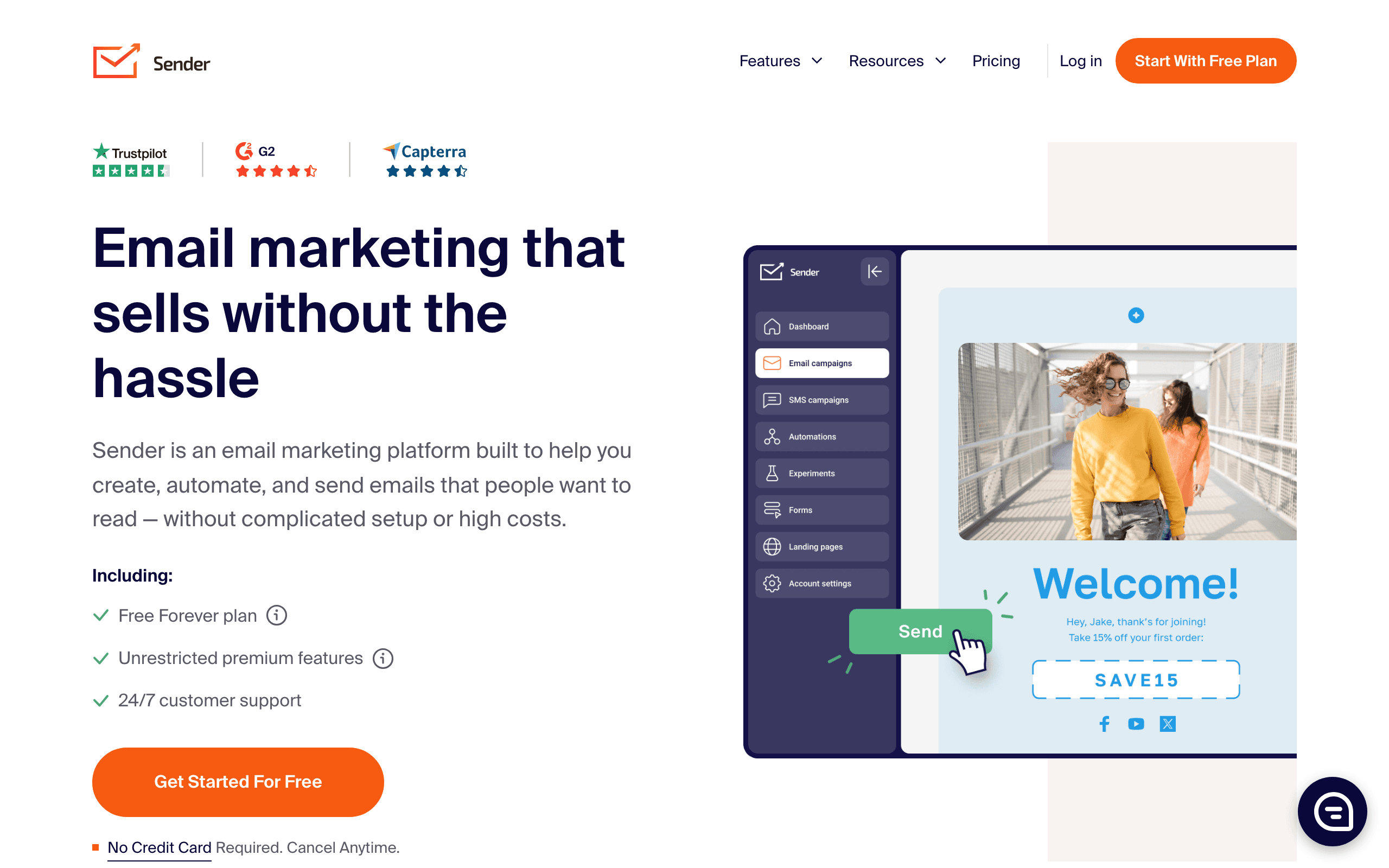
Sender and Moosend are both budget-friendly email marketing platforms. Sender has a better free tier and includes SMS. Moosend is cheaper on paid plans and backed by Sitecore. See our Moosend comparison for context.
Free Tier vs Trial
Sender offers an ongoing free plan with 2,500 subscribers and 15,000 emails monthly. Moosend only offers a 30-day trial with no permanent free tier. For long-term testing or small projects, Sender's free plan is far more useful.
Paid Plan Pricing
At 10k subscribers, Moosend costs $32/month vs Sender's ~$50/month. For paid users, Moosend is notably cheaper. However, Sender includes SMS which Moosend does not.
SMS Marketing
Sender includes native SMS marketing in its platform. Moosend does not offer SMS at all. If you need email + SMS from one platform, Sender is the only option between these two.
Platform Backing
Moosend is owned by Sitecore, a large enterprise software company. This provides stability, continued investment, and enterprise-grade infrastructure. Sender is independent with its own growth trajectory.
Template Libraries
Sender has 1600+ templates - a significantly larger library. Moosend has a good selection but smaller. For variety in design starting points, Sender offers more options.
E-commerce Capabilities
Sender has better e-commerce integrations with Shopify and WooCommerce. Abandoned cart, product blocks, and e-commerce automation are more developed. Moosend has basic e-commerce but less depth.
Automation Comparison
Both platforms offer good visual automation builders with drag-and-drop workflows. Sender has slightly better conditional logic. Moosend has solid pre-built recipes. For most use cases, both handle automation well.
The Tradeoff
Sender: Better free tier, SMS included, more templates, better e-commerce, higher paid price. Moosend: Cheaper paid plans, enterprise backing, no free tier, no SMS.
Choose based on whether free tier and SMS matter more than lower monthly costs.
For SaaS Companies
Neither platform is built for SaaS specifically. Both lack native Stripe integration. Sequenzy offers Stripe integration with subscription-aware automation at pricing between these two for software businesses.
Making the Choice
Choose Sender for the generous free tier, SMS marketing, and e-commerce depth. Choose Moosend for lower paid pricing and Sitecore backing. Both are solid budget platforms with different strengths.
The Free vs Cheap Calculation
Sender's free tier (2,500 subscribers, 15,000 emails) versus Moosend's 30-day trial represents a fundamental difference in how you start. With Sender, you can run email marketing for free indefinitely until you exceed 2,500 subscribers. With Moosend, you must commit to paying $32/month within 30 days or lose access.
For bootstrapped businesses, this timing difference matters. Building an email list to 2,500 subscribers while running email marketing for free means your first revenue from email costs you nothing. With Moosend, you start paying from month one regardless of list size. Over a year of growing a list from zero to 2,500 subscribers, Sender saves approximately $384 compared to Moosend's paid plans.
However, once you pass 2,500 subscribers, the math reverses. Sender's paid plans cost ~$50/month at 10k subscribers while Moosend costs $32/month. The $18/month difference favors Moosend on an ongoing basis. The breakeven point depends on how quickly your list grows past the free tier threshold.
Enterprise Backing vs Independence
Moosend's acquisition by Sitecore, a major enterprise software company, provides stability that independent platforms like Sender cannot guarantee. Enterprise backing means continued investment, infrastructure reliability, and reduced risk of the platform shutting down. For businesses that depend on email marketing continuity, this stability has real value.
The flip side of enterprise ownership is potential strategic shifts. Sitecore could reposition Moosend toward enterprise pricing, reduce features on lower tiers, or integrate it so deeply into the Sitecore ecosystem that standalone users face friction. Independent platforms like Sender maintain focus on their core audience without parent company influence.
Both platforms have operated reliably for years. Sender has been around since 2012 and serves over 180,000 businesses. Moosend has proven itself since 2013. Neither platform is likely to disappear. The stability concern matters more for highly risk-averse organizations than for typical small businesses. Use our email validator to maintain list health regardless of which platform you choose.
E-commerce Feature Depth
Sender's e-commerce integrations with Shopify and WooCommerce go deeper than Moosend's basic connections. Product blocks in emails, abandoned cart sequences with product images, and purchase-triggered follow-up flows are all more developed in Sender. For online stores, this depth translates to more revenue recovered from abandoned carts and more repeat purchases from targeted campaigns.
Moosend's e-commerce features cover the basics: contact syncing from e-commerce platforms, basic purchase tracking, and simple follow-up automation. These fundamentals work for stores with straightforward needs but lack the product-aware sophistication that dedicated e-commerce platforms provide.
Neither platform approaches the e-commerce depth of Klaviyo or Omnisend. For stores that need advanced product recommendations, predictive analytics, and deep catalog integration, both Sender and Moosend are stepping stones to more capable platforms. The choice between them for e-commerce is about whether SMS and product blocks (Sender) or lower cost and enterprise stability (Moosend) matters more during the current growth stage.
Use-case matchups
| Need | Better fit | Why |
|---|---|---|
| Budget email and SMS campaigns | Sender | Sender is stronger when the buyer wants low-cost email/SMS with practical campaign tools. |
| Affordable email automation | Moosend | Moosend is stronger when affordable email automation are the main requirements. |
| SaaS lifecycle and transactional email | Sequenzy | Sequenzy fits when the team needs Stripe-aware lifecycle campaigns, newsletters, and transactional email in one product. |
Best Fit by Budget Automation Need
Best budget email and SMS tool for simple campaigns
Sender fits teams that want low-cost email and SMS with practical campaign workflows. It is strongest when budget, SMS, and simple execution matter more than deeper automation logic.
Best email platform for affordable automation
Moosend is the better fit when newsletter automations, landing pages, workflow depth, and budget email marketing are the main requirements. It works better when the buyer wants more automation and campaign tooling without leaving the budget category.
Best email platform for SaaS lifecycle and transactionals
Sequenzy fits when Stripe-aware lifecycle campaigns, newsletters, and transactional email are more important than budget automation. It is more focused when subscription state and product behavior should trigger messages.
Pricing reality
The page data lists Sender at ~$50/month, Moosend at $32/month, and Sequenzy at $49/month for the cited comparison tier. Keep the original pricing context rather than turning these into generic equivalents.
Sender should be priced as a budget email/SMS platform. Moosend should be priced around affordable email automation. Sequenzy should be compared when SaaS lifecycle, transactional email, and Stripe-aware workflows matter more than general email/SMS pricing.
Review signals
For Sender, pay attention to affordability and whether email/SMS depth is enough. For Moosend, pay attention to affordable email automation, onboarding effort, support quality, and pricing as the list grows.
Migration checklist
| Workstream | What to verify |
|---|---|
| Subscriber data | Export subscribers, tags, custom fields, segments, consent, unsubscribes, bounces, and suppressions. |
| Channel consent | Preserve email consent, SMS consent if used, opt-out history, and suppression rules. |
| Automations | Rebuild welcome, nurture, cart, post-purchase, reactivation, newsletter, and promotional workflows manually. |
| Templates and forms | Recreate templates, forms, landing pages, coupons, dynamic content, and mobile rendering. |
| Integrations | Reconnect ecommerce, CRM, analytics, forms, billing, webhooks, and Zapier-style handoffs. |
| Reporting | Export campaign, automation, deliverability, revenue, and list-growth reports before cutover. |
Decision checklist
- Choose Sender if low-cost email/SMS is the main requirement.
- Choose Moosend if affordable email automation matter more than budget email/SMS basics.
- Skip Sender if you want parent-company backing like Moosend's Sitecore ownership, or if you need transactional email, which Sender does not offer.
- Avoid Moosend if the buyer only needs practical low-cost campaigns.
- Look at Sequenzy when Stripe events like failed payments or trial endings should trigger email, since neither Sender nor Moosend has native Stripe integration.









