Overview
Marketo and Pardot (now Salesforce Marketing Cloud Account Engagement) are the two dominant enterprise B2B marketing automation platforms. This comparison comes down to a fundamental question: do you prioritize automation depth (Marketo) or CRM integration (Pardot)? For our take on Marketo, see our Marketo comparison.
The CRM Question
Your CRM strategy largely determines this choice. If you're 100% committed to Salesforce and want native integration without sync complexity, Pardot is the natural choice. If you want the most capable B2B automation engine and might use non-Salesforce CRMs, Marketo offers more flexibility.
Automation Depth: Marketo's Advantage
Marketo's program builder is more sophisticated than Pardot's Engagement Studio. More branching logic, better nested programs, more flexible scoring models, and stronger multi-touch attribution. For complex B2B nurture programs with dozens of paths, Marketo gives marketing ops teams more control.
Salesforce Native: Pardot's Advantage
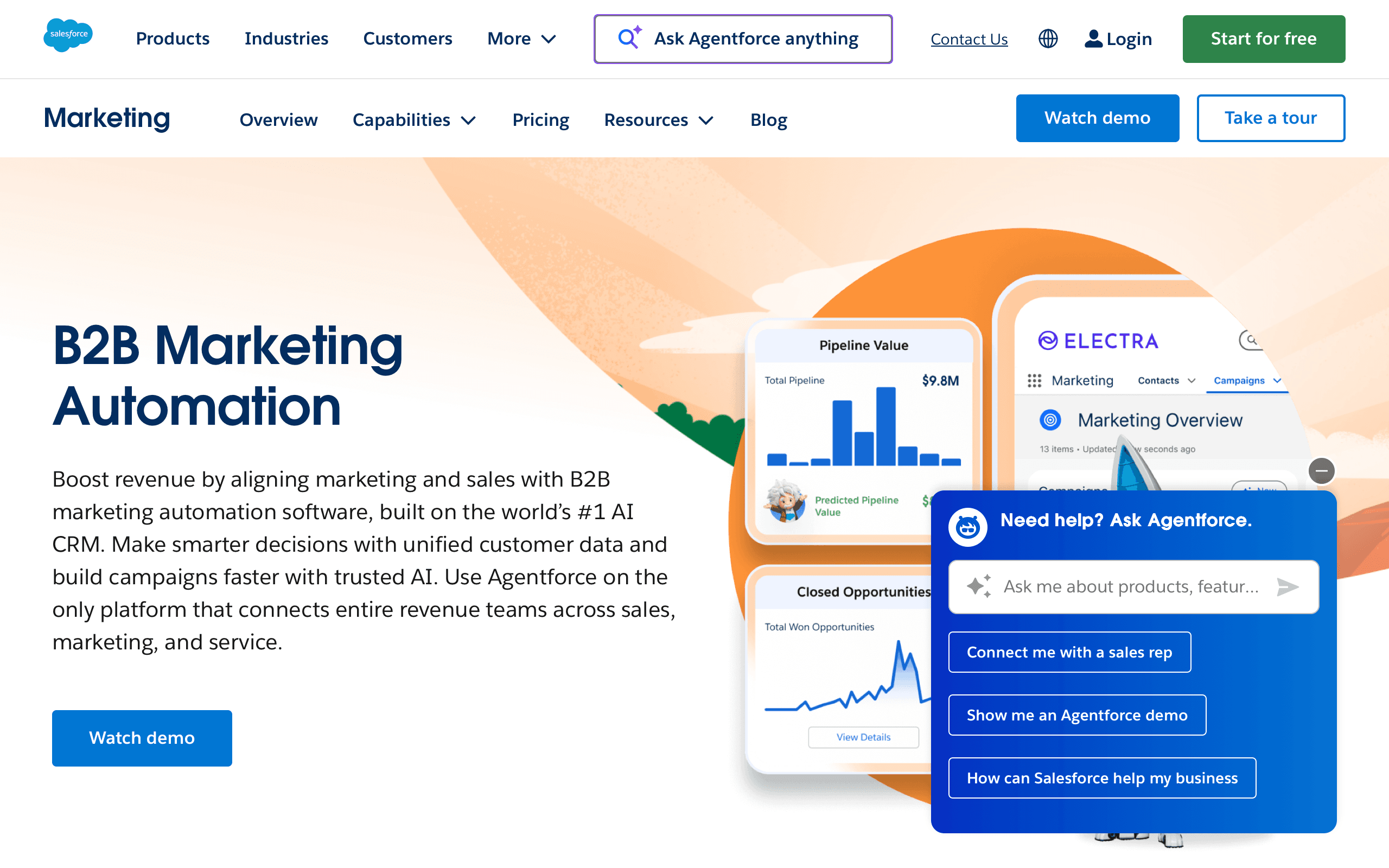
Pardot lives inside Salesforce. Shared contacts, native Einstein AI, Salesforce reports and dashboards, one admin console. There's no sync to manage, no data conflicts to resolve, no third-party connector to maintain. For Salesforce-centric organizations, this simplicity has real value.
The Sequenzy Alternative
For SaaS founders who don't need enterprise CRM integration, Sequenzy offers transactional email and marketing campaigns with native Stripe integration at $49/month - a fraction of either enterprise platform.
Enterprise Requirements vs Practical Needs
Marketo's enterprise pricing starts at $895 a month, which is actually less than Pardot's $1,250 Growth plan for the same 10,000 contacts, though both require annual contracts and dedicated admin support to implement well. Marketo's payoff comes from deeper automation branching and multi-CRM flexibility; Pardot's payoff comes from living inside Salesforce with Einstein AI built in. Before signing either contract, weigh whether your team needs Marketo's broader automation depth or Pardot's native Salesforce fit outweighs the higher price.
Deliverability and Sender Reputation
Marketo and Pardot deliver comparable results once authentication is configured correctly, since both route mail through established enterprise infrastructure. The bigger practical difference is workflow: Pardot's Engagement Studio ties sending closely to Salesforce data, while Marketo's program builder gives you more branching options independent of any single CRM. Whichever you pick, clean lists and proper SPF, DKIM, and DMARC records still matter more than the platform's automation sophistication for actually landing in the inbox.
Migration Path and Switching Costs
Moving between Marketo and Pardot means more than a contact export. Pardot's scoring and grading models are built around native Salesforce data, so shifting to Marketo means rebuilding those models for its predictive and behavioral scoring instead. Going the other direction ties your setup permanently to Salesforce, since Pardot has no support for other CRMs. Both are annual-contract enterprise platforms, so plan the switch around contract renewal and expect a temporary dip in reporting continuity.
Use-case matchups
| Situation | Best first look | Why |
|---|---|---|
| Adobe-aligned or standalone enterprise B2B marketing operations | Marketo | Marketo is strong for advanced nurture, lead scoring, ABM, and attribution beyond a single CRM decision. |
| Salesforce-first B2B team that wants native CRM alignment | Pardot | Pardot is the better first look when Salesforce is the operating center and native CRM alignment matters most. |
| Team that needs email automation and transactional/Stripe messages without enterprise B2B suites | Sequenzy | Sequenzy is simpler when lead grading, ABM, and Salesforce-native marketing automation are not required. |
Best Fit by CRM Alignment
Best marketing automation platform for Adobe-aligned B2B operations
Marketo fits teams that want advanced nurture, lead scoring, ABM, attribution, and enterprise B2B automation beyond a single CRM decision.
Best Salesforce-native marketing automation tool for B2B teams
Pardot is the better fit when Salesforce is the operating center and native CRM alignment matters more than Adobe ecosystem flexibility.
Best email platform without enterprise B2B suite overhead
Sequenzy fits when email automation, transactional email, and Stripe messages matter without lead grading, ABM, or Salesforce-native marketing automation.
Pricing reality
This page lists Marketo at $895/month and Pardot at $1,250/month at 10,000 contacts, with Sequenzy at $49/month. Both Marketo and Pardot should be treated as enterprise B2B purchases with annual-contract and implementation implications. Pardot's higher cited starting point can make sense only if Salesforce-native alignment is central.
Review signals
The review snippets include Marketo feedback from G2 and Trustpilot, and Pardot feedback from Capterra and G2. Marketo's signal points to value after setup. Pardot's signal should be validated against Salesforce expertise, reporting expectations, and the team's tolerance for enterprise complexity.
Migration checklist
| Workstream | Moving toward Marketo | Moving toward Pardot | Simplifying to Sequenzy |
|---|---|---|---|
| Data model | Map leads, accounts, scores, CRM fields, and attribution. | Map Salesforce leads, contacts, campaigns, grades, scores, and CRM fields. | Map subscribers, tags, Stripe events, and transactional triggers. |
| Automation rebuild | Rebuild nurture, scoring, ABM, and attribution programs. | Rebuild Engagement Studio programs, Salesforce campaign alignment, scoring, grading, and reporting. | Rebuild lifecycle email and transactional messages. |
| Buying validation | Confirm Adobe/Salesforce integration needs, admin ownership, and contract terms. | Confirm Salesforce admin ownership, CRM data hygiene, and reporting requirements. | Confirm email-only scope and integration coverage. |
Decision checklist
- Is Salesforce-native alignment more important than broader enterprise marketing automation?
- Do you have the Salesforce admin and marketing-ops capacity to maintain Pardot?
- Does Marketo provide meaningful ABM or attribution advantages for your process?
- Would email plus transactional lifecycle automation solve the current job at lower complexity?