
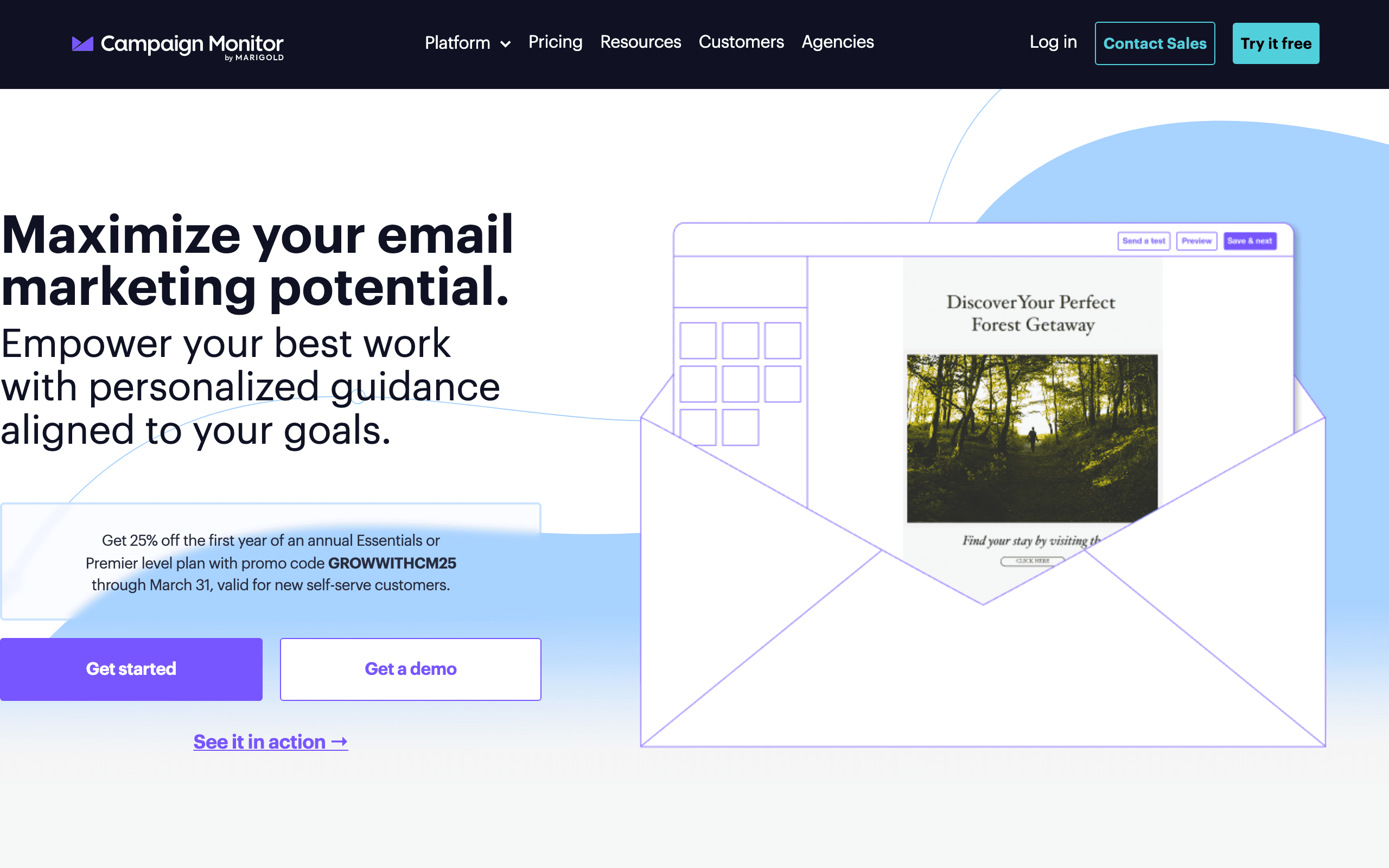
Premium Pricing for Different Reasons
Both Campaigner and Campaign Monitor sit at the premium end of email marketing pricing, but they justify their costs in different ways. Campaigner charges $179/month for 10,000 subscribers and gives you advanced automation, multivariate testing, and 900+ templates across every industry imaginable. You're paying for marketing sophistication and feature depth.
Campaign Monitor costs $111/month (pricing varies by send frequency) and focuses on design quality and agency features. You're paying for beautiful templates, a polished user interface, client management tools, and white-labeling options. The template library is smaller (100+ versus 900+), but the design standards are noticeably higher - emails look like they were crafted by professional designers.
For SaaS companies, the question is whether you need either of these premium features. If you're running a subscription business, you don't need 900 templates for different industries or client management for agencies. You need Stripe integration, trial conversion sequences, and subscription lifecycle automations - features neither platform offers. That's why Sequenzy's pricing at $49/month makes more sense for software companies.
Automation: Complexity vs. Simplicity
Campaigner wins on automation sophistication. The workflow builder supports complex, multi-branch customer journeys with triggers based on engagement, demographics, custom fields, and behavior. The multivariate testing (testing multiple variables simultaneously, not just A/B) is valuable for marketing teams running extensive optimization programs. If you have a dedicated marketing team trying to squeeze out incremental conversion improvements, Campaigner's tools support that level of rigor.
Campaign Monitor's automation is more straightforward - you can build welcome series, re-engagement campaigns, and triggered messages, but the workflow logic is simpler. For most businesses, this is actually fine. The additional complexity that Campaigner offers matters more to sophisticated marketing organizations than to small teams just trying to stay in touch with customers. Campaign Monitor's automation covers 90% of common use cases with less cognitive overhead.
Neither platform offers what SaaS companies actually need: automations that trigger based on subscription events. You can't natively build a "send this email when trial is about to expire" workflow or "trigger this sequence when payment fails" automation without custom API integrations. Sequenzy's automation features are designed specifically for subscription lifecycle management, with triggers based on Stripe events like trial started, payment failed, subscription cancelled, and customer upgraded. Learn more about SaaS email automation strategies.
Design Quality and User Experience
Campaign Monitor's reputation for beautiful email design is well-deserved. The templates look modern and professionally crafted, the interface is clean and intuitive, and the overall user experience feels polished. If you're a brand where visual quality is a competitive advantage - luxury goods, creative agencies, design studios - Campaign Monitor helps you maintain that standard in email.
Campaigner has more templates, but they vary in quality and style. Some look dated, while others are more modern. The sheer quantity (900+) means you'll find something that works, but you'll spend more time sorting through options. The interface is functional but less elegant than Campaign Monitor's. This matters more for non-technical users who value a clean, intuitive experience over feature density.
Sequenzy takes a different approach with AI email generation. Instead of browsing template libraries, you describe what you want to accomplish (like "convert trial users to paid subscribers") and AI generates the entire sequence with appropriate messaging, tone, and structure. For SaaS founders who aren't professional copywriters, this eliminates the blank page problem while still producing personalized, on-brand emails.
Agency Features: A Clear Winner
If you're an agency managing email marketing for multiple clients, Campaign Monitor is the obvious choice. The platform was designed with agencies in mind, offering client management tools, white-labeling options, and advanced team permissions that let you manage multiple client accounts from one dashboard. You can present email marketing as a seamless part of your service offering rather than an obviously branded third-party tool.
Campaigner doesn't focus on agency use cases - it's built for brands managing their own email marketing. There's no client management system, no white-labeling, and team features are basic. If you're an agency, Campaigner will force you to work around its limitations with separate accounts for each client, which becomes administratively messy as your client list grows.
For SaaS companies building software products, agency features don't matter. You need features designed for subscription businesses, not tools for managing client accounts. Sequenzy focuses exclusively on SaaS use cases with features like automatic customer tagging based on subscription status and native Stripe integration rather than trying to serve every possible email marketing need.
Use-case matchups
| Use case | Better fit | What to verify |
|---|---|---|
| Agency-managed client email | Campaign Monitor | Confirm client accounts, white labeling, permissions, brand controls, approval workflow, and pricing by send volume. |
| Advanced campaign testing | Campaigner | Verify multivariate testing, workflow branching, dynamic content, reports, and whether the team will use them. |
| Premium design-sensitive brands | Campaign Monitor | Campaign Monitor is stronger when polished templates and brand consistency matter most. |
| Sophisticated in-house marketing | Campaigner | Campaigner fits teams optimizing campaigns with complex segments and tests rather than agency workflows. |
| SaaS subscription lifecycle email | Sequenzy | Compare if Stripe events, transactional email, and AI-generated sequences matter more than agency/design features. |
Best Fit by Production Workflow
Best email marketing tool for in-house campaign experimentation
Campaigner fits teams that own complex segments, multivariate tests, dynamic content, and recurring optimization inside the marketing team.
Best email platform for agencies and premium design workflows
Campaign Monitor is the better fit when client accounts, white labeling, approval flows, brand controls, and polished templates matter most.
Best email platform for SaaS lifecycle and transactional email
Sequenzy fits when Stripe events, billing-aware sequences, and transactional messages matter more than agency workflow or brand-design tools.
Integration Ecosystems
Campaigner offers 800+ integrations with third-party apps, covering CRMs, e-commerce platforms, webinar tools, social media, and more. Campaign Monitor has 250+ integrations - fewer options but still covering the most common business tools. For most companies, 250 integrations is plenty, and both platforms offer full REST APIs for custom integrations if needed.
However, neither platform offers native Stripe integration - you'll need to use Zapier or hire a developer to build custom API workflows. This means manually setting up triggers for subscription events like trial started, payment failed, and subscription cancelled. Every automation you want to run based on Stripe data requires custom integration work, which adds development time and ongoing maintenance burden.
Sequenzy provides native Stripe integration that automatically tags customers based on subscription status and triggers automations based on Stripe events. No Zapier required, no custom development needed. For SaaS companies, this single integration eliminates hours of setup time and ongoing maintenance work. Check out our integration guide for details on how Stripe events map to email automations.
The Honest Assessment
Campaigner is expensive for what it offers. At $179/month, you're paying a premium for features like multivariate testing and 900+ templates that most small businesses won't fully utilize. The advanced automation is valuable for sophisticated marketing teams, but if you're a small company just trying to stay in touch with customers, simpler tools deliver 90% of the value at lower cost.
Campaign Monitor justifies its $111/month pricing better, especially if you're an agency or a brand where design quality matters. The beautiful templates, polished interface, and agency features (client management, white-labeling) provide clear value for their target market. However, the variable pricing based on send frequency can make budgeting unpredictable - you might pay significantly more during high-volume months.
For SaaS companies, both platforms force you to work around their limitations. You'll spend time and money on Zapier integrations or custom development to connect Stripe, build subscription-specific workflows, and manage transactional emails separately from marketing campaigns. Sequenzy eliminates this friction by treating subscription lifecycle management as the core use case rather than an afterthought. At $49/month with all features included, it's also significantly more affordable than either premium platform.
Two Premium Platforms, Zero SaaS Features
Both Campaigner and Campaign Monitor sit at the expensive end of email marketing, yet neither addresses the needs of SaaS subscription businesses. Campaigner's automation sophistication is designed for e-commerce purchase flows and B2B nurture sequences. Campaign Monitor's design excellence serves agencies and brand-conscious companies. Neither platform understands subscription lifecycle events.
A SaaS company paying $111-179/month for either platform still needs to build custom Zapier integrations to trigger emails when a trial ends, a payment fails, or a customer upgrades. The additional Zapier cost, development time, and maintenance overhead make the total cost of ownership significantly higher than the sticker price.
Sequenzy at $49/month addresses this gap directly with native Stripe integration that automatically triggers email sequences based on subscription events. For SaaS companies comparing premium email platforms, the relevant question is not whether Campaigner's automation or Campaign Monitor's design is better - it is whether either general-purpose tool is the right category for a subscription business.
Template Quantity vs Template Quality
Campaigner offers 900+ templates. Campaign Monitor offers 100+. The numbers suggest Campaigner wins decisively, but the comparison is more nuanced than quantity implies. Campaign Monitor's 100 templates are curated for design quality - each one looks like it was crafted by a professional designer with careful attention to typography, spacing, and color theory. Campaigner's 900 templates vary dramatically in quality - some are excellent, many are mediocre, and some look dated.
The practical difference depends on how you use templates. If you need templates for diverse industries and use cases - real estate, healthcare, education, hospitality, retail - Campaigner's variety saves time. If you need consistently polished templates that maintain brand standards, Campaign Monitor's curated library produces better results.
For email campaigns where design quality directly impacts brand perception - luxury goods, creative services, fashion - Campaign Monitor's fewer but better templates produce visibly superior emails. For functional marketing communications where content matters more than aesthetics - B2B lead nurture, e-commerce promotions, event announcements - Campaigner's variety provides more relevant starting points.
The Variable Pricing Trap
Campaign Monitor's pricing deserves specific attention because it varies based on send frequency, which creates budgeting unpredictability. The base price of $111/month at 10,000 subscribers assumes a specific send volume. Exceeding that volume increases the cost, sometimes significantly. A high-volume month - like a product launch with daily sends - can spike the bill unexpectedly.
Campaigner's pricing is simpler: $179/month for up to 25,000 contacts with unlimited sends. You know exactly what you will pay regardless of how many emails you send. For businesses with variable send patterns, this predictability has value despite the higher base price.
The variable pricing trap catches businesses that evaluate Campaign Monitor at the base rate without modeling their actual usage. A marketing team that sends 15 campaigns per month might find Campaign Monitor's actual cost approaching or exceeding Campaigner's $179. Before choosing Campaign Monitor for its lower sticker price, calculate the real cost based on your projected send volume across both high and low months.
Pricing reality
Campaigner and Campaign Monitor are both premium-priced relative to simpler email tools. Campaigner is easier to model when contact limits and unlimited sends are the important variables. Campaign Monitor can look cheaper at the same list size, but send-frequency pricing and agency features need to be modeled against real usage.
The useful pricing question is not which monthly number is lower. It is whether Campaigner's automation/testing depth or Campaign Monitor's design/agency workflow will be used enough to justify the premium.
Review signals
| Platform | Review signal used here | What it suggests | What to validate |
|---|---|---|---|
| Campaigner | G2 and Capterra reviews in this comparison | Teams value Campaigner for automation depth and multivariate testing, but call out interface complexity and premium pricing. | Validate whether complex branching, testing, and dynamic content will be used every week. |
| Campaign Monitor | G2 and Capterra reviews in this comparison | Teams value Campaign Monitor for design quality, client management, and white labeling. | Validate agency features, brand controls, send-volume pricing, and whether simpler automation is enough. |
Decision checklist
- Is the buyer optimizing sophisticated in-house campaigns or managing client/agency email?
- Does multivariate testing matter more than white labeling and client management?
- Will Campaign Monitor's send-frequency pricing stay predictable at peak campaign volume?
- Are template quantity or template quality more important for the team's actual work?
- If this is for SaaS, should Stripe-triggered lifecycle email replace both premium general-purpose tools?
Migration checklist
| Step | What to confirm |
|---|---|
| Audience export | Export subscribers, lists, segments, custom fields, unsubscribes, bounces, suppression lists, and consent records. |
| Agency/client setup | If leaving Campaign Monitor, map client accounts, brands, permissions, approvals, white-label settings, and reseller workflows. |
| Advanced campaign logic | If leaving Campaigner, preserve multivariate tests, dynamic content rules, workflows, templates, and performance reports. |
| Templates and brand assets | Rebuild email templates, saved sections, brand styles, preference pages, and test sends across mobile clients. |
| Integrations | Reconnect CRM, ecommerce, forms, webinar, analytics, payment, ads, and support tools. |
| Reporting | Export campaign, send-volume, test, client, deliverability, and subscriber-growth reports before closing old assets. |









