Overview
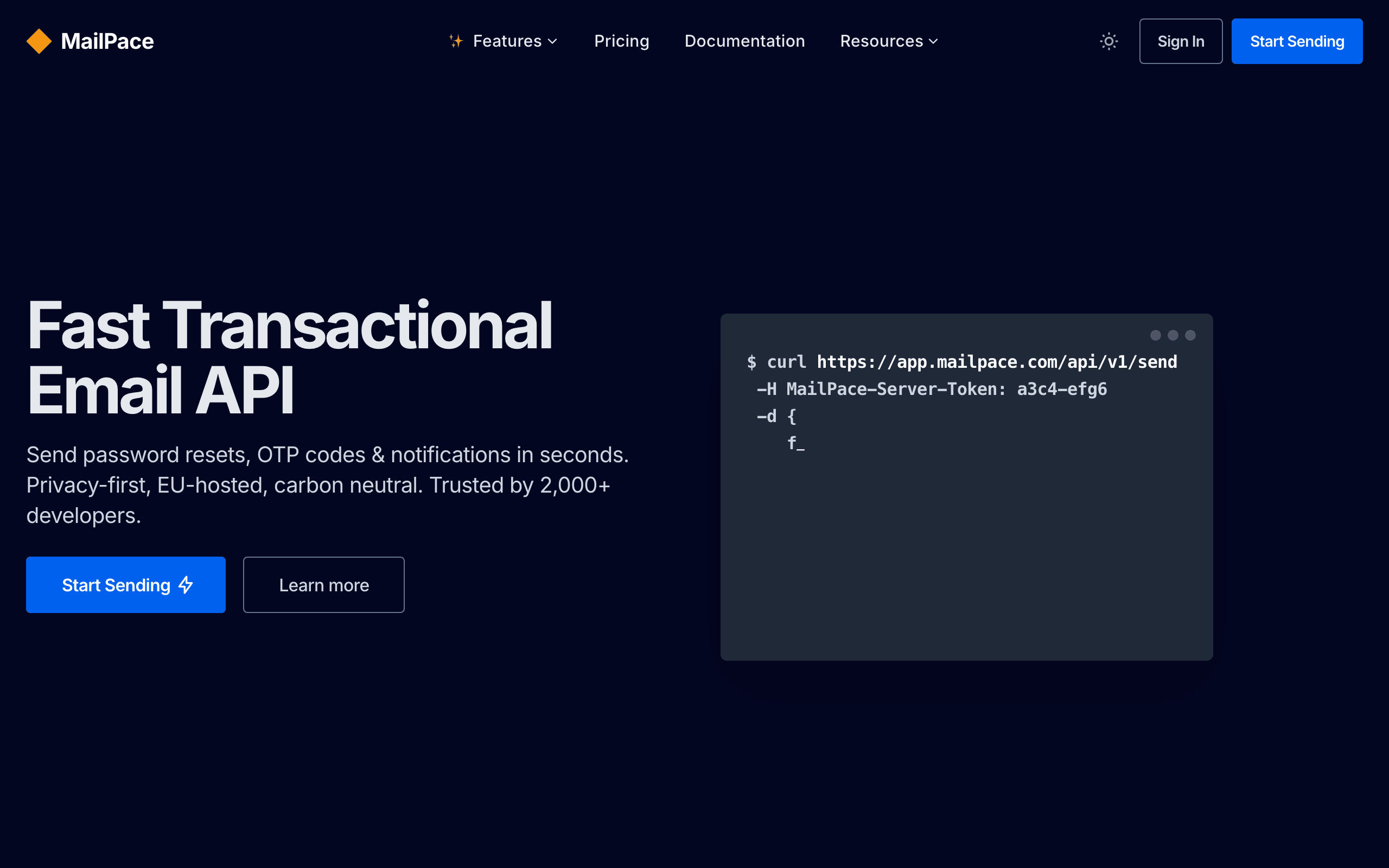
MailPace and Amazon SES serve different needs in the email space. MailPace is a privacy-first EU-hosted transactional email API. Amazon SES is a cheapest email sending via AWS.
The choice depends on what you need: eu-only hosting (MailPace) or cheapest per-email (Amazon SES). For SaaS businesses specifically, Sequenzy offers purpose-built features that neither tool provides.
Pricing Comparison
- MailPace: $10/month for transactional sending only, hosted in the EU with a privacy-first design.
- Amazon SES: $1 - $0.10 per 1,000 emails. AWS required.
- Sequenzy: $99/month for 120,000 emails, with a free plan covering 2,500 emails so you can test it first. See pricing.
Where MailPace Wins
EU-only hosting
MailPace keeps all hosting in the EU, which suits teams whose data must stay in Europe.
Privacy-first design
Tracking is off by default with MailPace, and it profiles recipients only as far as delivery requires.
Idempotent sending
Idempotent sending lets MailPace's API handle retries safely, so a repeated request does not send the same email twice.
Inbound email
MailPace also handles inbound email, so teams that need to receive replies can use the same provider for sending.
Where Amazon SES Wins
Cheapest per-email
Amazon SES offers cheapest per-email, which matters for teams that prioritize this.
Massive scale
Amazon SES offers massive scale, which matters for teams that prioritize this.
AWS integration
Amazon SES offers aws integration, which matters for teams that prioritize this.
EU region
Amazon SES offers eu region, which matters for teams that prioritize this.
Why Sequenzy for SaaS
If you are building a SaaS product, Sequenzy offers what neither MailPace nor Amazon SES provides: native Stripe integration for billing-based automation, AI sequences that generate onboarding and retention emails, and unified transactional + marketing email in one platform. Check our pricing page for details.
EU Data Sovereignty
MailPace's EU-only hosting is not just a feature but a compliance requirement for many European businesses. Customer email data stays within EU borders, simplifying GDPR documentation and satisfying data residency regulations. Amazon SES processes data across AWS regions, which may include US-based infrastructure.
For companies in regulated industries or those with European customers who require data processing guarantees, MailPace's approach eliminates compliance uncertainty that comes with global cloud providers.
Infrastructure Complexity Trade-off
Amazon SES provides raw email infrastructure at rock-bottom prices, but the total cost includes engineering time to build analytics, manage bounce handling, implement webhooks via Lambda, and maintain deliverability. MailPace handles these concerns as a managed service.
The right choice depends on team capacity. Organizations with dedicated infrastructure engineers and significant email volume can justify SES's engineering investment. Smaller teams benefit from MailPace's managed approach even at a slightly higher per-email cost.
When Volume Matters
At high volumes exceeding one million emails monthly, Amazon SES's cost advantage becomes substantial. The $0.10 per 1,000 emails pricing creates meaningful savings at scale. MailPace's flat pricing is simpler but less competitive for very high volume senders.
For moderate transactional email volumes typical of most SaaS applications, the price difference is modest. The decision should weigh compliance requirements, engineering resources, and operational simplicity rather than focusing solely on per-email cost.
Delivery Speed and Reliability
MailPace and Amazon SES both send transactional email fast, but they differ sharply in what surrounds that delivery. MailPace runs a flat $10-a-month plan with EU-only hosting and no tracking by default, aimed at privacy-conscious senders. Amazon SES charges about $0.10 per 1,000 emails with no subscription, the cheapest raw sending cost of the two, but leaves privacy defaults, dashboards, and setup entirely up to you.
API Design and Developer Experience
MailPace's documentation is clean and its API is simple, reflecting a small team that has kept the product deliberately narrow. Amazon SES gives you every AWS SDK language but expects AWS familiarity, since notifications and bounce handling route through SNS rather than a dedicated email dashboard. Developers already comfortable in AWS will find SES quick to wire up; anyone else may find MailPace's smaller surface easier to start with.
Scaling and Cost at Volume
Amazon SES's roughly $0.10 per 1,000 emails is difficult to beat on pure sending cost, especially at higher volumes. MailPace's flat $10 a month is simple to budget for lower-volume transactional sending but does not scale down in price the way SES's per-email model does. If your volume is unpredictable or growing fast, SES's usage-based pricing avoids paying for headroom you are not using.
The Privacy and Data Sovereignty Question
MailPace's EU-only hosting is not just a feature -- it is a fundamental design decision that matters for GDPR compliance. All email data stays within EU data centers, and MailPace does not track or profile recipients beyond what is necessary for delivery. Amazon SES processes email through AWS infrastructure that may span multiple regions, and Amazon's data processing terms are significantly more complex.
For businesses subject to strict European data protection regulations, MailPace provides a straightforward compliance story. Your data stays in the EU, processed by an EU company, with minimal data collection. Amazon SES can be configured for EU-region processing, but the AWS shared responsibility model and complex DPA create more compliance overhead.
The privacy trade-off is clear: SES is cheaper and more scalable, but MailPace offers simpler regulatory compliance for privacy-conscious organizations. Companies handling sensitive data -- healthcare, legal, financial services -- often find MailPace's approach reduces the compliance burden enough to justify the higher per-email cost.
The Infrastructure Complexity Gap
Amazon SES requires an AWS account, IAM configuration, sending quota management, bounce handling setup, and manual IP warming. The operational overhead before sending a single production email can take days for teams unfamiliar with AWS. MailPace requires domain verification and an API key -- setup takes minutes.
SES rewards infrastructure investment with unmatched cost at scale. But for startups and small teams that need to send transactional emails without becoming AWS specialists, MailPace eliminates infrastructure management entirely. The $10/month covers not just sending but managed deliverability, bounce processing, and reputation monitoring.
For SaaS companies that already use AWS extensively, SES fits naturally into the existing stack. But even AWS-native teams sometimes prefer a dedicated email service for critical communications, using SES for bulk operations and a specialized provider for deliverability-sensitive messages.
When Neither Fits SaaS Needs
Both MailPace and Amazon SES are pure sending infrastructure. Neither understands subscription businesses, product usage patterns, or billing lifecycle events. They deliver emails reliably but have no concept of trial users, churned customers, or expansion revenue.
SaaS companies need email that responds to business events -- a user hits a usage limit, a payment fails, a trial is about to expire. Building this logic on top of raw sending infrastructure requires custom code for every trigger, every segment, and every automated sequence.
Sequenzy provides this business logic layer with native Stripe integration that triggers emails based on subscription events. At $49/month, it costs more than either MailPace or SES but eliminates the custom development required to make either platform SaaS-aware.
Use-case matchups
| Situation | Better fit | Why |
|---|---|---|
| You need privacy-first EU-hosted transactional email | MailPace | MailPace's specific value is EU hosting, minimal tracking, and managed transactional delivery. |
| You need the cheapest possible raw email sending | Amazon SES | SES is far cheaper per email if your team can manage AWS complexity. |
| You have strict GDPR/data-residency requirements | MailPace | MailPace offers the simpler EU-only compliance story in this comparison. |
| You already operate heavily on AWS and send high volume | Amazon SES | SES fits AWS-native infrastructure and scales cheaply. |
| You need SaaS lifecycle automation, not just delivery | Sequenzy | Sequenzy adds Stripe-aware campaigns and transactional workflows. |
Pricing reality
Amazon SES wins raw per-email pricing. The listed $0.10 per 1,000 emails can be unbeatable at scale. But SES excludes engineering setup, bounce/complaint processing, monitoring, campaign logic, unsubscribe handling, and analytics.
MailPace costs more per unit but buys managed simplicity and a clearer privacy posture. The practical comparison is AWS engineering overhead versus a focused managed transactional provider.
Review signals
MailPace reviews emphasize privacy-first delivery, transparent pricing, no tracking by default, and a small-team/limited-feature trade-off.
Amazon SES reviews emphasize low cost, AWS integration, and high-scale deliverability. The recurring caution is technical setup and lack of marketing features.
Best Fit by Privacy Posture and Infrastructure Control
Best transactional email service for EU-first privacy requirements
MailPace is the better fit when the team wants managed transactional delivery with EU hosting, minimal tracking, and a simpler privacy story. It suits organizations where compliance posture and low operational burden matter more than the absolute lowest per-email cost.
Best raw email infrastructure for AWS scale and cost control
Amazon SES is the better fit when high-volume sending, AWS integration, and infrastructure control matter most. It is strongest for teams ready to manage sandbox removal, IAM, DKIM, MAIL FROM, SNS/Lambda events, suppression handling, and monitoring themselves.
Best SaaS email platform for business-event messaging
Sequenzy fits SaaS teams that need email triggered by subscription and product events rather than only a privacy-first or AWS sending pipe. It is relevant when trial, churn, payment, onboarding, and campaign workflows should be managed without custom lifecycle code.
Migration checklist
- Inventory templates, API calls, SMTP credentials, webhooks, bounces, complaints, suppressions, and tracking requirements.
- If moving to SES, configure IAM, verified identities, DKIM, MAIL FROM, SNS/Lambda event handling, and sandbox removal.
- If moving to MailPace, confirm EU data requirements, API behavior, idempotency, and inbound handling.
- Recreate SPF, DKIM, DMARC, return-path, tracking domains, and sender identities.
- Warm up sending gradually, especially when changing IPs, regions, or volume patterns.
- Monitor delivery latency, bounce rate, complaint rate, suppression behavior, and inbox placement before disabling the old provider.
Decision checklist
- Choose MailPace if privacy, EU data residency, and managed simplicity outweigh lowest cost.
- Choose Amazon SES if raw scale and low per-email pricing matter more than operational simplicity.
- Choose Sequenzy if subscription-aware SaaS email should already include marketing, transactional, analytics, and Stripe events.