

Overview
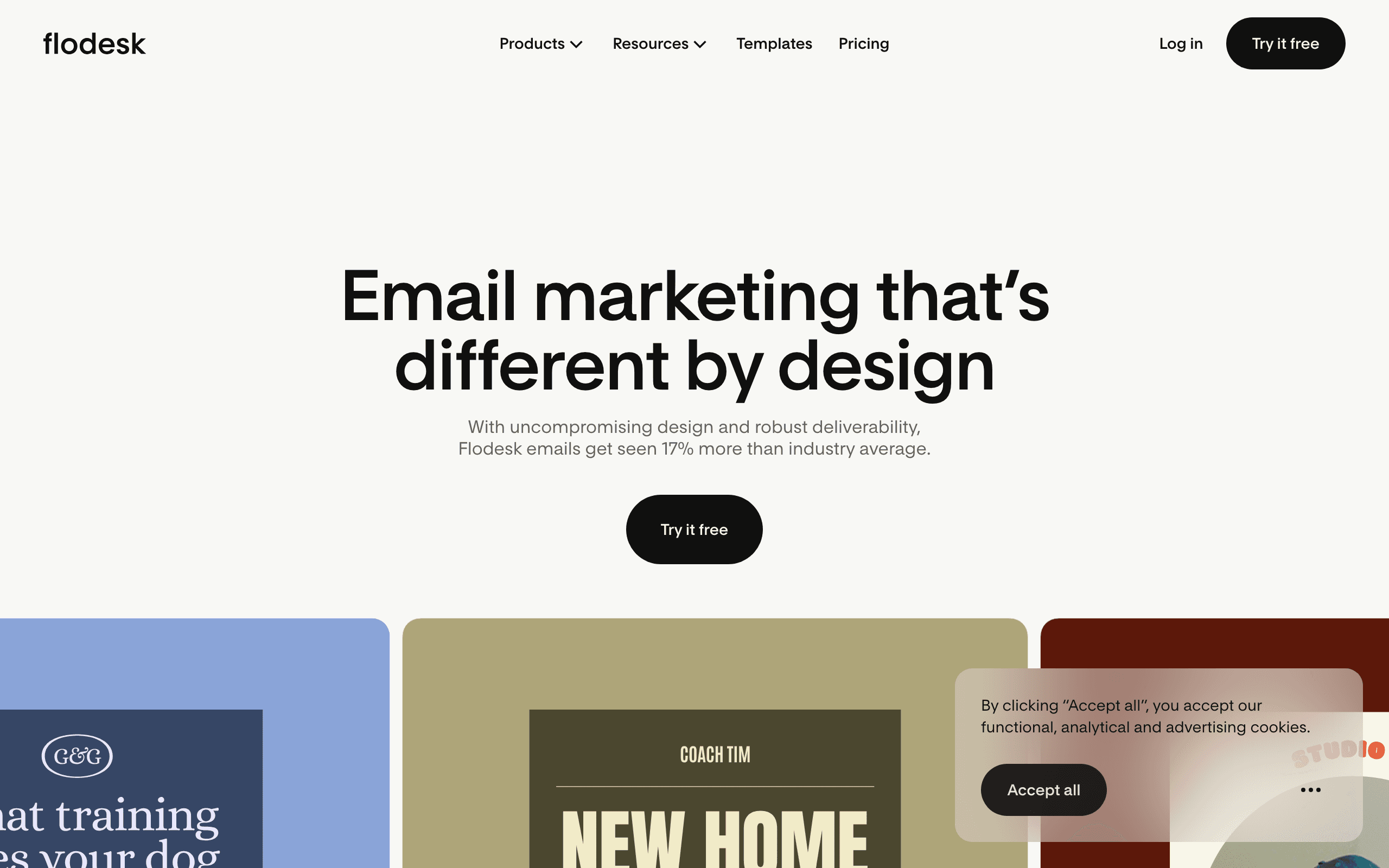
Flodesk and ActiveCampaign represent opposite ends of the email marketing spectrum. Flodesk is a design-focused platform for beautiful emails with flat pricing. ActiveCampaign is an automation powerhouse with CRM and sophisticated workflows.
Price vs Power
Flodesk is 52% cheaper at $38/month vs ActiveCampaign's $79/month for 10k subscribers. But the value proposition is completely different - you're comparing design simplicity against marketing automation power.
Design Quality
Flodesk has stunning, modern templates that make emails look professionally designed. ActiveCampaign templates are functional but not at Flodesk's aesthetic level. For visual brands, Flodesk is the clear winner.
Automation Comparison
ActiveCampaign is in a completely different league for automation. 850+ pre-built recipes, advanced conditional logic, site tracking, and predictive sending. Flodesk automation is basic - simple sequences that can't approach this sophistication.
CRM and Sales
ActiveCampaign includes CRM on Plus plan with lead scoring, sales automation, and pipeline management. Flodesk is purely for sending beautiful emails. For sales-marketing alignment, ActiveCampaign delivers.
Learning Curve
Flodesk is intentionally simple - focused on beautiful design without complexity. ActiveCampaign's power comes with a significant learning curve. For ease of use, Flodesk wins.
For SaaS Companies
Neither offers native Stripe integration. ActiveCampaign has better automation but isn't SaaS-focused. For SaaS companies, consider Sequenzy which offers purpose-built SaaS automation at a middle price point.
Making the Choice
Choose Flodesk for beautiful designs and simplicity. Choose ActiveCampaign for sophisticated automation and CRM. For SaaS, consider Sequenzy.
The Complexity Trade-off
ActiveCampaign's power comes with genuine complexity. Setting up advanced automations, configuring CRM pipelines, and mastering conditional logic takes weeks of learning. Flodesk can be mastered in an afternoon. For solo entrepreneurs and small teams without a dedicated marketing person, ActiveCampaign's capabilities often go unused - you pay for features you never learn to leverage. Flodesk's simplicity means you actually use everything you pay for.
The question to ask yourself is whether your business genuinely needs sophisticated automation. If your email strategy is "send beautiful newsletters and welcome sequences," Flodesk handles that perfectly at half the cost. If your strategy involves lead scoring, behavioral triggers, multi-channel campaigns, and CRM integration, ActiveCampaign is worth the investment and learning curve.
Flat Pricing Economics at Scale
Flodesk's flat $38/month becomes increasingly valuable as your list grows. At 50,000 subscribers, you are still paying $38/month while ActiveCampaign would charge $229/month or more. That is $2,292/year in savings. At 100,000 subscribers, the gap widens further. For creators and businesses with large, engaged audiences, Flodesk's pricing model is genuinely revolutionary - it removes the financial anxiety of list growth entirely.
However, this pricing model only matters if Flodesk's features are sufficient for your needs. Saving money on a tool that cannot execute your marketing strategy is not actually saving money. If you need ActiveCampaign's automation to convert leads effectively, the higher cost pays for itself through better conversion rates.
When Neither Is the Right Choice
Both Flodesk and ActiveCampaign are designed for general marketing use cases. SaaS companies with subscription-based business models need features that neither platform provides natively - Stripe billing integration, subscription lifecycle triggers, and payment-based segmentation. If your email strategy revolves around trial conversions, upgrade nudges, and churn prevention tied to billing events, neither platform is purpose-built for you.
Review signals
The Flodesk reviews on this page support the design-and-flat-pricing story: one user values polished emails and predictable cost, while another hit limits around click and purchase-based workflows.
The ActiveCampaign reviews support the automation-power story: users praise sophisticated workflows, CRM integration, and saved time after setup, but they also warn about the learning curve. That makes the choice a design simplicity versus automation maturity decision.
Use-case matchups
| Use case | Better fit | Why |
|---|---|---|
| Design-first newsletters and forms | Flodesk | It is built around polished templates, visual simplicity, and flat pricing. |
| Advanced automation and CRM | ActiveCampaign | Workflows, CRM, lead scoring, site tracking, and sales automation are the main strengths. |
| Large creator list with simple emails | Flodesk | Flat pricing can be compelling if automation needs stay simple. |
| Multi-step lifecycle or sales nurture | ActiveCampaign | Conditional logic and automation recipes handle deeper customer journeys. |
| SaaS billing and transactional email | Sequenzy | Product and Stripe events are a different requirement from design-first or CRM marketing. |
Best Fit by Workflow Depth
Best email marketing tool for design-first creators
Flodesk is the better fit when the main job is sending polished newsletters, forms, and brand-led campaigns without building a complex marketing operations system. It works best for creators, coaches, photographers, and boutique brands where visual presentation is the differentiator.
Best email marketing tool for CRM automation
ActiveCampaign is the better fit when the team needs sales pipelines, lead scoring, site tracking, branching automations, and multi-step nurture. It is stronger when customer journeys need rules, conditions, and CRM context rather than just beautiful sends.
Best email marketing tool for SaaS billing lifecycle email
Sequenzy is the better fit when messages need to react to product usage, transactional events, and Stripe billing state. Trial conversion, payment recovery, upgrades, and churn prevention are not design-first newsletter or CRM-marketing problems.
Pricing reality
Flodesk's flat price is attractive only if its feature set is enough. It becomes a strong value for large lists with simple campaigns, but it becomes expensive in a different way if missing automation forces manual work or another tool.
ActiveCampaign costs more as the list grows, and CRM features may require a higher plan. Its value depends on whether automation and sales follow-up improve conversion enough to justify the extra cost and setup time.
Migration checklist
| Workstream | What to check |
|---|---|
| Contacts and consent | Export subscribers, tags, segments, unsubscribes, bounces, custom fields, and consent status. |
| Design assets | Rebuild templates, brand styles, forms, landing pages, and image libraries in the destination tool. |
| Automations | Recreate welcome, lead nurture, click-based, purchase-based, and re-engagement flows manually. |
| CRM data | If leaving ActiveCampaign, preserve deals, pipelines, owners, lead scores, tasks, and sales notes. |
| Tracking | Reinstall site tracking, form embeds, pixels, and integration scripts where required. |
| Reporting | Export campaign, automation, CRM, and conversion reports before closing the old account. |
| Sender setup | Reverify SPF, DKIM, DMARC, tracking domains, unsubscribe links, and reply-to addresses. |
Decision checklist
- Is visual quality more important than workflow depth?
- Will the team actually build and maintain advanced automations?
- Does the business need CRM, lead scoring, or sales pipelines?
- Does flat pricing matter more than automation capability?
- Are SaaS lifecycle events or transactional messages part of the job?









