
21 Best Email Tools With Stripe Integration for SaaS (2026)

If you run a SaaS business on Stripe, your email tool needs to talk to Stripe. Not through a Zapier hack that breaks when Stripe changes their webhook format. Not through a CSV export you remember to run on Tuesdays. Natively. In real time.
When someone's trial expires, their payment fails, or they upgrade to a higher plan, your email system should know about it instantly and react automatically. That's what Stripe integration actually means in practice.
I've tested every major email platform's Stripe integration. Some are genuinely native. Some are glorified webhook listeners. Some require so much setup that you might as well build it yourself. Here's the honest breakdown of 21 tools, ranked by how well they actually handle subscription data.
Quick Comparison
| Tool | Best For | Starting Price | Free Tier | Integration Depth |
|---|---|---|---|---|
| Sequenzy | Zero-config Stripe automation for SaaS | $19/mo | No | Native OAuth, auto event + tag + attribute sync |
| Customer.io | Flexible event-driven flows | $100/mo | No | Native via Data Pipelines / Segment |
| Userlist | B2B SaaS account-level subscription data | $149/mo | No | Native API, company + user sync |
| Loops | Modern simple email for indie SaaS | $49/mo | Yes (1k contacts) | Native (Stripe app) + webhook events |
| Encharge | Visual flows for non-technical teams | $79/mo | No | Native Stripe trigger source |
| Mailchimp | Basic billing data for existing users | $13/mo | Yes (500 contacts) | Marketplace app, e-commerce focused |
| ActiveCampaign | CRM + email for sales-led SaaS | $29/mo | No | Native Deep Data (higher tiers) |
| Postmark | Transactional from Stripe webhooks | $15/mo | No | Webhook-driven (no automation builder) |
| Resend | Email infra in code | $20/mo | Yes (100/day) | Webhook-driven (DIY automation) |
| Bento | Events + email in one tool | $30/mo | No | Native Stripe integration |
| Vero | Event-based messaging with Stripe | $99/mo | No | Native via webhooks + Segment |
| Ortto | Journey builder with Stripe data | $599/mo | No | Native Stripe data source |
| HubSpot | HubSpot CRM-centered SaaS | $20/mo | Yes | Native HubSpot Payments / Stripe app |
| Klaviyo | Hybrid e-commerce + SaaS | $45/mo | Yes (250 contacts) | Native Stripe integration |
| Drip | E-commerce SaaS hybrids | $39/mo | No | Via Zapier (no native Stripe) |
| Brevo | Budget email + SMS | $9/mo | Yes (300/day) | Via Zapier or webhooks |
| MailerLite | Simple paid newsletters | $10/mo | Yes (1k subs) | Native for paid newsletters only |
| Beehiiv | Newsletter monetization | $39/mo | Yes (2.5k subs) | Native Stripe Connect for paid tiers |
| ConvertKit (Kit) | Creator SaaS with paid products | $29/mo | Yes (10k subs) | Native (Stripe + Commerce) |
| Iterable | Enterprise complex lifecycle | $500+/mo | No | Via webhooks / data warehouse |
| SendGrid | Transactional from Stripe webhooks | $20/mo | Yes (100/day) | Webhook-driven (no automation builder) |
What "Stripe Integration" Actually Means
Before comparing tools, let's clarify what we're looking for. A real Stripe integration should:
- Sync subscription events automatically: New subscriptions, cancellations, upgrades, downgrades, trial starts/ends, and payment failures should flow into your email tool without code.
- Tag or segment subscribers by status: Your email tool should know who's a paying customer, who's on a trial, who's churned, and who has a failed payment. Good subscriber segmentation based on billing data is what separates real Stripe integrations from cosmetic ones.
- Trigger automations based on Stripe events: When a payment fails, a dunning sequence starts. When someone upgrades, the upsell sequence stops. Automatically.
- Sync revenue data: Ideally, your email tool knows each subscriber's MRR, plan name, and billing interval so you can segment by value. This enables revenue attribution back to specific email sequences.
Anything less than this and you're doing manual work that should be automated.
Why This Matters for SaaS
Your Stripe data tells you where every customer is in their lifecycle. Trial, active, past-due, cancelled, churned. Each state demands a different email conversation. Sending an upsell email to someone with a failed payment is tone-deaf. Sending a dunning email to someone who already updated their card is annoying.
When your email tool has real-time Stripe data, your email program becomes lifecycle-aware. That's the difference between generic email blasts and email that actually moves metrics.
Best Stripe Email Tool by Subscription Use Case
Best for failed payment recovery: Sequenzy
Dunning emails need Stripe status, retry timing, and subscriber state in one place. Sequenzy is the strongest fit when you want payment failures to trigger and stop sequences automatically; start with the failed payment recovery guide, then adapt the SaaS dunning templates.
Best for trial conversion tied to billing status: Sequenzy or Customer.io
For early SaaS teams, Sequenzy is faster because Stripe events, trial tags, and email sequences are already connected. Customer.io is better when trial conversion depends on many product events and custom branches; compare both against your workflow in the Customer.io comparison and the trial conversion guide.
Best for B2B account-level subscription data: Userlist
Userlist is strongest when one Stripe customer represents a company with admins, users, and billing contacts. If account-level lifecycle email matters more than low setup effort, read the Userlist comparison before committing.
Best for developer-owned Stripe receipts: Postmark or Resend
If you only need receipts, invoices, and payment confirmation emails from Stripe webhooks, use Postmark for deliverability or Resend for developer experience. For reusable copy, the Stripe email templates and transactional email templates are better starting points than a marketing automation builder.
Best for low-budget SaaS with basic billing email: Loops or Brevo
Loops is cleaner for simple SaaS lifecycle email, while Brevo is cheaper for broad email and SMS. The trade-off is that advanced subscription states often require extra glue code or simpler automations than a Stripe-first lifecycle platform.
The 21 Best Email Tools With Stripe Integration
1. Sequenzy
Best for: SaaS founders who want Stripe automation without code
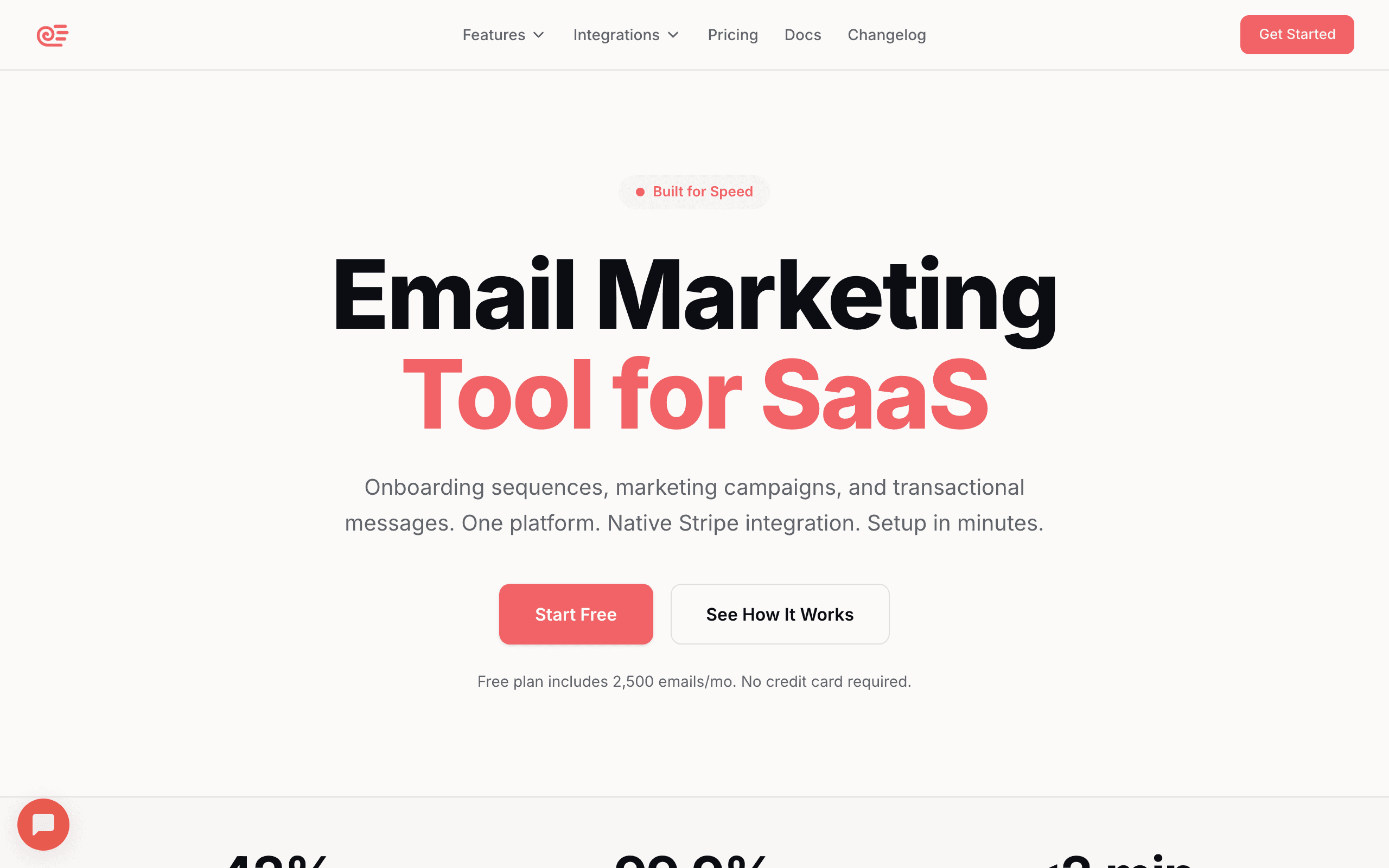
Sequenzy was built specifically for SaaS, and the Stripe integration reflects that. It's a native OAuth connection (Settings > Integrations > Connect Stripe), not a webhook configuration.
Once connected, Sequenzy automatically:
- Creates events for every subscription lifecycle action (purchase, cancellation, payment failure, upgrade, downgrade, trial start/end)
- Applies status tags to subscribers (customer, trial, cancelled, churned, past-due)
- Syncs subscription attributes (MRR, plan name, billing interval)
- Fires automations based on any of these events or tags
The key differentiator is that you don't configure any of this. Connect Stripe and it all works. There's no webhook URL to copy, no event mapping to set up, and no custom fields to configure.
The dunning automation is a good example of how this plays out. When a payment fails in Stripe, Sequenzy receives the event in real time, tags the subscriber as "past-due," and triggers your dunning sequence automatically. If the customer updates their payment method and the charge succeeds, the tag updates and the dunning sequence stops. All without any code or manual intervention.
For teams that also want their Slack channel to know about subscription events, Sequenzy can push notifications for trial expirations, churn events, and payment failures to Slack alongside the email automation.
- Stripe integration: Native OAuth, real-time webhooks managed for you, automatic event + tag + attribute sync
- Pricing: Free up to 2,500 emails/month, paid plans from $19/month
- Pros: Zero-config OAuth setup, automatic event creation and subscriber tagging, built-in dunning, trial conversion, and lifecycle sequences, revenue data syncs to subscriber profiles, both transactional and marketing email in one platform
- Cons: Newer platform (launched 2025), no SMS channel, smaller template library than established competitors
2. Customer.io
Best for: Technical teams wanting flexible event-driven automation
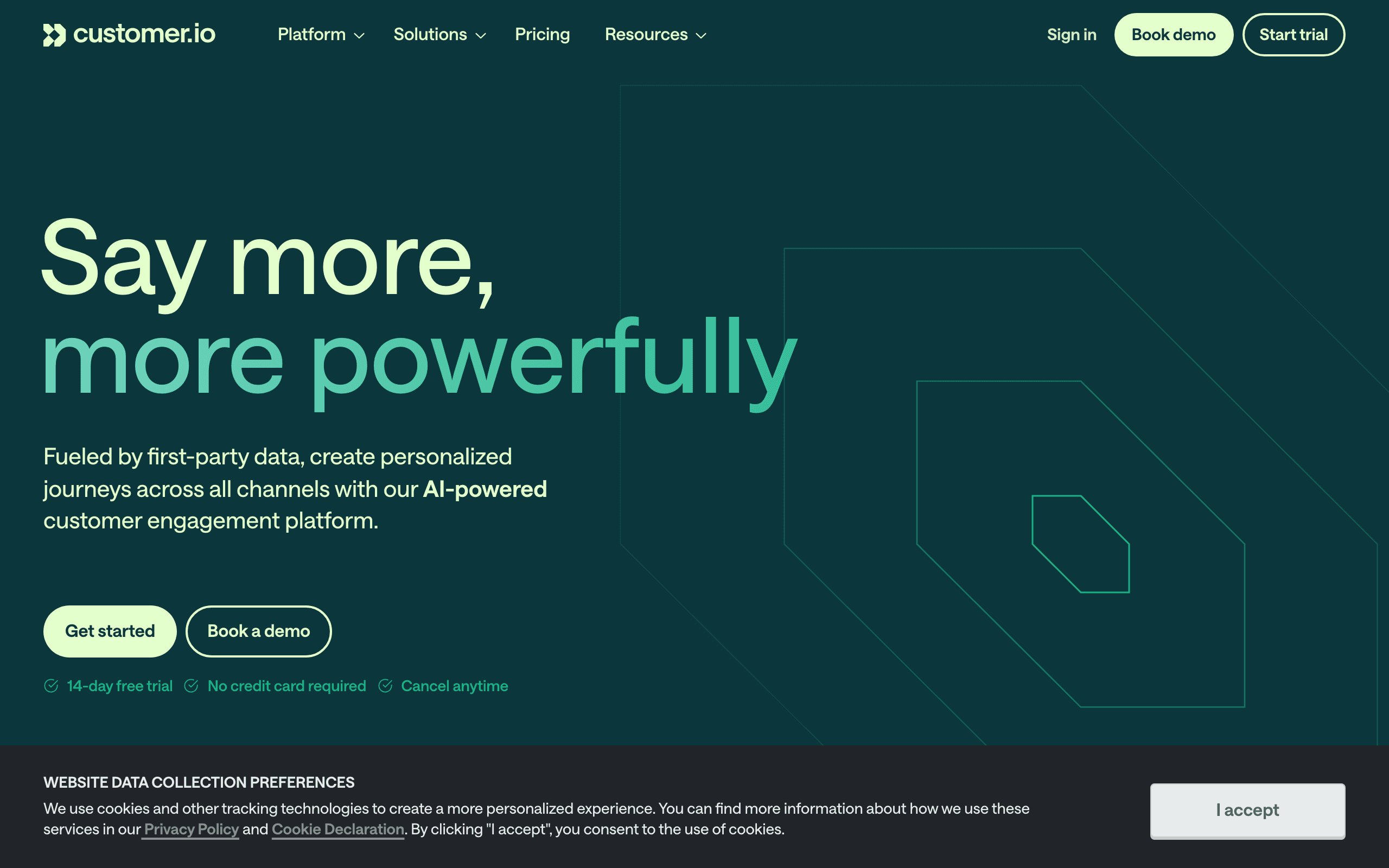
Customer.io has solid Stripe support through their data integration layer. You can connect Stripe events via their Data Pipelines (formerly powered by Segment) or send events directly via their Track API, then use those events to trigger workflows.
The integration is powerful but requires more setup than plug-and-play solutions. You'll need to map Stripe events to Customer.io events and configure which attributes to sync. For technical teams comfortable with APIs, this flexibility is a strength. You can process Stripe events exactly the way your business needs, with custom transformations and logic.
Customer.io's automation builder can handle complex multi-step workflows that go beyond simple email sequences. Combine Stripe events with product usage data, support ticket status, and engagement metrics to build sophisticated lifecycle automation. If someone's payment fails AND they haven't logged in for 30 days, that's a different conversation than a payment failure from an active user.
The webhook support is robust, allowing bidirectional data flow between your application and Customer.io.
- Stripe integration: Via Data Pipelines / Segment or direct Track API; flexible but requires mapping
- Pricing: Starts at $100/month (Essentials plan)
- Pros: Flexible event-driven automation engine, can handle complex multi-step workflows, good API and webhook support, supports email, push, and in-app, combine Stripe data with product usage data
- Cons: Requires technical setup for Stripe integration, expensive for small teams, steeper learning curve, no native one-click Stripe connection
3. Userlist
Best for: SaaS companies wanting clean lifecycle segmentation
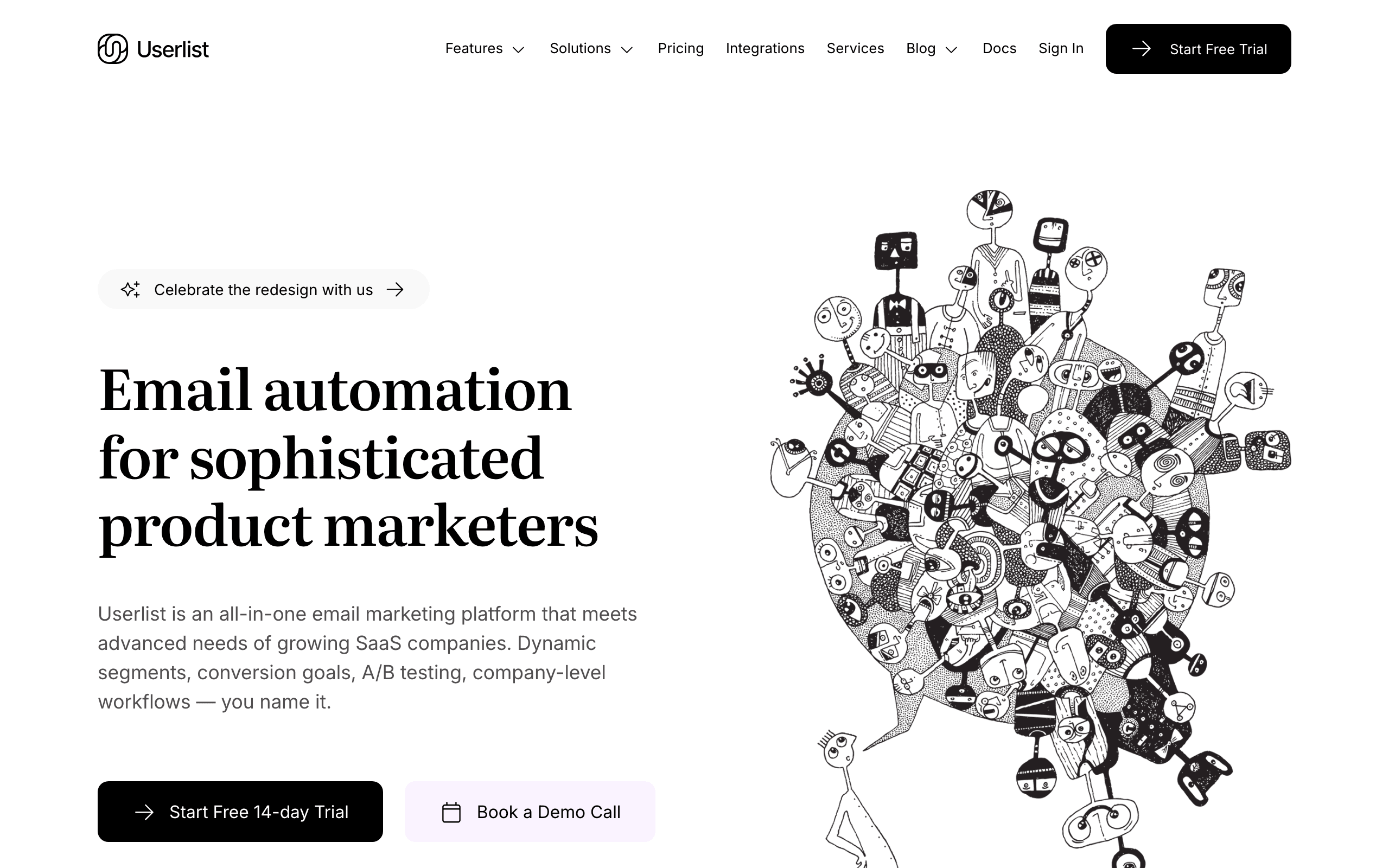
Userlist positions itself as email for SaaS, and the Stripe integration is decent. You connect via API and can sync subscription data to create segments based on plan, status, and trial state.
The automation builder is straightforward and supports Stripe event triggers. It handles the common SaaS use cases (trial conversion, dunning, lifecycle) well. Userlist also supports company-level data alongside user-level data, which is important for B2B SaaS where multiple users belong to a single paying account.
This company-level view means you can build automations like: "When a company's subscription is cancelled, email the admin AND the power users with different messages." Most email tools that aren't SaaS-specific can't do this cleanly because they think in terms of individual contacts, not accounts.
- Stripe integration: Native API integration, syncs to user + company entities, supports common lifecycle events
- Pricing: Starts at $149/month
- Pros: Built specifically for SaaS, clean segmentation by subscription status, supports both user and company-level data, good for B2B SaaS with multiple users per account
- Cons: Higher starting price, Stripe integration requires API work to get the most out of it, smaller community and fewer resources, limited template options
4. Loops
Best for: Founders who want a modern, simple email tool
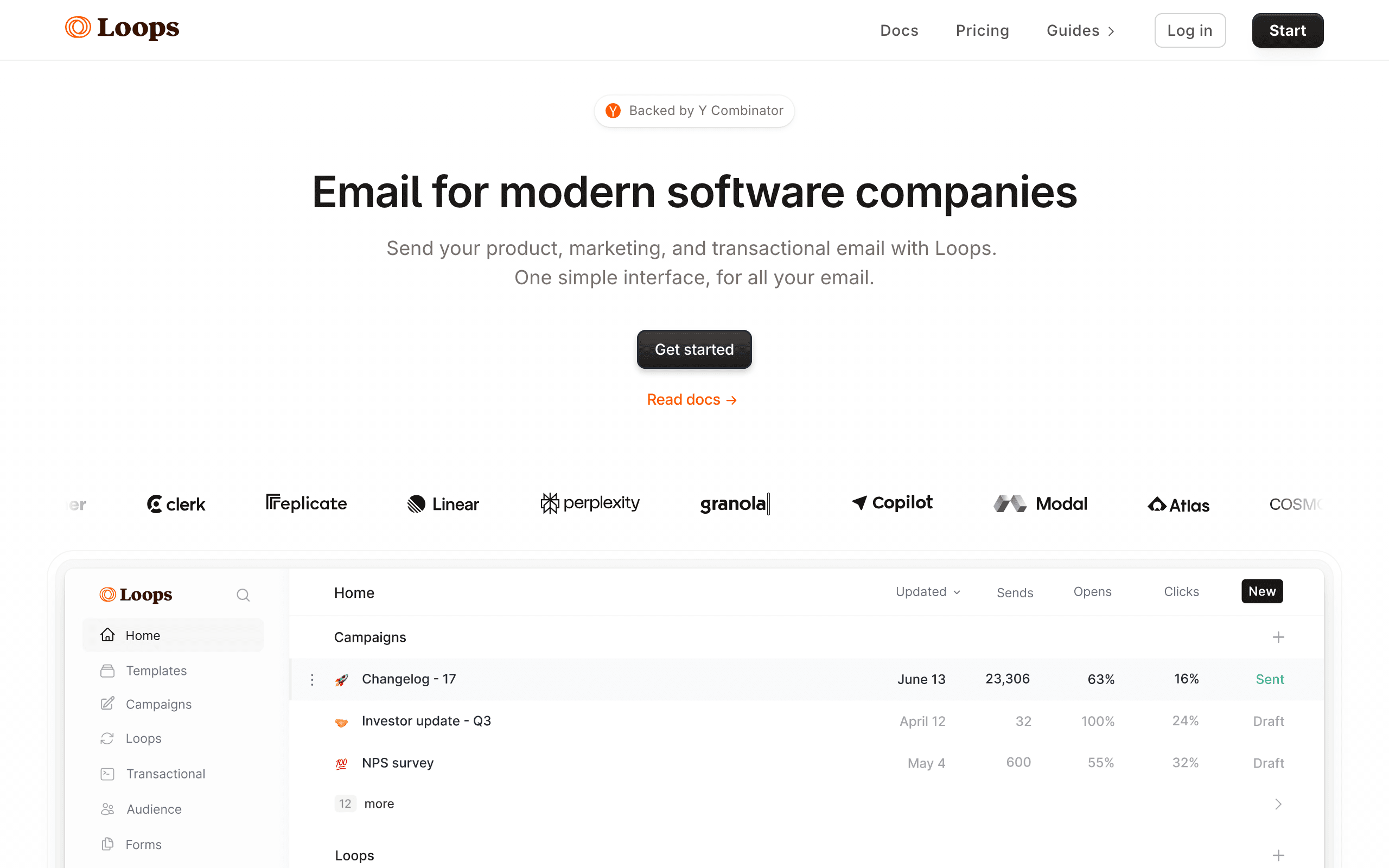
Loops is a newer email platform that's popular with indie hackers and early-stage SaaS founders. The Stripe integration ships as a first-party integration in their Apps section, plus you can send custom events via their API for anything the integration doesn't cover natively.
The integration handles the common subscription events (created, updated, deleted, trial ending, payment failed) and creates contact properties for plan and status. For events the native integration doesn't cover, you forward them from your app to Loops via their events API. The implementation is straightforward, but you'll likely write some glue code if you want every Stripe edge case represented.
For early-stage SaaS that isn't ready to commit to an expensive email platform, Loops' free tier gives you room to experiment with Stripe-triggered email before your list grows.
- Stripe integration: Native Stripe app for core events, plus custom events API for anything else
- Pricing: Free for up to 1,000 contacts, then starts at $49/month
- Pros: Clean, modern interface, simple event-driven automation, good free tier for early-stage, fast setup, developer-friendly API
- Cons: Native integration covers core events but you'll forward custom events yourself, limited segmentation compared to more mature tools, basic analytics, fewer templates
5. Encharge
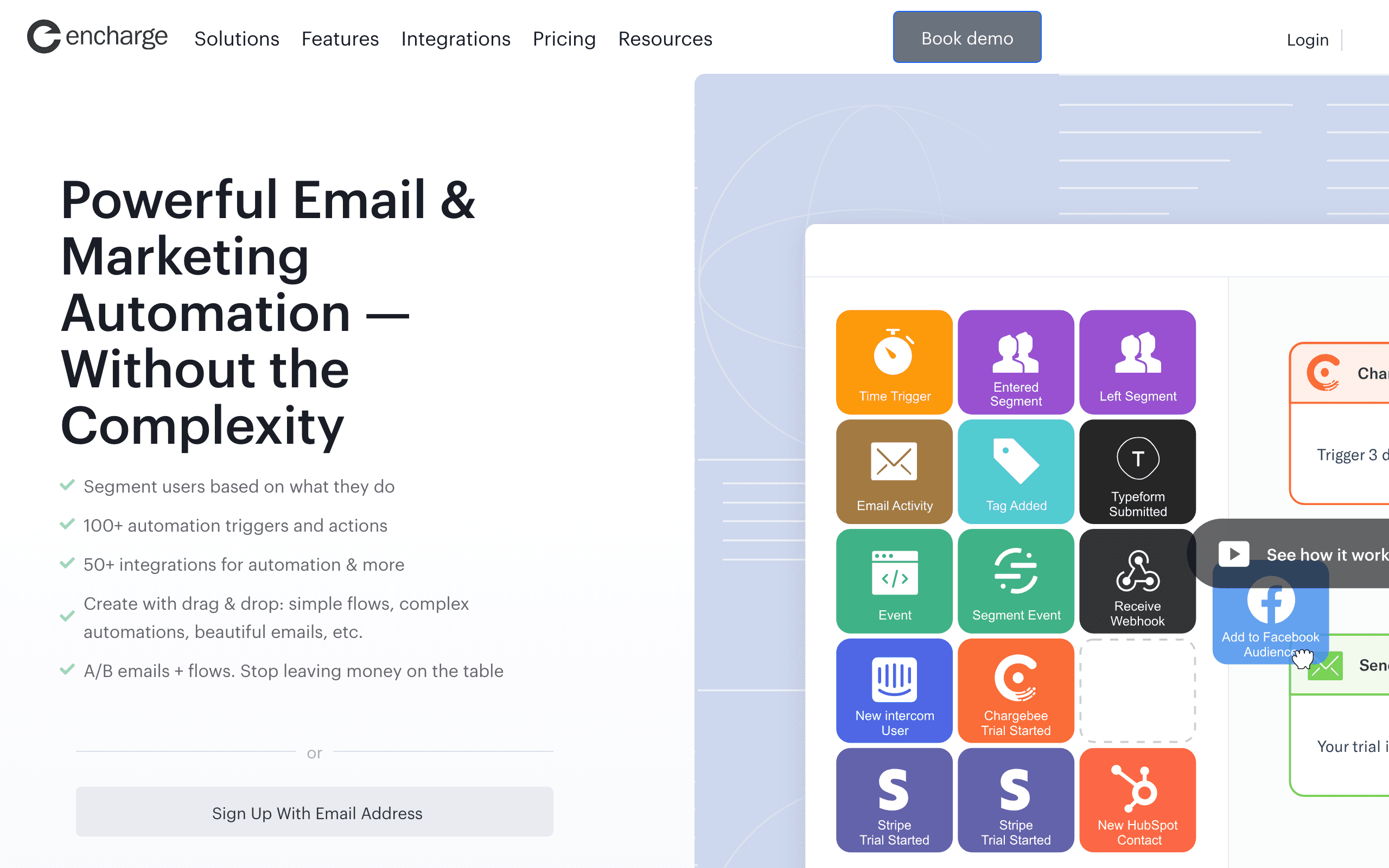
Best for: Non-technical teams wanting visual Stripe automation
Encharge offers a visual flow builder with Stripe as a native trigger source. You can connect Stripe directly and build visual automations that respond to subscription events.
The visual builder makes it easy to see the logic of your automation flows, which is helpful for non-technical founders who want to understand what's happening. You can see branching logic visually: "If payment fails, send dunning sequence. If payment fails AND they're on the free trial, send a different message." The visual representation makes complex flows comprehensible.
Encharge also supports combining Stripe triggers with other data sources. Connect your CRM and product analytics alongside Stripe to build automations that consider the full customer context.
- Stripe integration: Native Stripe trigger source with one-click connection, supports all major subscription events
- Pricing: Starts at $79/month
- Pros: Visual flow builder with Stripe triggers, relatively easy setup, good for non-technical users, supports common SaaS automation patterns, visual branching logic
- Cons: Visual builder can get complex for sophisticated flows, mid-range pricing, smaller user base than major platforms, email editor is basic
6. Mailchimp (with Stripe Add-on)
Best for: Companies already on Mailchimp who want basic Stripe data
Mailchimp offers a Stripe integration through their marketplace. It syncs customer data and purchase history, allowing you to segment by purchase behavior.
However, the integration is limited compared to SaaS-focused tools. It's designed more for e-commerce (one-time purchases) than subscription lifecycle management. You won't get native trial/churn/dunning triggers without significant custom work. The Stripe data appears as purchase events rather than subscription lifecycle events, which limits what you can automate.
If you're already on Mailchimp and want to add basic Stripe data, the integration works. But if you're evaluating tools specifically for SaaS subscription management, Mailchimp isn't the right starting point. You'd need to supplement with Zapier to handle subscription events, which adds cost and complexity.
- Stripe integration: Marketplace app, syncs customers and purchase history, e-commerce-shaped
- Pricing: Free for up to 500 contacts, paid plans from $13/month
- Pros: Familiar interface if you already use Mailchimp, large template library, wide ecosystem of integrations, generous free tier
- Cons: Stripe integration is basic and e-commerce-focused, no native subscription lifecycle triggers, no trial conversion or dunning automation out of the box, gets expensive at scale
7. ActiveCampaign
Best for: Teams wanting CRM + email with Stripe data
ActiveCampaign connects to Stripe through their native integration (part of Deep Data on higher-tier plans) and third-party connectors. You can sync customer data, trigger automations on purchase events, and segment by Stripe attributes.
The CRM component is useful if you want to track individual customer relationships alongside email automation. For sales-led SaaS companies, having deal data and subscription data in the same platform eliminates context switching. Your sales team can see email engagement alongside subscription status.
But for pure SaaS lifecycle email, the Stripe integration requires more configuration than dedicated SaaS tools. ActiveCampaign wasn't built specifically for subscription businesses, so you'll spend time mapping Stripe events to ActiveCampaign's contact model. Some events may need Zapier as a bridge depending on your plan, which introduces the latency and reliability concerns mentioned earlier.
- Stripe integration: Native Deep Data Stripe connector on higher tiers; Zapier fallback on lower tiers
- Pricing: Starts at $29/month (Lite plan); Deep Data requires Plus or higher
- Pros: Built-in CRM alongside email, mature automation builder, large ecosystem of integrations, good deliverability reputation
- Cons: Native Stripe data is gated behind higher plans, not purpose-built for SaaS subscription management, complex interface with steep learning curve, pricing increases significantly with contacts and features
8. Postmark (Transactional Only)
Best for: Developers who need transactional email triggered by Stripe webhooks
Postmark isn't an email marketing platform. It's a transactional email service with exceptional deliverability. You'd use it alongside Stripe by sending transactional emails (receipts, payment confirmations, dunning notices) directly from your application when Stripe webhooks fire.
No automation builder, no sequences, no marketing campaigns. But for pure transactional email triggered by Stripe events, it's hard to beat on deliverability and speed. Payment confirmation emails arrive in seconds. Dunning notices land in the inbox, not spam.
If your email strategy separates transactional and marketing, Postmark handles the transactional side exceptionally well. Pair it with a marketing platform (Sequenzy, Customer.io, etc.) for lifecycle sequences.
- Stripe integration: Webhook-driven from your own app; Postmark sends, you orchestrate
- Pricing: Starts at $15/month for 10,000 emails
- Pros: Best-in-class transactional deliverability, fast delivery (seconds, not minutes), clean API and excellent documentation, template system for transactional emails
- Cons: No marketing email capabilities, no automation or sequences, requires development work to integrate with Stripe, you'll need a separate tool for marketing email
9. Resend
Best for: Developers who want to build their own email layer in code
Resend is an API-first transactional and broadcast email service with a strong developer experience. Like Postmark, it doesn't have a Stripe integration in the dashboard sense. You listen to Stripe webhooks in your own application, render an email (often with React Email), and call Resend's API to send.
The DX is the differentiator. The TypeScript SDK, React Email components, and broadcast features make Resend a comfortable place for engineering teams to own their email layer. If you're already shipping React for your product, your Stripe receipts and dunning emails can be the same components, version-controlled in your repo.
What you don't get is an automation builder. Multi-step dunning, trial nurture sequences, and behavior-based branching all live in your code (or in a state machine you build). For some teams, that control is the point. For others, that's a foot-gun: the day someone forgets to handle invoice.payment_failed retries, you ship a bug instead of editing a flow.
- Stripe integration: Webhook-driven from your own app; Resend sends, you orchestrate
- Pricing: Free for 100 emails/day, from $20/month
- Pros: Excellent developer experience, TypeScript SDK, React Email components, fast delivery, easy domain setup
- Cons: No automation builder, no native Stripe connector, you build all sequencing and state yourself, broadcast features are still maturing
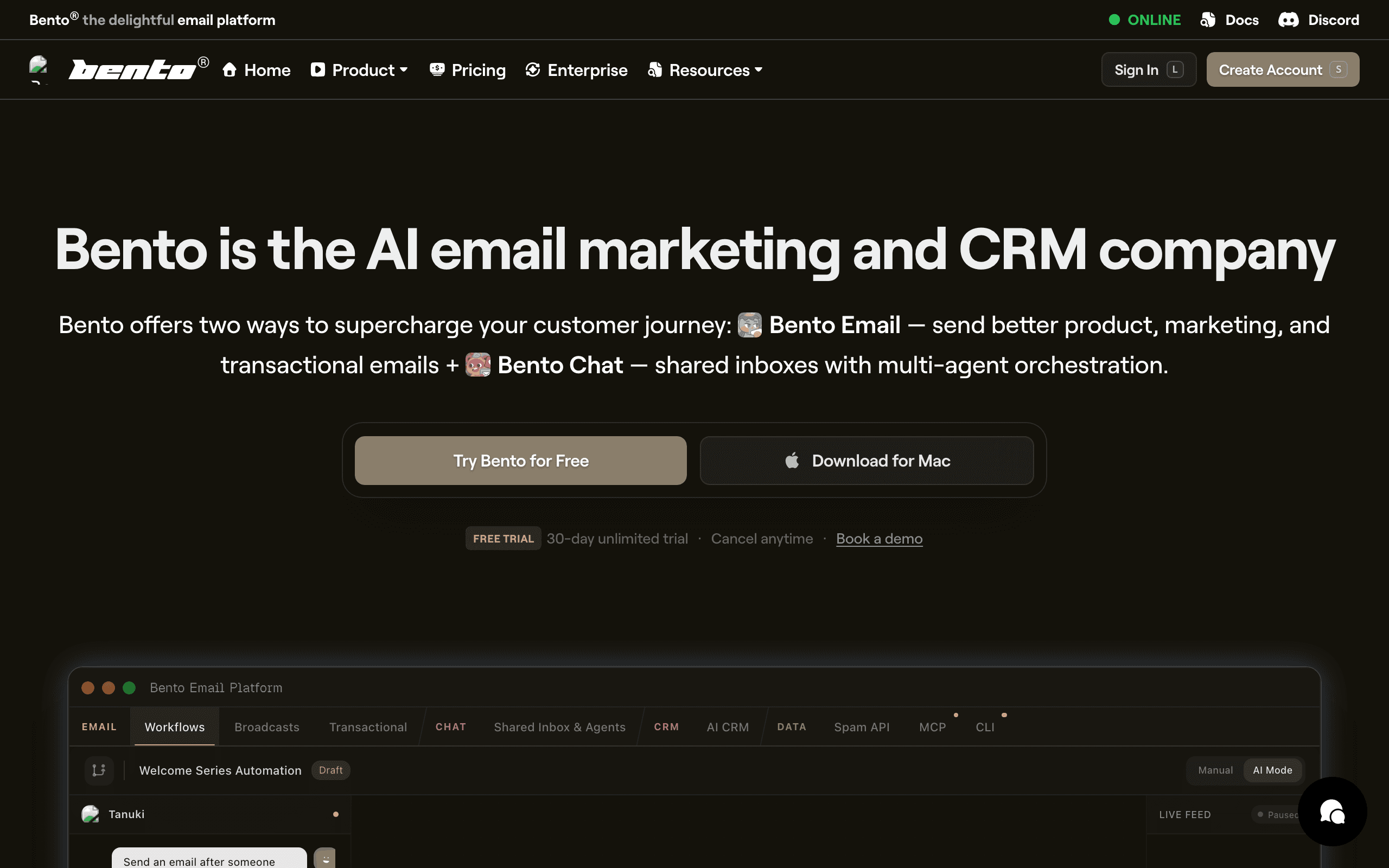
10. Bento
Best for: Indie SaaS wanting events, email, and Stripe in one tool
Bento markets itself to indie hackers and small SaaS teams as a behavior-driven email platform. The Stripe integration is native: connect with OAuth, and Bento ingests subscription events and creates contact attributes for plan, MRR, and status.
The platform leans heavily on events. Every Stripe action becomes an event you can use to trigger flows or build segments, and you can send your own product events to combine with Stripe data. This is closer to the Customer.io model than the Mailchimp model, but at indie pricing.
Where Bento falls short is polish. The UI is busy, documentation can be uneven, and some workflows take more clicks than they should. If you can look past that, the underlying capability is genuinely strong for the price.
- Stripe integration: Native OAuth, syncs subscription events and revenue attributes
- Pricing: Starts at $30/month
- Pros: Native Stripe support at indie pricing, real event-driven model, generous attribute sync, includes deliverability tooling
- Cons: UI feels cluttered, documentation gaps, smaller ecosystem, fewer pre-built templates
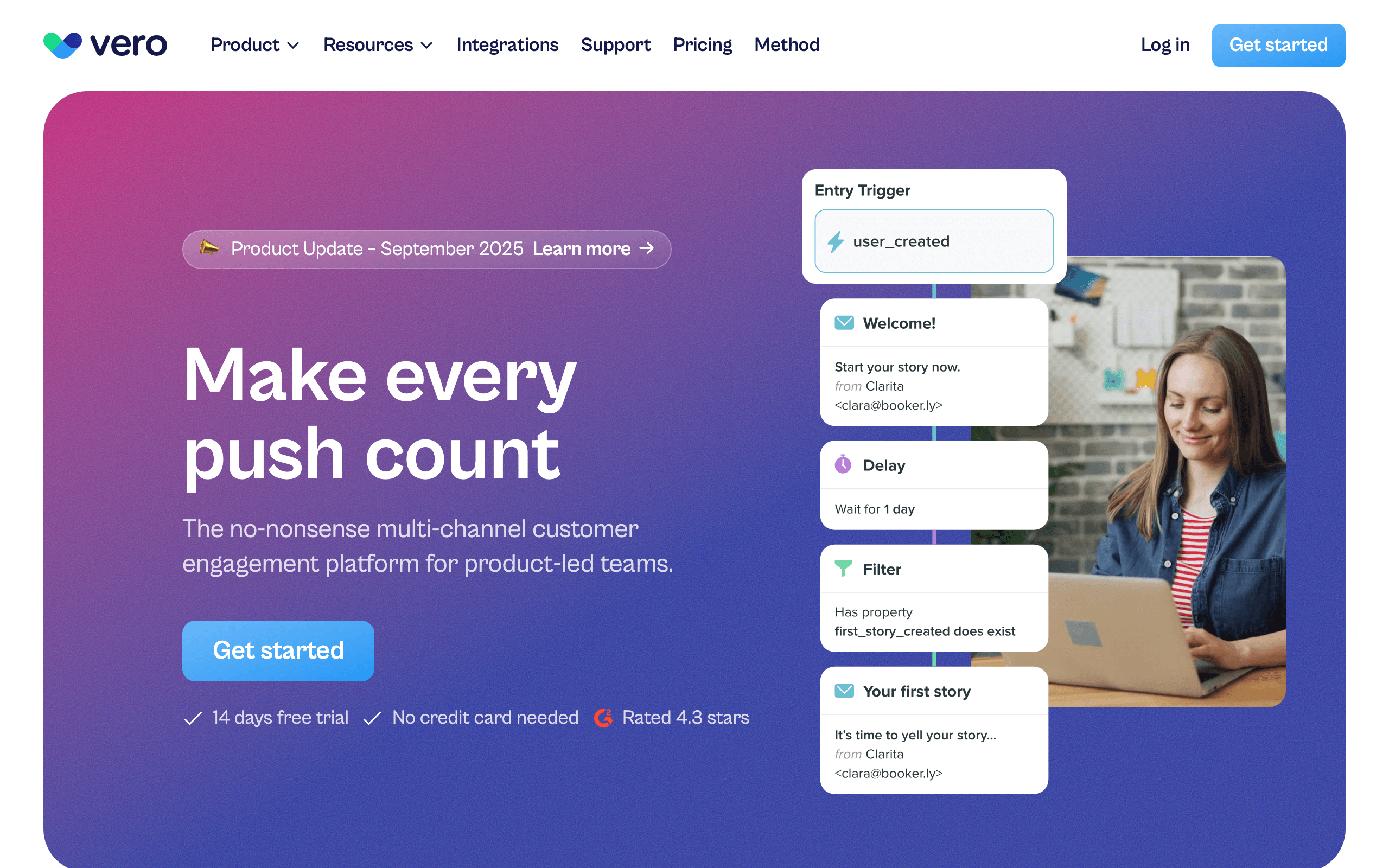
11. Vero
Best for: Product teams that want event-based messaging with Stripe context
Vero is an event-based messaging platform that's been around longer than most of the names on this list. There's no one-click Stripe connector, but Vero's event API and Segment integration make Stripe data straightforward to ingest. Forward Stripe webhooks via your app or via Segment, and every subscription event becomes a Vero event you can trigger workflows on.
The strength of Vero is its workflow engine. You can express "if payment failed, wait 24 hours, check if still past-due, send email, branch on engagement" cleanly, and the same workflow can drive email and push notifications.
It's not the trendiest tool in the category anymore, but for teams who want Customer.io-style flexibility at a slightly lower price point, Vero is worth a look.
- Stripe integration: Via webhooks or Segment; ingest Stripe events as Vero events
- Pricing: Starts at $99/month
- Pros: Mature workflow engine, multi-channel (email + push), strong segmentation, predictable pricing
- Cons: No native one-click Stripe app, smaller ecosystem than Customer.io, dated UI in places, fewer integrations than competitors
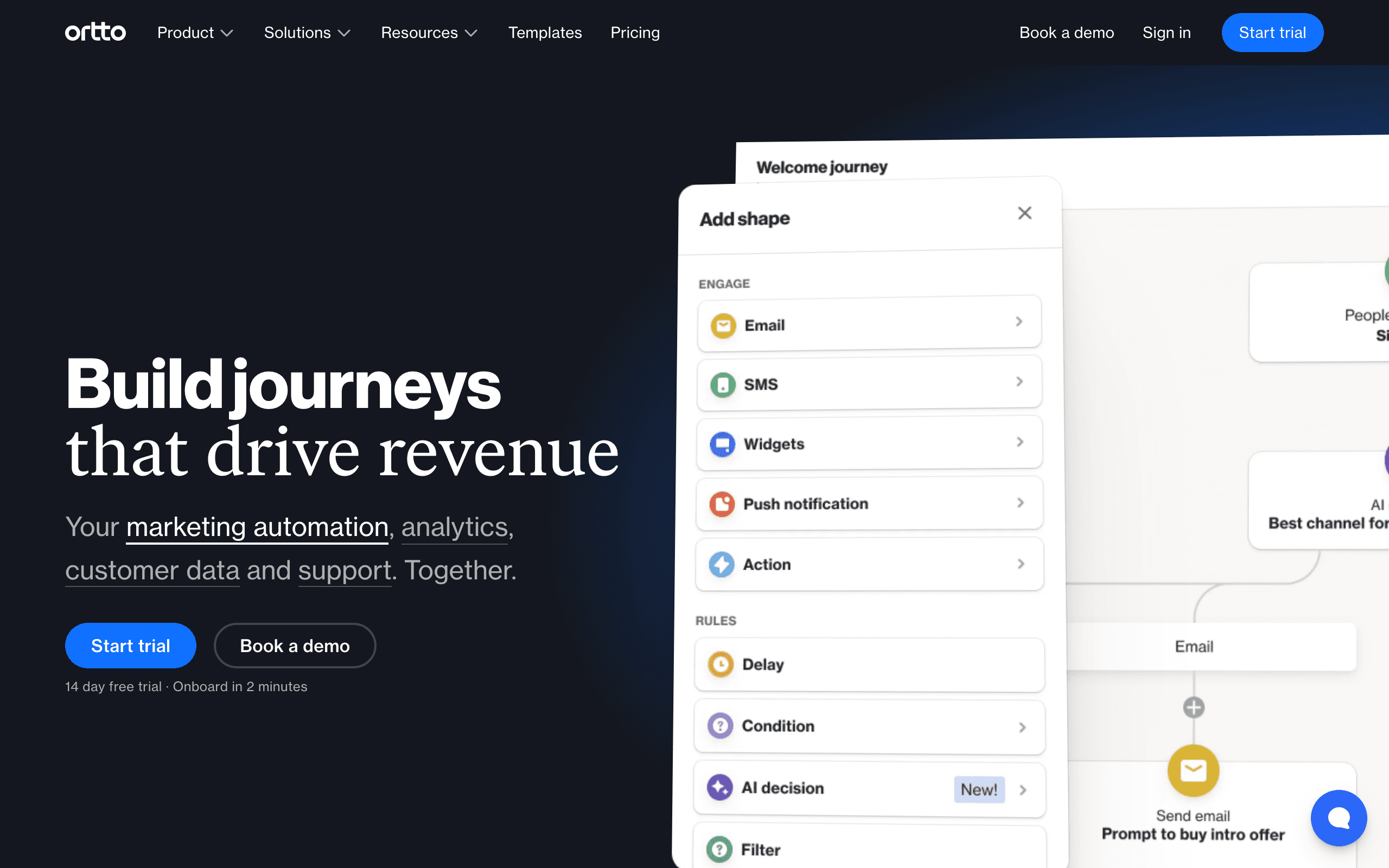
12. Ortto (formerly Autopilot)
Best for: Marketing teams wanting Stripe data inside a journey builder
Ortto rebuilt and rebranded Autopilot into a more analytics-heavy marketing automation platform. Stripe is a native data source: connect it and Ortto pulls subscription, invoice, and customer data into its CDP-style activity feed.
That data then flows into Ortto's journey builder, dashboards, and segments. You can build fairly sophisticated lifecycle journeys (onboarding, trial conversion, dunning, win-back) using Stripe events as triggers, and segment customers by MRR or plan inside the audience builder.
The catch is pricing. Ortto's lower tiers don't include the data sources you actually need for SaaS, so realistically you're looking at the higher plans before Stripe-driven journeys are usable.
- Stripe integration: Native data source feeding journeys, audiences, and dashboards
- Pricing: Starts at $599/month for the plan tier where Stripe data is genuinely usable
- Pros: Strong journey builder, Stripe data integrated with analytics, multi-channel (email, SMS, push, in-app), polished UI
- Cons: Expensive once you need Stripe + automation, complex to learn, overkill for small SaaS, contracts can be rigid
13. HubSpot

Best for: Companies already standardized on HubSpot CRM
HubSpot has both a Stripe app in their marketplace and HubSpot Payments (powered by Stripe). The Stripe app syncs customers, products, invoices, and subscription status into HubSpot contacts and deals, which you can then use in workflows and lists.
For SaaS companies that have committed to HubSpot as the CRM, this is an obvious path: subscription data flows into the same place as your sales pipeline and marketing engagement. You can build workflows like "if MRR drops, notify CSM and start retention email."
The honest caveats: HubSpot's automation pricing scales hard, the Stripe app's depth is improving but still less native-feeling than dedicated SaaS tools, and dunning sequences feel grafted onto a CRM rather than designed for subscription businesses.
- Stripe integration: Native Stripe app + HubSpot Payments; syncs customers, subscriptions, invoices to CRM
- Pricing: Free CRM; Marketing Hub from $20/month, automation features gated by tier
- Pros: Unified with CRM, deals, and pipelines, strong reporting, large ecosystem of integrations, good support
- Cons: Pricing escalates rapidly with contacts and features, Stripe integration feels CRM-shaped not SaaS-shaped, no purpose-built dunning, complex permissions model
14. Klaviyo
Best for: Hybrid e-commerce and SaaS businesses
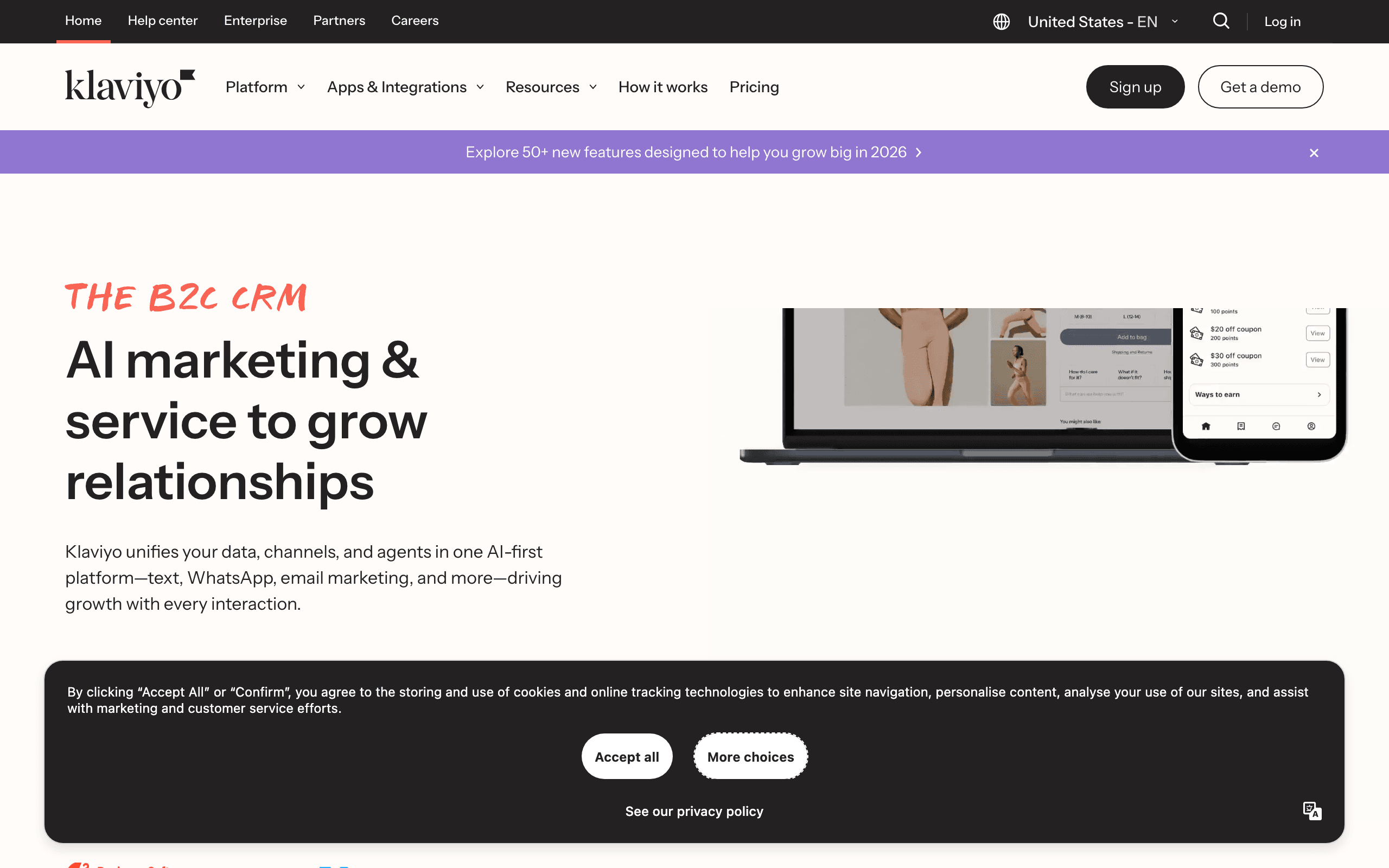
Klaviyo is best known for e-commerce, but they offer a native Stripe integration that pulls subscription and payment data into customer profiles. You get events for subscriptions created, updated, cancelled, and for failed payments, plus profile properties for plan and status.
Klaviyo's segmentation engine is genuinely excellent. If your business has both transactional purchases (Shopify, etc.) and a SaaS layer (Stripe), Klaviyo lets you blend that data in a single profile and segment across both. Few platforms do that as cleanly.
The downside for pure SaaS is that everything in Klaviyo is shaped like e-commerce. Flows, templates, terminology, and dashboards all assume order-based behavior. You can absolutely run SaaS lifecycle email on Klaviyo, but you'll be translating concepts the whole way.
- Stripe integration: Native, syncs subscription + payment events and properties to profiles
- Pricing: Free up to 250 contacts, from $45/month
- Pros: Best-in-class segmentation, blends e-commerce + SaaS data, strong analytics, many templates
- Cons: Mental model is e-commerce, not SaaS, pricing scales aggressively with contacts, dunning is DIY, can feel heavy for small teams
15. Drip
Best for: E-commerce-led SaaS hybrids
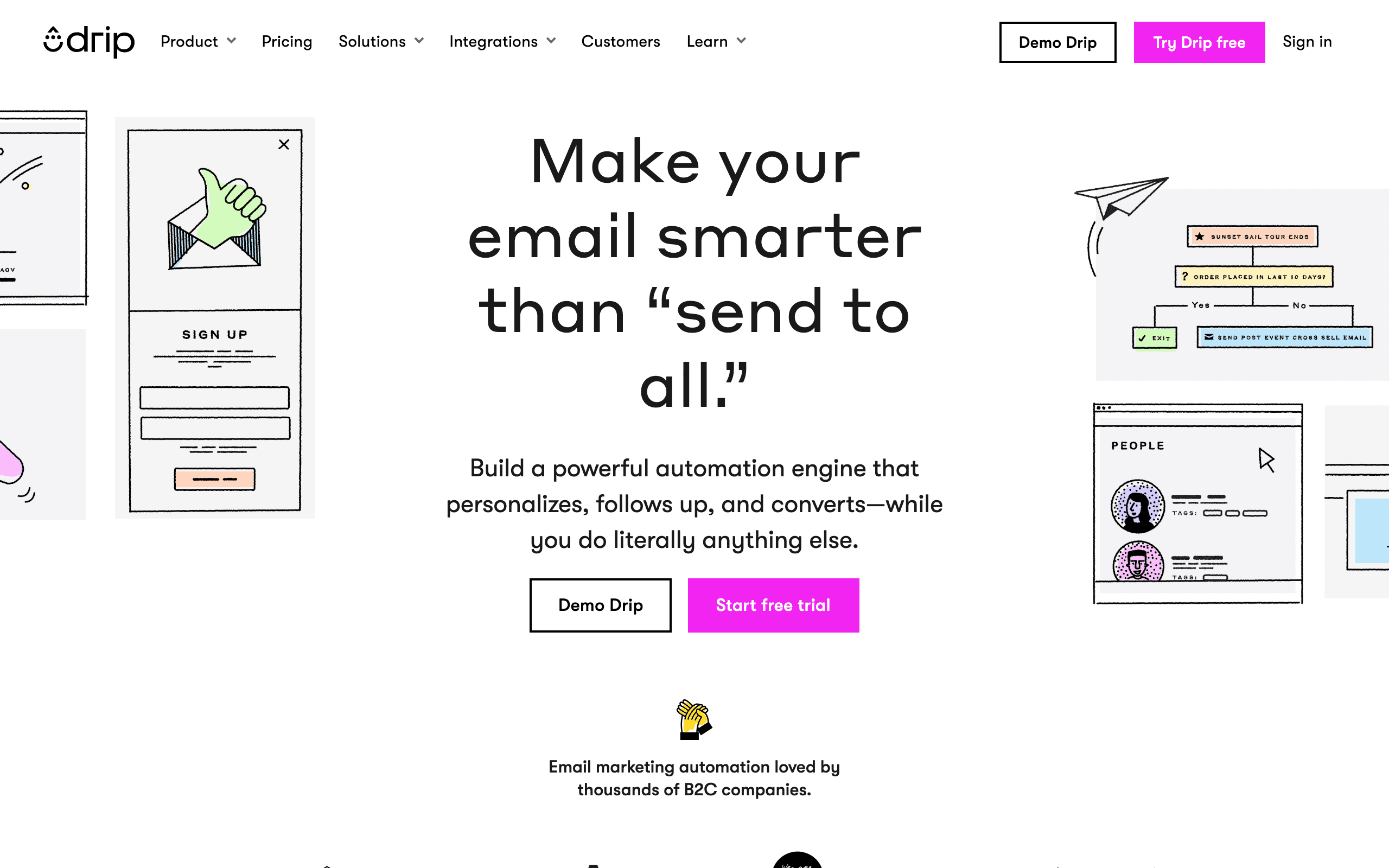
Drip is positioned as ECRM (e-commerce CRM) and competes with Klaviyo. It does not currently have a native Stripe integration in the same sense that Klaviyo does. You'll connect Stripe via Zapier, a custom webhook handler, or by piping events through their Events API.
Once events are flowing, Drip's workflow builder is capable and the segmentation is solid. But the lack of a first-party Stripe connector means you carry the integration yourself, which feels out of step with where the rest of the category has moved.
For a SaaS with a strong e-commerce arm already on Drip, supplementing with Stripe via Zapier might be acceptable. For a SaaS-first business, there are better-fit tools on this list.
- Stripe integration: No native connector; Zapier or custom webhook handler required
- Pricing: Starts at $39/month for 2,500 contacts
- Pros: Strong workflow builder, e-commerce-aware segmentation, decent template editor
- Cons: No native Stripe integration, Zapier latency and cost, e-commerce mindset, less SaaS focus than competitors
16. Brevo (formerly Sendinblue)
Best for: Budget-conscious teams wanting email + SMS in one tool
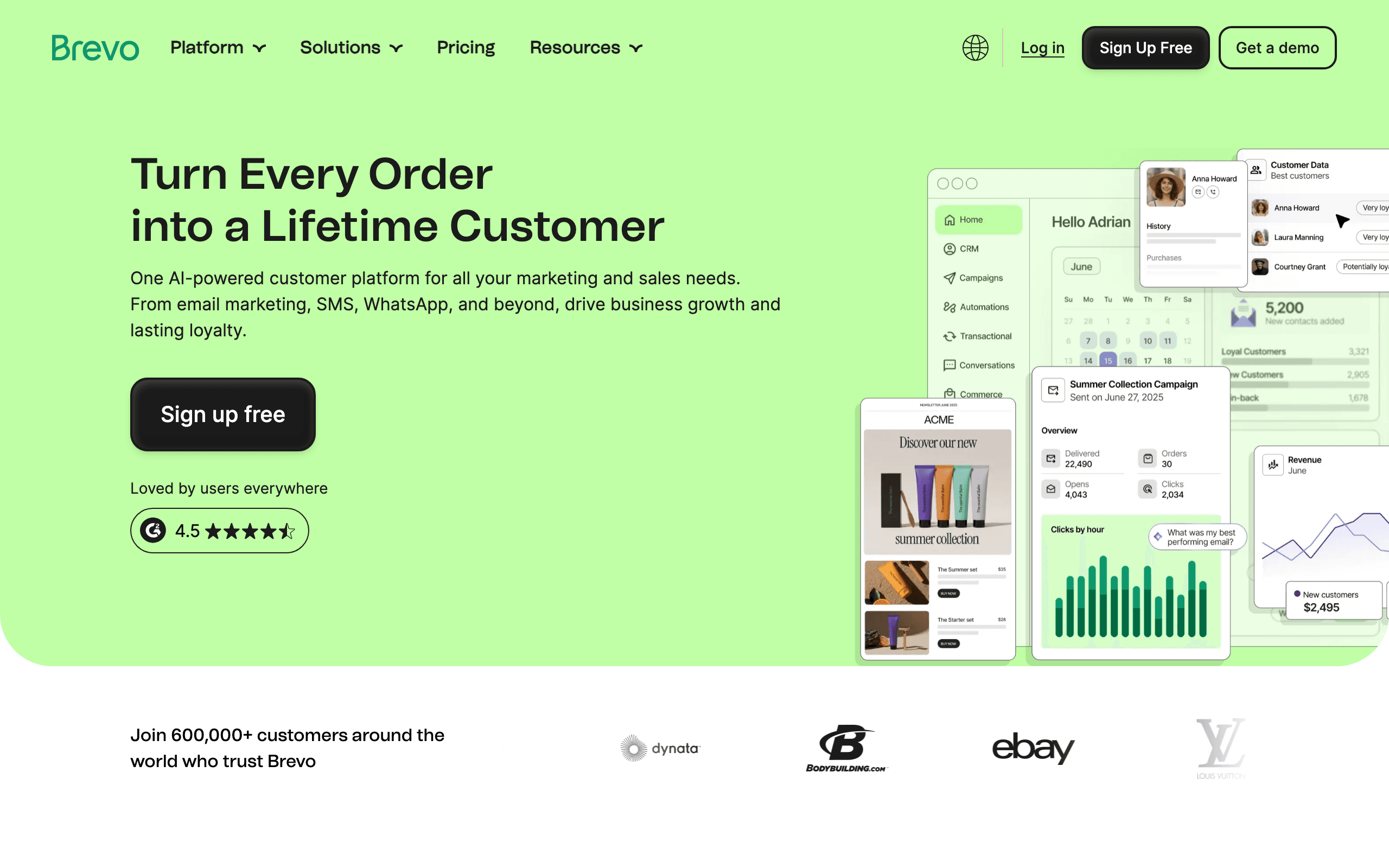
Brevo is one of the most affordable platforms in the category and includes email, SMS, and basic CRM. Stripe support, however, is not native. You'll connect via Zapier, n8n, Make, or by pushing events through Brevo's API from your own webhook handler.
Once events are in Brevo, you can build automations and segments. The automation builder is workable but not class-leading, and you won't get the polished SaaS-specific templates that come with dedicated tools.
If your SaaS is early enough that price is the primary constraint, and you're willing to wire up Stripe yourself, Brevo can carry you for a long time before you outgrow it.
- Stripe integration: No first-party connector; Zapier, n8n, or custom webhooks required
- Pricing: Free up to 300 emails/day; paid plans from $9/month
- Pros: Very affordable, includes SMS and basic CRM, decent deliverability, generous free tier
- Cons: No native Stripe integration, generic automation builder, fewer SaaS-specific patterns, support quality varies
17. MailerLite
Best for: Solo founders running paid newsletters or simple SaaS
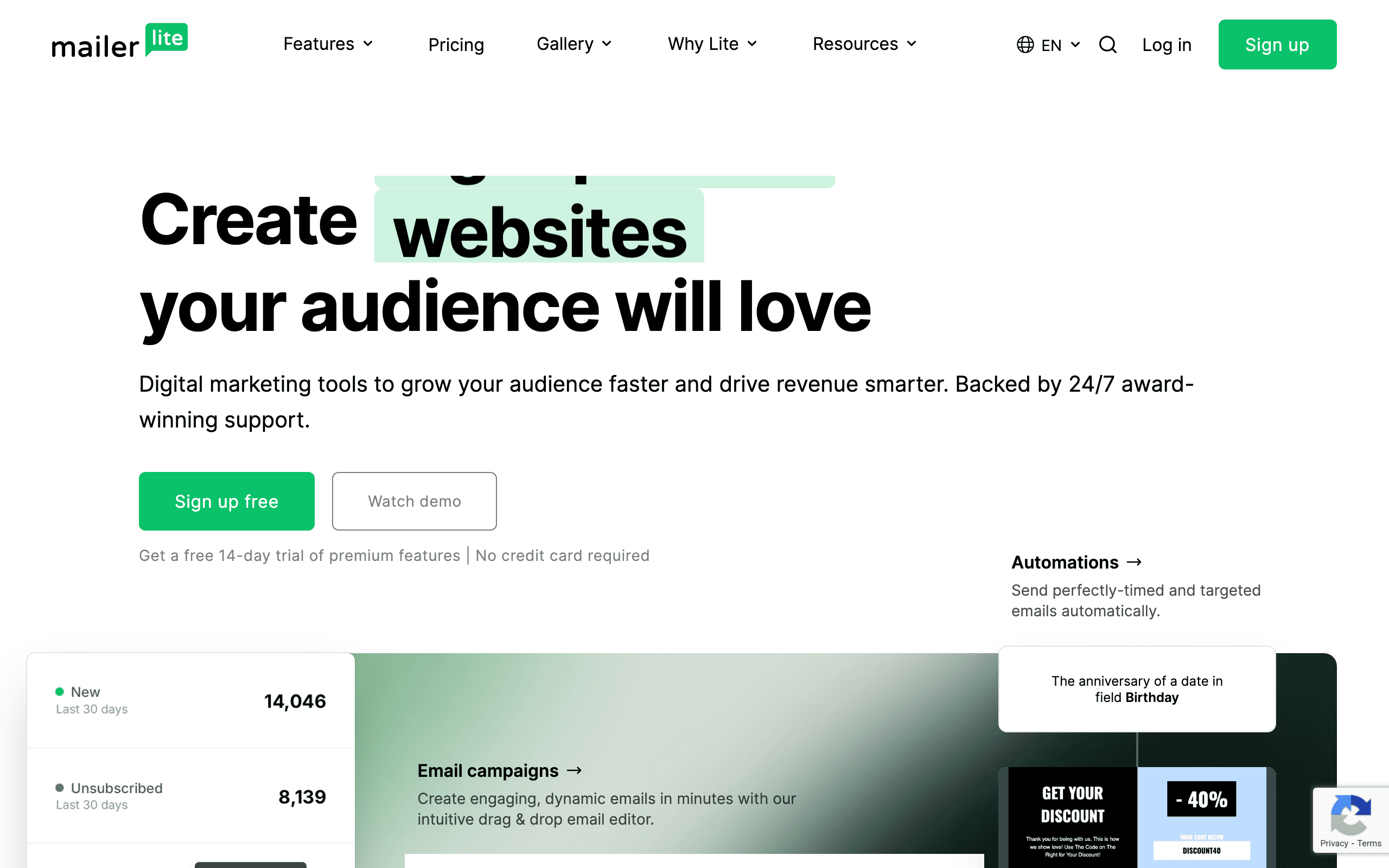
MailerLite has a native Stripe integration, but it's narrowly scoped: it powers their paid newsletter and digital product features, not full subscription lifecycle automation. If you want to sell access to a paid newsletter or one-off digital products and have Stripe handle the payments, MailerLite stitches it together cleanly.
For broader SaaS use cases (dunning, trial-to-paid, upgrade nudges), you'd treat MailerLite like Brevo: ingest events via Zapier or webhooks and build automations on top. That works for simple needs but doesn't compete with purpose-built SaaS tools.
The platform itself is pleasant to use, with a clean editor and one of the better free tiers in the space. For a solo founder shipping a small SaaS plus a paid newsletter, MailerLite is a reasonable single-tool answer.
- Stripe integration: Native for paid newsletters and digital products; via Zapier for general subscription events
- Pricing: Free up to 1,000 subscribers and 12,000 emails/month; from $10/month
- Pros: Pleasant editor, generous free tier, native paid newsletter support, simple pricing
- Cons: Native Stripe scope is narrow, broader SaaS automation is DIY, segmentation is basic, fewer integrations than larger platforms
18. Beehiiv
Best for: Newsletter-led SaaS monetizing audiences with paid tiers
Beehiiv is a newsletter platform that has invested heavily in Stripe Connect for paid subscriptions. If your "SaaS" is really a paid media or newsletter business, Beehiiv handles the subscription side natively: tiered pricing, trials, upgrades, downgrades, and churn all flow through Stripe and back into Beehiiv as audience attributes.
For traditional SaaS (an app with a billing page), Beehiiv is the wrong tool. There's no general-purpose Stripe-event-to-automation pipeline like Sequenzy or Customer.io offer. But for a content-led business with a paid tier, the integration is one of the cleanest in the space.
The platform also includes solid audience growth features (referral programs, recommendations network, ad network) that are genuinely differentiated from email-first tools.
- Stripe integration: Native Stripe Connect for paid newsletter subscriptions and tiers
- Pricing: Free up to 2,500 subscribers; paid plans from $39/month
- Pros: Native paid subscription handling, strong audience growth tools, polished editor, good analytics
- Cons: Newsletter-shaped, not SaaS-shaped, no general Stripe-event automation, limited segmentation by behavior, weak transactional email
19. ConvertKit (Kit)

Best for: Creator-style SaaS selling courses, products, and subscriptions
ConvertKit (now branded "Kit") added a native Stripe integration alongside their existing Commerce product, which already supported paid newsletters and digital downloads. Stripe data syncs into subscriber profiles, and you can trigger automations on purchase events.
For creators who run a hybrid business (courses, paid newsletters, a small SaaS), ConvertKit is a defensible single-tool answer. The tagging system handles segmentation cleanly, the editor is solid, and the automation builder is approachable for non-technical founders.
For pure SaaS with serious lifecycle needs (multi-step dunning with branching, MRR-based segmentation, trial conversion sequences with usage signals), it falls short of dedicated tools. The Stripe integration is real, but the platform itself is shaped around creator workflows.
- Stripe integration: Native Stripe connection plus Commerce features for in-platform checkout
- Pricing: Free up to 10,000 subscribers; paid from $29/month
- Pros: Strong creator features, generous free tier, clean tagging-based segmentation, good editor
- Cons: Creator-shaped, not SaaS-shaped, dunning is DIY, automation is approachable but not deep, reporting is limited
20. Iterable
Best for: Enterprise SaaS with complex multi-channel lifecycle programs
Iterable is an enterprise messaging platform used by larger SaaS businesses for cross-channel lifecycle programs (email, SMS, push, in-app). There's no point-and-click Stripe connector, but Iterable expects you to feed events from a CDP, data warehouse, or your own services. Stripe events typically arrive via Segment, your warehouse (Snowflake, BigQuery), or your application's event pipeline.
Once data is flowing, Iterable's strengths are real: sophisticated journey orchestration, robust experimentation, and the ability to run truly cross-channel lifecycle programs at scale. If you're a Series B+ SaaS with a real growth team, this is the tool that scales.
For early or mid-stage SaaS, Iterable is overkill. The licensing alone usually rules it out, and the time-to-value on a custom Stripe integration is significant compared to plug-and-play options.
- Stripe integration: Via CDP (Segment), data warehouse, or your own webhook ingestion; no native connector
- Pricing: Custom enterprise pricing, typically $500+/month and up significantly with volume
- Pros: Enterprise-grade orchestration, true cross-channel lifecycle, strong experimentation, scales to billions of messages
- Cons: Expensive, custom integration work required, overkill for small/mid SaaS, long implementation timelines
21. SendGrid
Best for: Teams sending transactional email triggered by Stripe webhooks
SendGrid (Twilio SendGrid) is one of the original transactional email APIs and is still heavily used for receipts, password resets, and other Stripe-webhook-triggered emails. There's no native Stripe automation, no journey builder for SaaS lifecycle. You listen to Stripe webhooks in your app and call SendGrid's API to send the right template.
The Marketing Campaigns product on top of SendGrid does exist, but it's broadly seen as the weakest part of the platform. Most SaaS teams using SendGrid pair it with a marketing/lifecycle tool from this list and treat SendGrid purely as transactional infrastructure.
For Stripe-triggered transactional email at high volume with mature deliverability tooling, SendGrid still earns a spot. Just don't expect it to be your dunning automation engine.
- Stripe integration: Webhook-driven from your own app; no native Stripe connector
- Pricing: Free up to 100 emails/day; paid plans from $20/month
- Pros: Mature transactional infrastructure, scales to high volume, established deliverability tooling, large ecosystem
- Cons: Marketing Campaigns is weak, no Stripe-aware automation, requires engineering to wire up, support has a mixed reputation
How to Choose
If you want zero-configuration Stripe automation: Sequenzy connects via OAuth and handles everything automatically. No webhook setup, no event mapping.
If you're technical and want maximum flexibility: Customer.io or Vero give you the most control over how Stripe data flows into your email automation.
If you need B2B account-level data: Userlist supports company-level subscription data alongside individual users, which matters for B2B SaaS.
If you want a hybrid e-commerce + SaaS view: Klaviyo blends Shopify-style and Stripe-style data better than anything else on this list.
If you're already standardized on HubSpot: HubSpot's Stripe app is the path of least resistance, even if it's not the most SaaS-native option.
If you only need transactional email: Postmark, Resend, or SendGrid are the deliverability-first options. Pair with a marketing tool for sequences.
If you're early-stage and budget-conscious: Loops, Bento, MailerLite, or Brevo can each carry an early SaaS for a long time before you outgrow them.
If you're enterprise: Iterable or Ortto's higher tiers handle real complexity, at real prices.
If you're a content-led business with a paid tier: Beehiiv or ConvertKit handle paid newsletter subscriptions natively through Stripe.
Key SaaS Email Sequences Powered by Stripe
Understanding what sequences to build helps you evaluate which tool is right for your needs:
Dunning (Failed Payment Recovery)
The most valuable Stripe-triggered sequence. When a payment fails:
- Immediate: "Your payment failed. Update your card to keep your access."
- Day 3: "We tried charging your card again. It still failed. Here's how to fix it."
- Day 7: "Your account will be downgraded in 3 days if payment isn't updated."
- Day 10: "Your account has been downgraded. Update payment to restore access."
Good dunning sequences recover 20-40% of involuntary churn. The email deliverability of these messages matters enormously, since a dunning email in spam is the same as no dunning email.
Trial Conversion
When a trial starts:
- Day 0: Welcome + quick-start guide
- Day 3: Feature highlight relevant to their use case
- Day 7 (mid-trial): Check in. Are they getting value?
- Day 12: Social proof + pricing preview
- Day 14 (trial ending): "Your trial ends tomorrow. Subscribe to keep access."
Upgrade Nudge
Based on product usage synced alongside Stripe data:
- Hitting plan limits: "You've used 80% of your plan's API calls. Upgrade for unlimited."
- Power user behavior: "You're getting a lot out of [Feature]. The Pro plan includes [Advanced Feature] too."
Cancellation Follow-up
When a subscription is cancelled:
- Immediate: "We're sorry to see you go. Quick question: what could we do better?"
- Day 7: "Missing [key feature]? Here's what we've shipped since you left."
- Day 30: Win-back offer if applicable.
What to Look For in a Stripe Integration
When evaluating any email tool's Stripe integration, ask these questions:
- Is it native or through a third party? Native integrations are more reliable and require less maintenance. If the tool requires Zapier or Segment as a bridge, factor in that additional cost and complexity.
- Does it handle all subscription events? Payment failures, cancellations, upgrades, downgrades, and trial events should all be supported. Some tools only support purchase events, which isn't sufficient for subscription businesses.
- Does it auto-tag subscribers? Manually tagging customers by subscription status defeats the purpose of automation. Look for automatic status tags that update in real time.
- Does it sync revenue data? Knowing each subscriber's MRR lets you segment by customer value. This enables treating a $500/month customer differently from a $29/month customer in your email program.
- What happens when Stripe changes their API? Native integrations handle this for you. Custom webhook setups may need updating. Ask the vendor about their Stripe API version management.
- What's the latency? For dunning emails, a delay of hours can mean the difference between recovering a customer and losing one. Test the time between a Stripe event and the email sending.
FAQ
Do I need a Stripe integration if I already use Zapier? Zapier works as a bridge, but it adds cost ($20+/month), latency (minutes vs. seconds), and a potential point of failure. For critical flows like dunning, a native integration is more reliable. For non-critical flows, Zapier is fine. Consider which events are time-sensitive (dunning, trial expiration) and which aren't (upgrade confirmation) when deciding.
Can I use multiple email tools with Stripe? Yes, but be careful about duplicate emails. If both your transactional service and marketing platform listen to Stripe events, make sure they're handling different use cases (receipts vs. lifecycle sequences). Some teams use Postmark or Resend for transactional and Sequenzy for marketing, with clear boundaries between what each tool handles.
What Stripe events matter most for SaaS email?
The critical ones: customer.subscription.created, customer.subscription.deleted, invoice.payment_failed, customer.subscription.trial_will_end, and customer.subscription.updated. These cover the core lifecycle. For a deeper dive into connecting Stripe to your email program, see our guide on Stripe email automation.
How fast should the integration sync? For dunning emails, speed matters. A payment failure should trigger the first email within minutes, not hours. For other events like upgrades or cancellations, a delay of a few minutes is acceptable. Test the actual latency of any integration before relying on it for time-sensitive sequences.
What if I switch payment processors later? If you're deeply integrated with a tool that has native Stripe support, switching payment processors means rebuilding that integration. Consider whether the tool also supports Paddle, Chargebee, or Lemon Squeezy. If you anticipate switching, choose a tool with flexible event-driven automation that isn't tightly coupled to a single payment processor.
Should I build my own Stripe email integration instead? For simple receipt emails, building your own is straightforward. Listen for Stripe webhooks, render an email template, send via SES, Postmark, Resend, or SendGrid. But for lifecycle email (dunning sequences, trial conversion, upgrade nudges), the state management and sequencing logic gets complex quickly. Read our build vs. buy analysis for a deeper comparison. Most SaaS companies find that buying a platform with native Stripe integration saves hundreds of engineering hours.
How do I measure the ROI of Stripe-triggered email? Track revenue recovered from dunning sequences, trial-to-paid conversion rate changes, and expansion revenue influenced by upgrade emails. Good email platforms with built-in analytics can attribute revenue to specific sequences. At a minimum, compare your involuntary churn rate before and after implementing dunning automation.
What about Stripe's own email features? Stripe can send basic transactional emails (receipts, invoice notifications) natively. These are functional but not customizable. They cover the minimum. For branded communications, lifecycle sequences, and marketing email, you need a dedicated email tool. Don't rely on Stripe's built-in emails for your customer communication strategy.
Native Stripe integration vs. Zapier - is the latency really that different? Yes. Native webhook ingestion typically delivers an event to the email tool within 1-5 seconds. Zapier polling can be 1-15 minutes depending on plan. For a customer who just had a payment fail and is sitting on your billing page wondering what happened, that difference is the difference between a relevant email and a useless one.
Which tool has the best out-of-the-box dunning? Sequenzy ships dunning as a built-in template you can enable in a few clicks. Customer.io and Vero require you to build the flow yourself but give you complete control. Klaviyo and Mailchimp don't really have SaaS-shaped dunning at all without custom work.