Welcome back to AI, Tech & Money. I’m ADWEEK’s senior tech reporter, Kendra Barnett, writing from New York. Anthropic’s S-1 dropped this week, a Halloween miracle! In it are details on the company’s 1300%+ year-over-year revenue growth, a rate that is now outpacing its ballooning compute costs. Plus, 94 pages of risk factors. Those include “self-preserving” model behavior, bioterrorism, and “a catastrophic AI-related incident.” Oh, sweet. Notably absent: price range, share count, and any plans for introducing ads to its systems. Also this week: Instagram debuted a long-form video product called Features in a push to compete more handily with YouTube. But unlike the big red giant at the heart of Google’s stack, Instagram won’t give creators a cut of the ad revenue. Elsewhere in the world of media, in a scoop from my colleague Mark Stenberg, Condé Nast is on track to miss its U.S. ad sale targets by more than $40 million in the second half of the year, with Q3 bookings falling $6 million short and Q4 bookings projected to come in roughly $35 million below goal. Meanwhile, Google and Microsoft posted third-quarter earnings Wednesday. Taken in stride with Meta’s report last week, it’s becoming clear that cash flow is an increasingly important tell for investors concerned with hyperscalers’ sky-high AI spend. More on that below. Plus, a special invite for AI, Tech & Money readers: Join General Mills, the Minnesota Vikings, Thrivent, and ADWEEK CEO Will Lee next Thursday, Nov. 5 in Minneapolis for an exclusive breakfast exploring the power of attention metrics. You’ll leave with an exclusive report showing whether your ads were seen, where creative holds attention second by second, and how your brand compares with competitors. See the agenda and register your interest here.
|
Per usual, replies to this email go straight to my inbox, so please share feedback or tips. Alternatively, reach me securely at kendra.16 on Signal. |
|
|
If you were forwarded this newsletter, you can sign up here. |
|
|
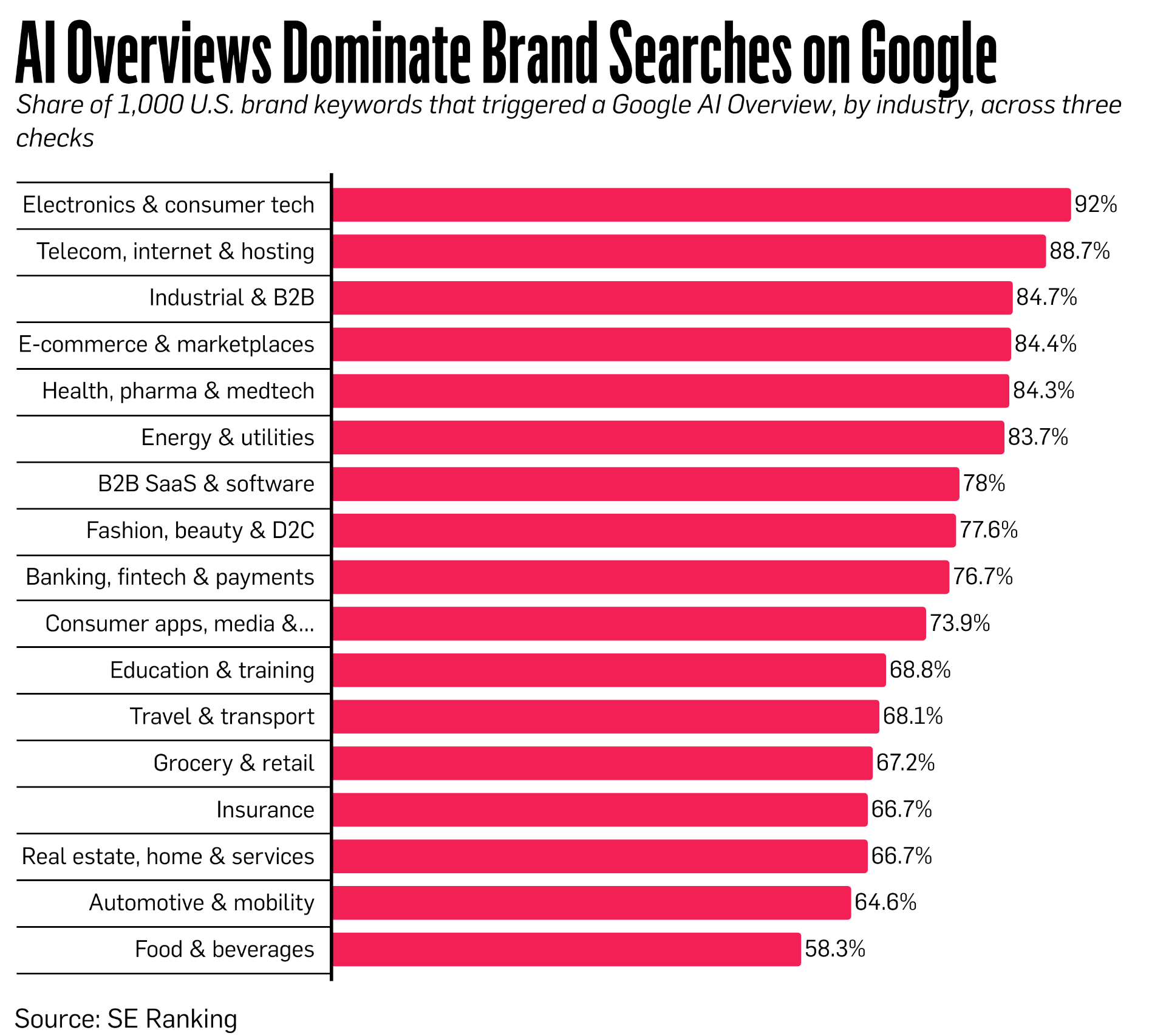
Today, more than 4 in 5 searches that include brand keywords trigger an AI Overview on Google, according to recent research from SE Ranking. But the rate varies across industries. While roughly 58% of searches about food and beverage brands produced an AI Overview, searches about electronics and consumer tech brands produced an AI Overview in 92% of searches. Interestingly, the research also found that the biggest brands are less likely to get an AI Overview. Brand keywords searched less than 50,000 times monthly in the U.S. consistently produced an AI Overview 85.2% of the time, versus just 63.3% of brand keywords with more than a million searches monthly. |
|
|
Great benchmarks. Where's the revenue? |
AI labs chase benchmarks. Your board chases revenue. WRITER delivers agents built for marketing and revenue teams — not technical work. Enterprises are seeing 333% ROI, payback under six months. The frontier of enterprise growth is here. See how. |
|
|
Across Big Tech, Investors Are Demanding Cash, Not Growth
|
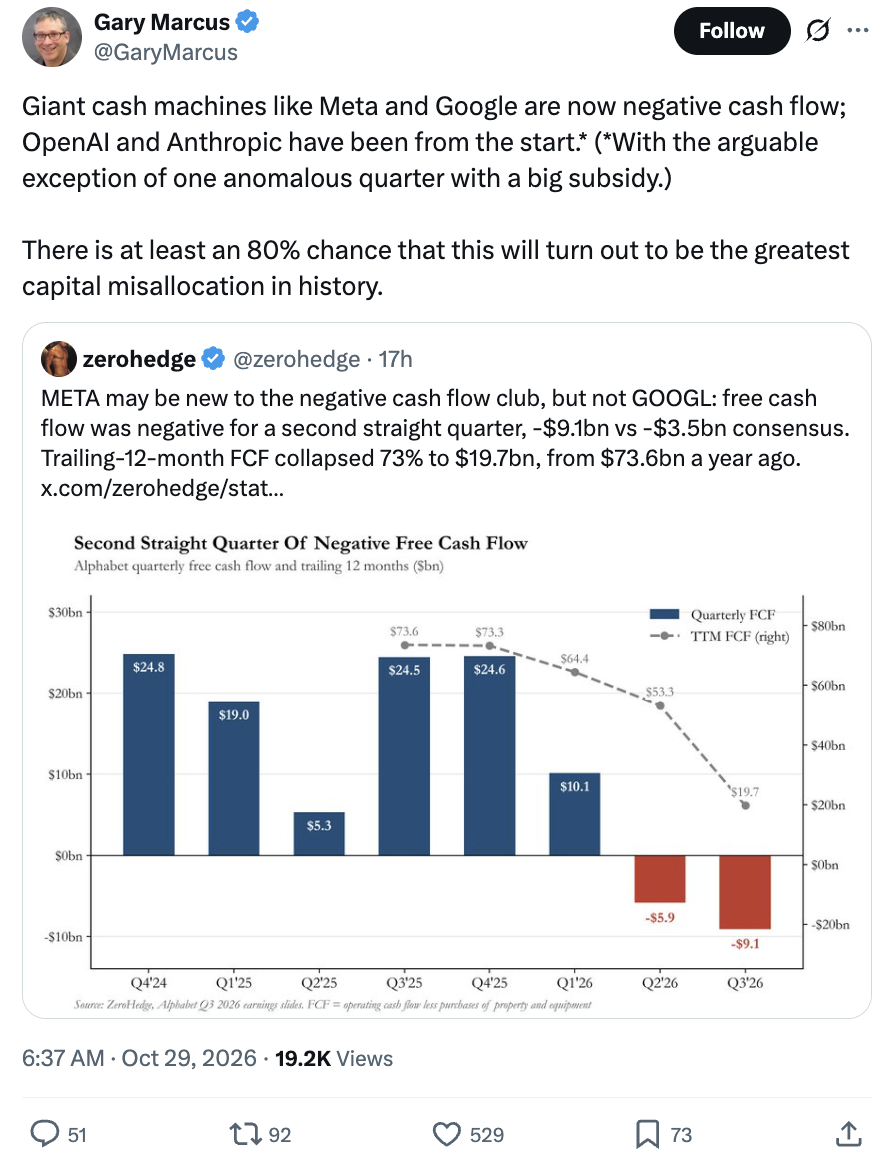
We’re squarely in the midst of Q3 earnings, and across the big tech stock financials trickling in, one clear narrative is emerging. For investors, cash is king. With capital expenditure guidance across all the major tech players reaching cartoonish proportions—spend they say is necessary to support AI development—Wall Street is asking questions. In Q2, that question was: How are you justifying that spend? And they still want to know. But a new, pressing question would appear to be: Can you pay for your AI investments with cash flow? Microsoft and Meta delivered results that beat expectations, while Alphabet missed Wall Street’s revenue and earnings forecasts. Only Microsoft’s stock popped. But the stories of the three stocks suggest that free cash flow could be a new litmus test for investors, perhaps more than capex figures. Microsoft, which reported earnings Wednesday, spent $45.2 billion during the quarter but still produced $18.6 billion in free cash flow, about $10 billion above Wall Street expectations. Shares spiked 4% in after-hours trading and were up about 3% in pre-market trading today. Google parent Alphabet, meanwhile, generated $42.3 billion in operating cash flow in Q3, but that was offset by $51.4 billion in capex as the company races to build out its AI operations, ultimately producing a negative free cash flow of $9.1 billion. It marks the company's second consecutive quarter of cash burn following a $5.9 billion deficit in the second quarter, which was the first negative free cash flow quarter in its history as a public company. The stock slid about 10% after the bell. "As the market shifts from simple AI capex to a more complex view of AI free cash flow, with a focus on profitability and adoption, [CEO Sundar] Pichai’s team clearly needs to find a way out of the back of the line,” said Thomas Monteiro, senior analyst at Investing.com.
Meta reported negative free cash flow for the quarter, too, the first time it’s done so since its 2012 IPO. It burned $2.1 billion in the quarter, leading to a sell-off that produced the stock’s worst day on the market in months.
If free cash flow continues to fall at the hyperscalers, Wall Street will only grow more skeptical of the sustainability of AI spend, senior BNY Wealth equity analyst Kevin Shea told Bloomberg this week ahead of Alphabet and Microsoft earnings. The ripple effect, he suggested, could extend to specialized cloud computing providers and related AI businesses. “The market is discounting megacap growth because the market is becoming less certain that this growth is sustainable,” he said. |
So are the big tech players whipping up innovative financing plans to pay for their AI buildouts? Yes, kind of. Alphabet, for its part, raised $28.7 billion in bonds during the quarter, cash that will help bankroll its AI buildout. It can also bet on incoming cloud revenues to buoy its financial picture; Google Cloud has secured $561 billion in commitments, and the company is leasing its AI chips to customers including Anthropic and Meta. Microsoft, meanwhile, plans to recategorize many of its future data center leases as “operating leases” rather than “finance leases,” the company’s CFO Amy Hood said in July. That means that a notable portion of data center spend will be wiped from the company’s capex line, potentially making the tech giant’s expenditures appear, on the surface, more restrained than they actually are. But Microsoft, like Alphabet, also has the silver lining of a booming cloud business, and revenues from that division could also support its AI expenditures. Meta can’t say the same. Its core revenue engine is still ads. The social giant reported that its ad pricing is up by 14% thanks to macro conditions and “ad performance gains”, but without a major cloud operation, the company is still trying to grow into an AI powerhouse without a key advantage enjoyed by its competitors. So this week, the company unveiled a bold new financing plan. Meta is looking to raise as much as $97.5 billion, starting with $37.5 billion in stock sales priced Monday. It could bring in another $60 billion from selling shares of a new non-voting class of stock, which the company plans to start trading early next year.
In the third quarter, both Microsoft and Alphabet actually spent less than analysts expected, and neither raised its outlook. Microsoft trimmed its 2026 capex forecast to roughly $170 billion from about $175 billion, blaming delayed deliveries from third-party GPU capacity providers. Alphabet held its range at $195 billion to $205 billion. Meta, however, raised its lower limit, and now expects to spend between $135 billion and $145 billion this year.
None of the big tech players has put a number on 2027 capex yet, though Alphabet said it expects spending to increase significantly, and Meta’s finance chief Susan Li said the company will “continue investing aggressively to support both our core business and emerging AI initiatives.” Amazon will report its earnings after the bell today, and Apple is slated for Monday. Those results will help fill out the picture, underscoring what investors will actually pay for as they stare down the barrel of big tech’s unwavering AI convictions. |
|
|
AI, Tech & Money covers the intersection of artificial intelligence, emerging technology, and the business forces shaping them — from groundbreaking research and infrastructure shifts to the investors, startups, and strategies driving the next wave of innovation. Each issue breaks down how new AI developments translate into real economic impact, market opportunities, and competitive advantage across industries. | |
|
|
|