We’re introducing Reasoning for TTS-2, so your app can create expressive speech from text and context without manually tagging every line. MiMo 2.6 Pro and Flash, two models you’ve been asking for, are now available on Inworld, and they are fast! We’ve also added video generation through six models, new image and video playgrounds, and more options for classification, routing, and policy checks. On the voice side, this month’s updates help your app recognize languages more accurately, respond to interruptions, and deliver speech that fits the scene.
tl;dr
The first speech model with reasoning: expressive delivery without manual tags
Fast MiMo 2.6 Pro and Flash with multimodal inputs (text, image and audio); GPT 6.1 Terra and Kimi K3.1 Pro
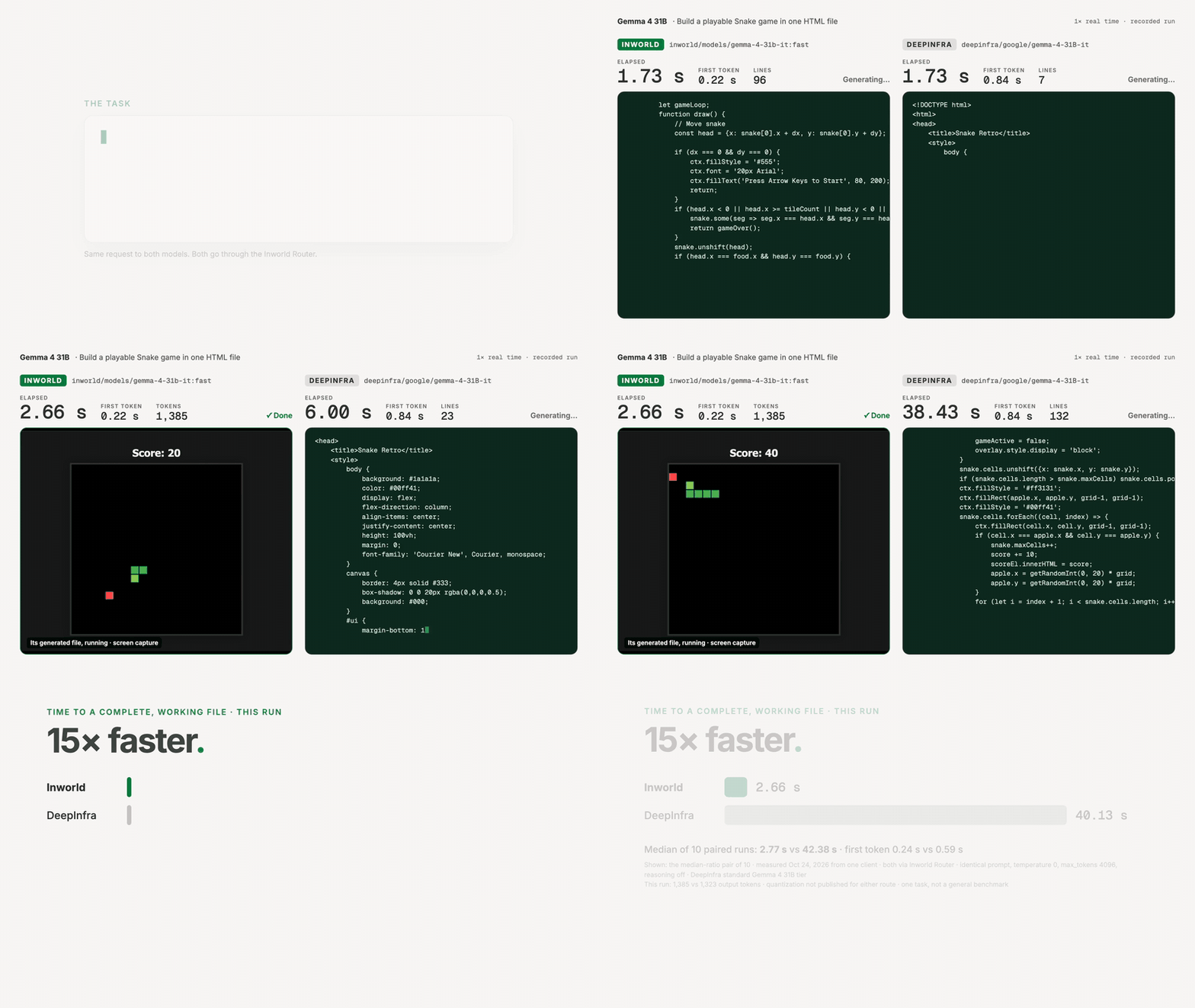
Gemma 4 31B Fast Mode, available on request
Six video generation models through the API and Portal
More decision models for classification, routing, and policy checks
New image and video creation playgrounds
Better language detection and interruption handling for TTS
STT on Europe and Hong Kong endpoints
Copy custom voices between workspaces through the API
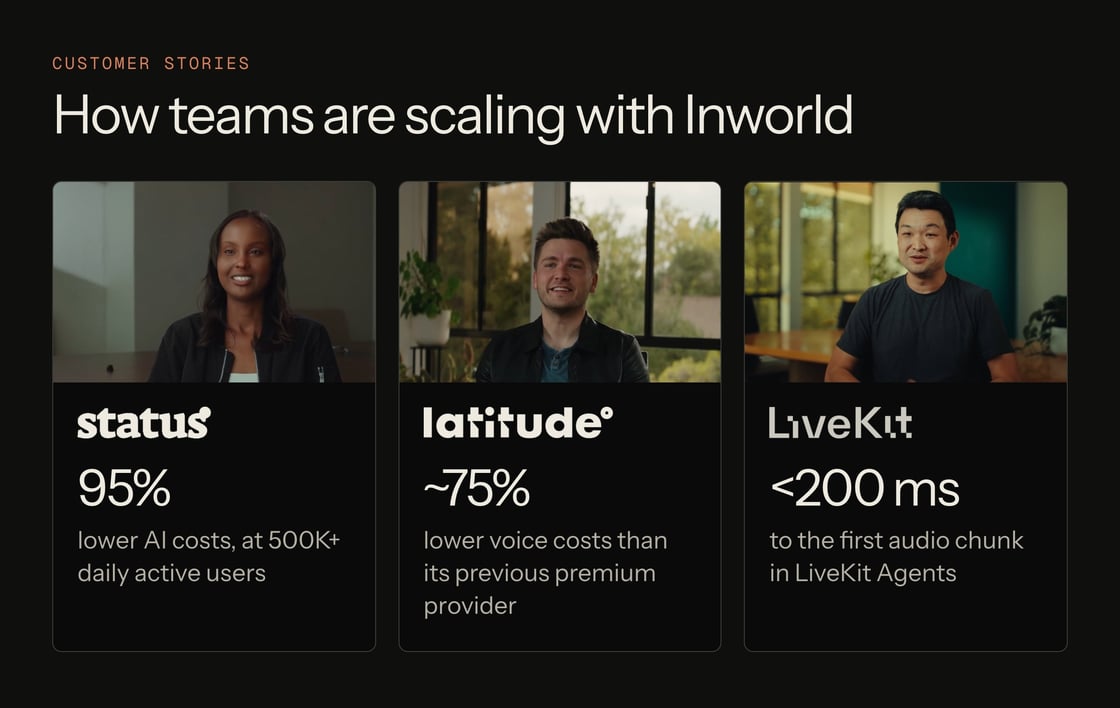
Customer stories: how Status, Latitude, and LiveKit build with Inworld
Inworld Inference & Router
MiMo 2.6 Pro and Flash are here
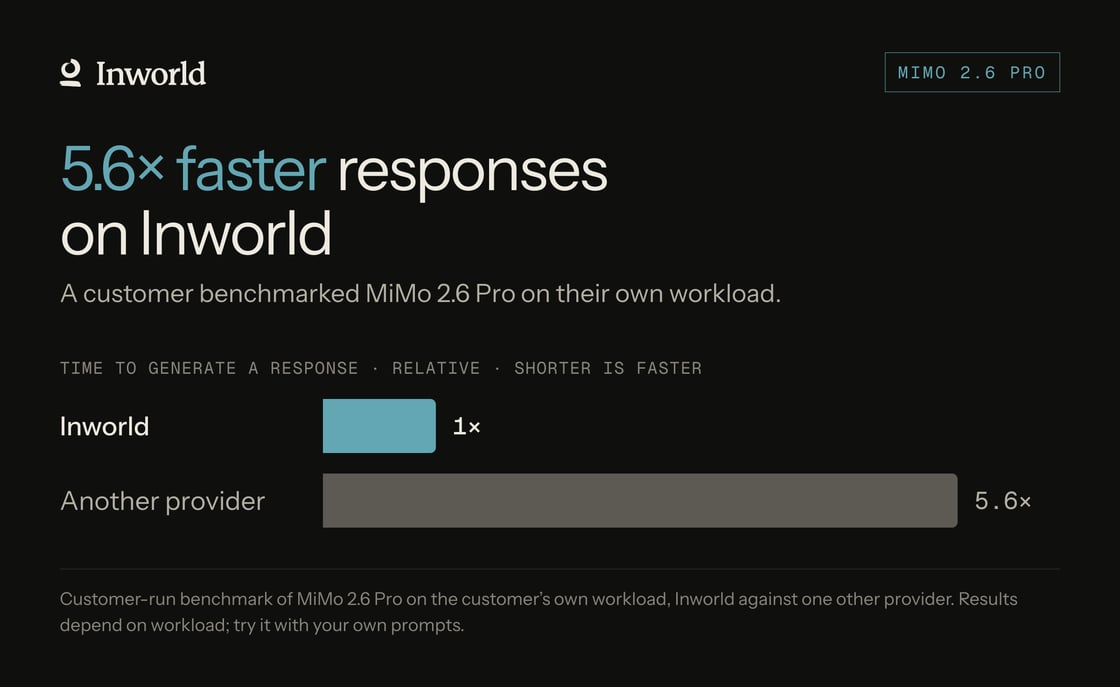
You asked for MiMo. Both MiMo 2.6 Pro and MiMo 2.6 Flash are now available on Inworld and accept text, images, and audio. In a customer-run benchmark on their own workload, our MiMo 2.6 Pro generated responses about 5.6× faster on Inworld than on another provider. Give them a try with your own prompts!
Also new this month: GPT 6.1 Terra and Kimi K3.1 Pro join DeepSeek v4.1 Flash 1017. GPT 6.1 Terra supports text, images, and files with a 1.05M-token context; Kimi K3.1 Pro supports text and images with a 1M-token context. DeepSeek v4.1 Flash and Flash 1017 now support a 512K-token context window.
Classify a request, choose a workflow, or check it against a policy. Our expanded decision-model lineup gives you more options for these steps: Clef, Clef Flash, Jev 1.14, D1 Ultra, GPT 6 Luna Decisions, PPLX Decider v1.2, and PPLX Decider Flash v1.2.
Send PDFs, Word documents, PowerPoint presentations, and Excel workbooks in Chat Completions and Responses, inline or through the Files API. PDFs also work with models without native PDF support: Inworld extracts text and can add selected page images for vision models. Office documents are read as text.
Image & Video
Generate video through Inworld
You can now generate video through the API and Portal with six models: Wan 3.0, MiniMax H3, H3 Fast, H3 Turbo, Grok Imagine Video 1.5 Lite, and HeyGen Video 1.
Try them in the Portal, then use the API to bring video generation into your app.
Test your next visual experience with Nano Banana 2.1, GPT Image 2.5 Flare, and GPT Image 2.5 Sunburst in the image playground. Generate images, guide videos with frames and media references, and upload files to reuse across supported workflows.
It’s easier to experiment with your own assets before building the workflow into your app. The Files API now supports chunked uploads of audio up to 1 GiB and video up to 4 GiB, so you can upload larger media once and reuse file IDs in supported workflows. Single-request uploads remain capped at 100 MiB. The video playground’s Enhance button can also turn a short idea into a fuller scenario with characters, scenes, and dialogue.
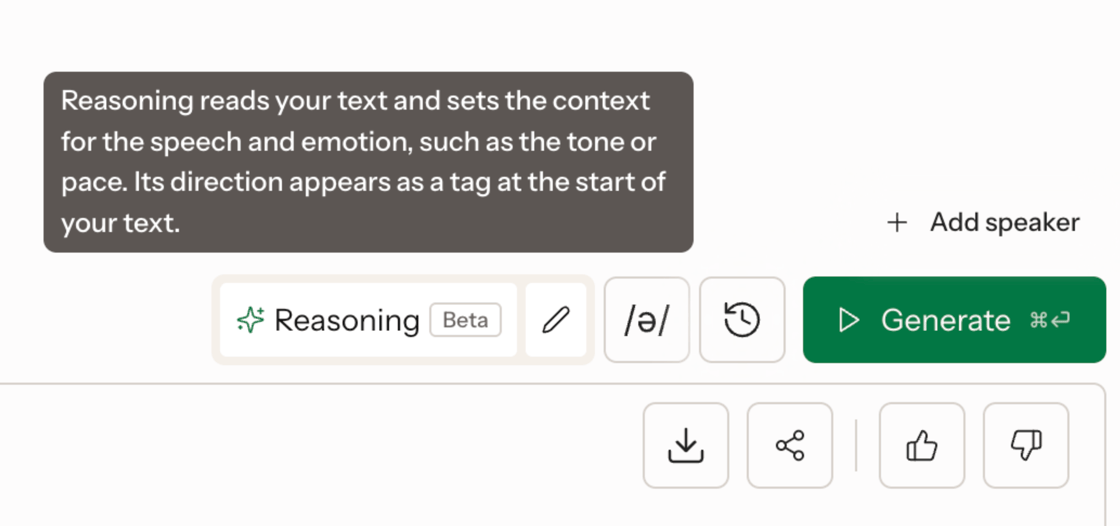
Reasoning reads your text and optional scene or character context, then writes delivery directions for TTS-2 to perform. You get speech that fits the moment without writing emotion tags for every line.
Scene notes are never spoken, and you can inspect the generated direction in the API response. Try it in the TTS Playground or enable it for HTTP synthesis with TTS-2.
Short phrases can be hard to identify, especially when the same words appear in multiple languages. You can now specify the languages your application expects, helping TTS detect the right language more accurately.
That gives multilingual apps more reliable speech, even when there isn’t much text to go on.
TTS WebSocket sessions can now cancel an active context immediately when a user interrupts. Your app can stop unnecessary synthesis and move on to the next turn, helping realtime voice agents feel more responsive.
Inworld Speech-to-Text is now available in EU and Hong Kong regions. Teams have more flexibility to run speech recognition closer to their users and choose a region that fits their deployment.
Copy custom voices between workspaces through the API
You can now copy custom voices between workspaces through the API using secure copy tokens. Reuse a voice across projects, environments, and customer deployments without recreating it in each workspace.
From AI worlds to realtime voice agents, see how developers are building responsive experiences with economics that work at scale.
Status: 500K+ daily active users, 95% lower AI costs
Wishroll worked with Inworld to scale its AI social simulation game to more than 500,000 daily active users while reducing AI costs by approximately 95%.
Latitude runs Voyage’s narrators and dynamic NPC voices on Inworld at roughly a quarter of the cost of its previous premium provider. It also uses Inworld for story generation and game engine tasks, bringing voice and inference together with one partner.
LiveKit: Expressive voices for realtime experiences
Developers can access Inworld TTS through LiveKit’s Agents framework to build games, simulations, and voice agents—with latency under 200 ms to the first audio chunk.