|
|
|

|
Oct 19, 2026
|
|
|
|
|
Supported by
|

|
|
|
|
|
Welcome back! Microsoft pulls out of a planned U.K. data center Nscale was building for it. Anthropic commits at least 5% of its shares to a fund that will support public-benefit causes. China is considering new export controls on AI technologies.
|
|
|
Microsoft has pulled out of a planned U.K. data center Nscale was building for it, an Nscale spokesperson said, after the cloud provider faced delays accessing power to bring the site online. The cancellation is likely to weigh on Nscale’s planned public offering this month as investor concerns swirl over whether AI cloud providers can bring in revenue fast enough to pay their debts. Firmus Grid, an Australian competitor to Nscale, abruptly pulled its planned IPO earlier this month, and shares in AI cloud provider CoreWeave fell more than 23% last week. Microsoft, one of Nscale’s two largest customers, had announced last fall that it planned to spend $15 billion in capital expenditures on new data center capacity in the U.K. by 2028, including on a new campus built by Nscale. But power suppliers recently informed Nscale that the site may not be able to access power until 2030, according to someone familiar with the situation. Nscale disclosed last month that Microsoft had committed to spend roughly $44 billion with it by 2033, including at facilities in the U.K., Texas, Portugal, and Norway. But Nscale said at the time that its contracts allowed customers to walk away from commitments if they faced construction delays. The Telegraph first reported on Microsoft pulling out of the U.K. site. “We remain committed to both the Loughton project and the UK and we are exploring alternative power sources for the site, in addition to other expansion sites in the UK,” an Nscale spokesperson said in a statement. “Our relationship with Microsoft remains strong and long-term, and this unfortunate London-wide grid issue has no impact on our other contracts.” Microsoft declined to comment.
|
|
|
Anthropic announced the creation of a new fund that will get at least 5% of its shares and support public-benefit causes such as addressing the employment impact of AI. The Anthropic Public Benefit Fund could get an additional 2% of the company’s shares on top of the initial 5% commitment, at the discretion of the company’s board, for every 50% increase in the company’s value above a baseline, Anthropic said in a blog post Sunday. The post added that the allocation plan is subject to stockholder approval, and said Anthropic would disclose further details about the fund in the coming months. The fund adds to the unusual elements of Anthropic’s structure as it plans an initial public offering that is expected to be one of the biggest ever. It is a public benefit corporation, meaning it can pursue societal goals as well as shareholders’ financial interests, and a majority of its board is appointed by its Long-Term Benefit Trust, a group of non-shareholders who advise the company on safety and social issues. Anthropic also has an unusually generous matching program for employee charitable donations. And, ahead of its IPO, Anthropic developed a plan to grant its seven co-founders, including CEO Dario Amodei, a combined 50.1% of voting power even if they reduce some of their stakes, The Information has reported. Sunday’s post said that about half of Anthropic’s employees participate in the matching program and that, including the initial stake for the new fund, roughly 20% of the company’s shares “will be dedicated to the public good.” Anthropic was valued at $965 billion in May. Anthropic said none of the new fund’s Anthropic equity will be used for lobbying or political giving.
|
|
|
China is considering new export controls on AI technologies that could potentially restrict the overseas transfers of AI models and chip designs deemed strategically important. The Ministry of Commerce on Friday issued a draft plan to add 40 technologies across AI, biomedicine and photovoltaic sectors to China’s list of restricted technologies. The proposed curbs cover 23 AI-related technologies such as large language models, AI agents, chip design and computing clusters. Technologies already available through published research papers or open-source releases wouldn’t be subject to the restrictions. For the largest models or models that rank among the world’s top 10 on leaderboards, companies would need approval to send the model, its code or its underlying design overseas, according to the ministry. This year, Chinese models such as Moonshot AI’s Kimi K3 and Z.ai’s GLM-5.3 have gained massive popularity around the world by offering capabilities that come close to those of American frontier models at much lower prices. A ministry spokesperson told reporters that the new restrictions were aimed at ensuring that AI remains safe and controllable, citing the risk of misuse of the technology. “If obtained by non-state actors or malicious entities, they could pose a threat to national security and the security of humanity,” the spokesperson said. Public opinion is being sought on the proposal until November 15. Pending the formal implementation of new rules, companies must register for the export of technologies covered under the draft proposal. The registration requirement, effective Friday, covers transfers of technology ownership, overseas licensing and transfers of ownership to foreign entities. It also applies to export transactions that began but have yet to be completed.
|
|
|
DeepSeek’s latest update to its affordable lightweight model, V4.1-Flash, is making a big splash in the industry because of significant improvements from the previous version that bring it closer to frontier models. The upgraded version released on Saturday, V4.1-Flash-1017, is delivering highly competitive performance despite the model’s relatively small size and very low pricing. It scored higher than OpenAI’s GPT5.6 Sol on Terminal-Bench 4.0, a benchmark for evaluating a model’s ability to perform complex multi-step tasks. The original V4.1-Flash model, released last month, has gained massive popularity among developers around the world seeking models that can power autonomous agents without breaking the bank. The update is likely to further boost the demand for the model. DeepSeek only charges $1.20 for output per 1 million tokens at peak hours and $0.60 at non-peak hours for the application programming interface of V4.1-Flash—a tiny fraction compared to $20 for GPT5.6 Sol.
|
|
|
Nvidia has asked the suppliers of its next-generation custom high-bandwidth memory chip to use Taiwan Semiconductor Manufacturing Co’s 3-nanometer manufacturing process, the Seoul Economic Daily reported. Nvidia asked Samsung Electronics, SK Hynix and Micron to standardize the manufacturing process by using TSMC’s 3-nanometer technology to produce base dies, core components of the chips. The request is aimed at ensuring consistent performance while simplifying product validation across suppliers, the newspaper reported, citing industry sources. Nvidia has also asked that the suppliers use sixth-generation DRAM technology for its core dies. Samsung has agreed to the technical requirement for NVHBM, the custom Nvidia memory unveiled in August. It marks the first time Samsung has worked with TSMC at the high-bandwidth memory manufacturing stage. The move deepens the cooperation between Samsung and TSMC, two chipmaking giants fiercely vying for the same business.
|
|
|
|
This week on AI Deep Dive
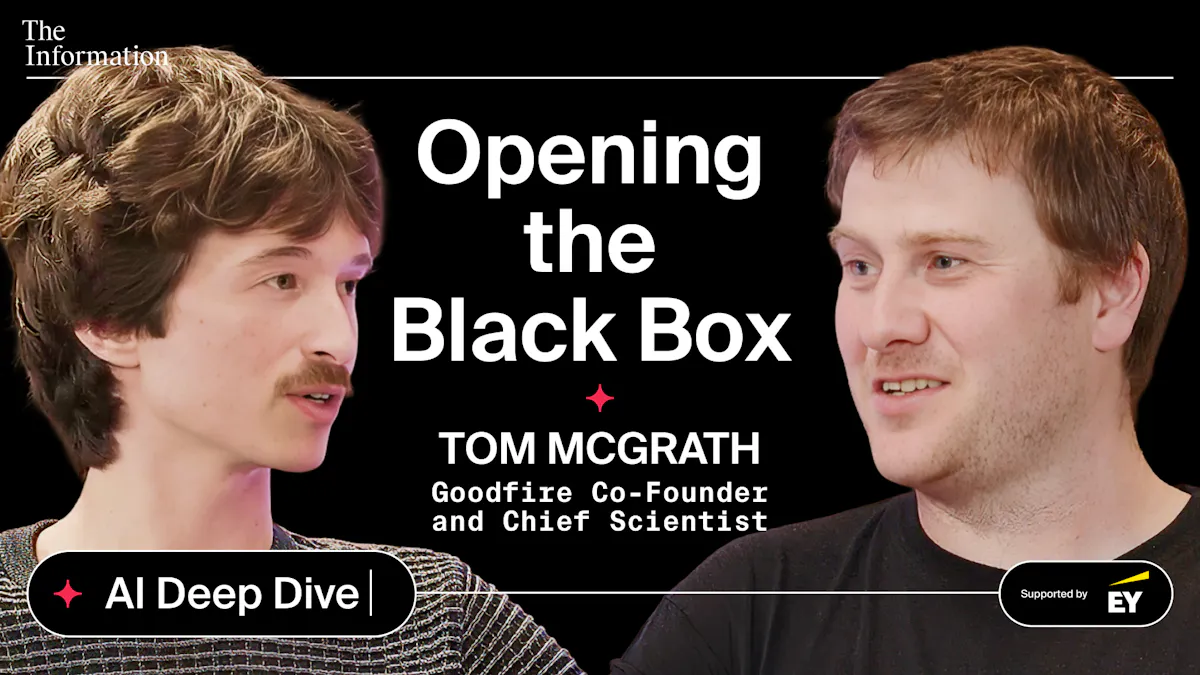
Check out the most recent episode of AI Deep Dive. A reported deep dive into how frontier AI actually gets built — the models, the money, and the people behind them.
| |
Popular articles
By Valida Pau and Amir Efrati
|
|
|
|
Opportunities
Empower your teams to stay ahead of market trends with the most trusted tech journalism.
Learn more
Reach The Information's influential audience with your message.
Connect with our team
|
|
|
|
|