I’m Johanna. I’m taking The Context Window over from Sumeru, who built it into something worth your inbox.
I'm the Head of Marketing at CrewAI with over 15 years in sales & marketing: Kustomer, Contentful, GoodData, and a first act in finance at Merrill Lynch and JPMorgan.
What you’ll get from me: carrying the baton on from Sumeru, filtered through someone who spends most of her week talking to the people actually building agents in production. I’m happiest when a builder is the expert in the room and I’m the one asking questions.
It was fun, but this week, I want to do the opposite.
Let's look at three agents, built by real teams on CrewAI, that might open your mind around what could be done through AI agents. They come from an oil field, a beverage maker and a pharma services company. These are places where a wrong answer costs real money.
They share one trait. In each, plain code does most of the work. The agent gets one narrow job, and a line it can’t cross.
That’s how you get to an agent you can trust. On CrewAI, it looks like deterministic Flows for the steps that must always go the same way, and agents only where judgment is needed.
Let’s explore:
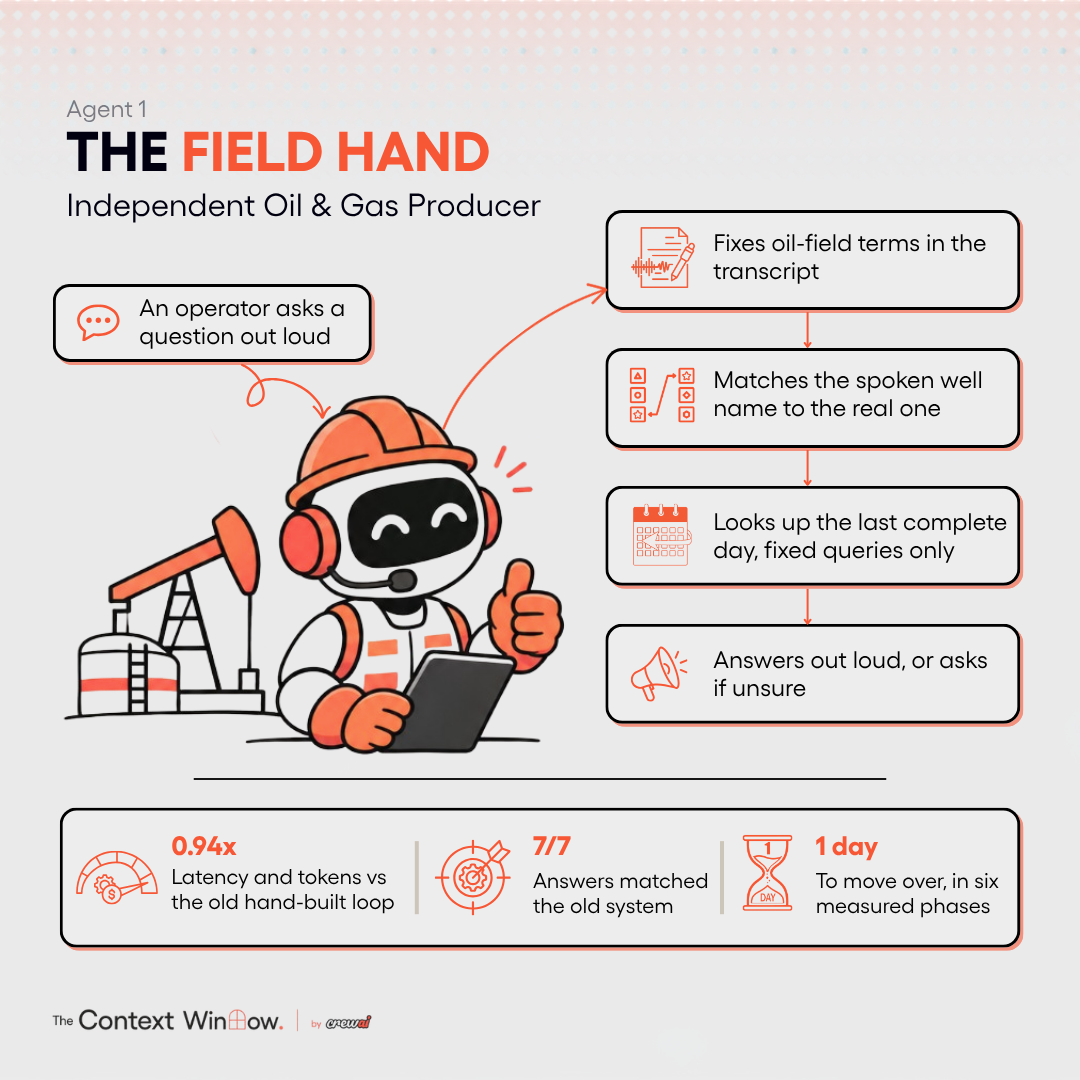
Agent One: The Field Hand
An independent oil and gas producer, onshore North America.
Lease operators work outdoors, in heavy gloves. They can't use a keyboard. But all day they need well data: test results, how full the tanks are, and whether any alarms are going off.
So the interface has to be spoken.
The company had already built a prototype that listens, looks things up and talks back. About 4,700 lines of custom code.
The question wasn't whether an agent could do this. It was whether a governed runtime on CrewAI could match what they already had.
An operator asks a question out loud.
A small correction map fixes the oil-field terms that speech models mangle, like MCF and BOPD (gas and oil volume units). One agent with three tools then queries a data warehouse. The agent can only ask the database pre-approved questions. It never writes its own.
Spoken well names never match the database exactly. So the system resolves each one to the real name before any query runs. If it's ambiguous, the agent asks.
One rule worth stealing: "latest" means the last complete day. The agent skips today's partial numbers, and if it has to fall back, it flags that the value may be incomplete.
It also does something the old system couldn't: a half-filled form now survives a restart. It now answers in about 5 seconds, on par with the system they built themselves.
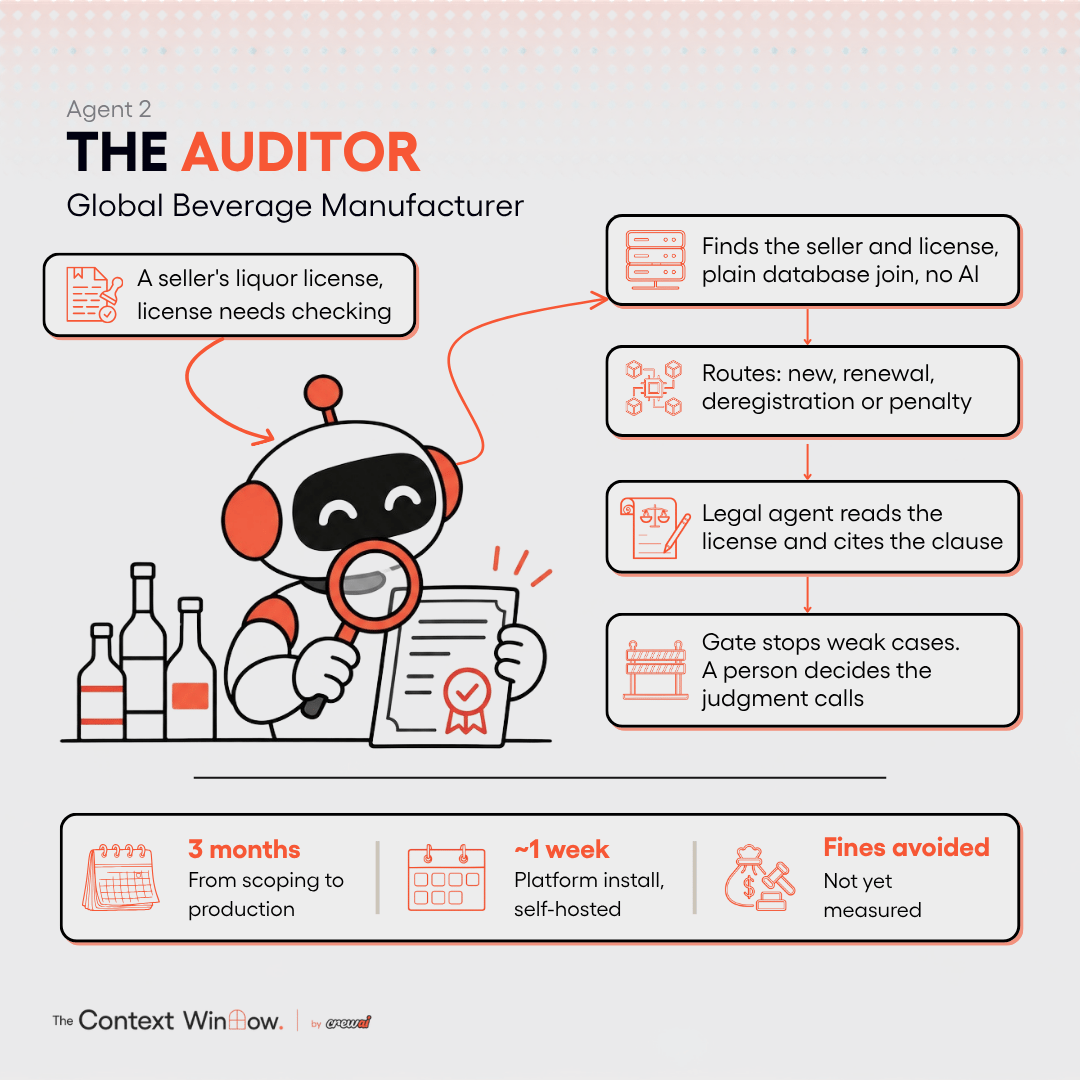
Agent Two: The Auditor
A global beverage manufacturer.
Every third-party seller that distributes this company's drinks needs a valid liquor license. If one lapses, the manufacturer is the one on the hook.
The checking was manual, across thousands of sellers. Some licenses expired and triggered fines. Others were renewed far too early, which wasted money. Some sellers were simply left out of the review.
The agent handles four situations: a new license, a renewal, a deregistration, or a penalty.
Plain database joins find the seller and its license, no model involved. A router then sends each case down one of four paths, and the path comes from the record, not from a guess. Next, a legal agent reads the license documents and the local rules and returns a position: compliant, deficient or unclear, citing the clause it relied on.
Then comes the gate. It’s a rule. If required fields are missing or the legal agent's confidence is low, the case can't move forward, whatever the agent concluded.
Clean, in-policy cases go through without a person. Anything that needs judgment goes to the accountable owner with the evidence attached. Fees and penalties are calculated and submitted by a tool, not the agent. Every decision lands in an audit trail, with a clock on each path.
The line is simple. The agent reads and writes. It doesn't decide whether a case is compliant enough to proceed, and it doesn't touch finance. The same company runs other agents in production too. One handles refund adjudication, which went from 3 days to 10 minutes.
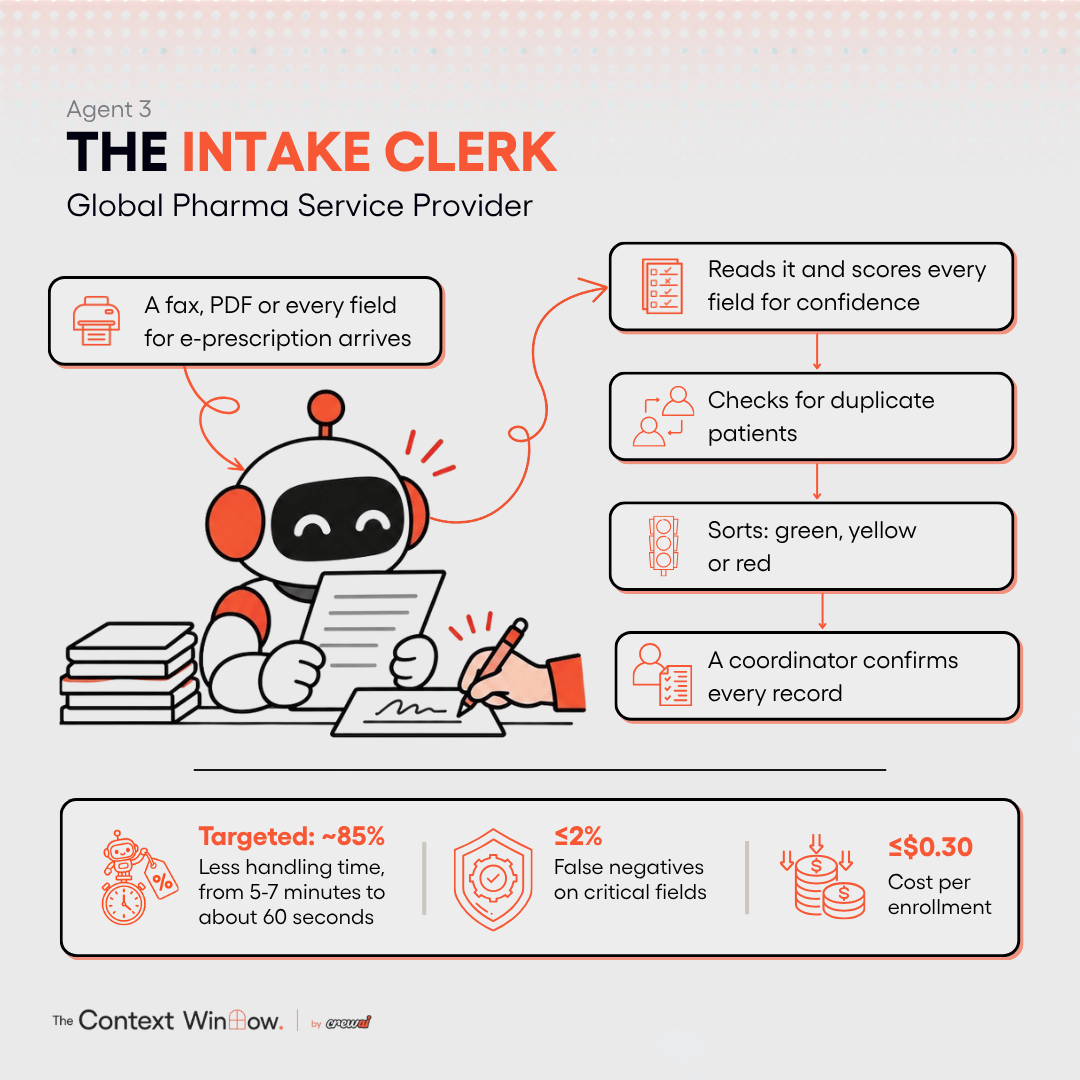
Agent Three: The Intake Clerk
A global pharma services provider, patient services.
This one is still being built.
Patients enroll in treatment programs by fax, PDF and e-prescription. Documents arrive bundled, with cover pages and several forms in one transmission.
A coordinator types about 50 fields per enrollment by hand. That’s roughly 5,000 enrollments a month, at five to seven minutes each.
Two rules shaped the whole design:
Privacy law applies throughout, because this is patient health data.
No agent may create a patient record on its own.
Here’s the plan. An agent reads each document and scores every field for confidence, not just the document as a whole. A check against the existing system catches duplicates, so a re-faxed form never becomes a second patient.
Then a router sorts each case. The split below is what they expect, not what they’ve measured.
Green, expected at about 73%, goes to a coordinator for roughly 60 seconds of review.
Yellow, expected at about 17%, triggers an outreach agent that texts the patient or faxes the prescriber to close the gap, but only after consent is verified. That check is a gate, not a warning.
Red, expected at about 10%, goes to full manual processing.
Every record, green included, is confirmed by a coordinator. There is no path to a patient record without a person.
We saw three agents in three different industries. And all had one pattern: the team decided what the agent could never do before deciding what it could.
So before your next agent review, ask: “If this agent is wrong tomorrow, which line stops it from mattering?”
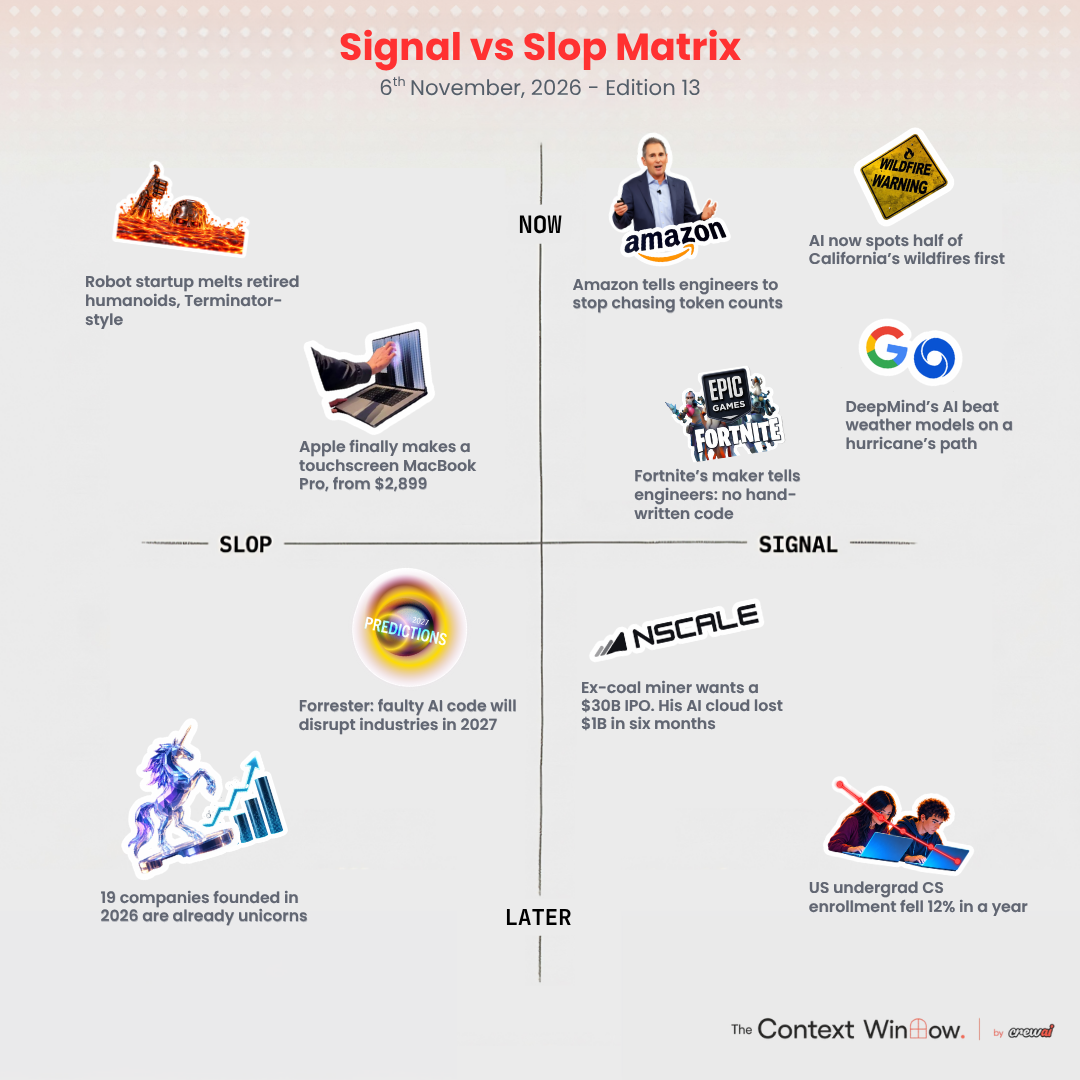
Twice a month, we plot what happened in AI on two axes.
Slop ↔ Signal: was there actual substance, or was it noise? Now ↔ Later: is this something you should act on this quarter, or a signal about where things are headed in 1-3 years?
2. Google DeepMind’s AI beat traditional models on Hurricane Isaias’s path When Isaias hit near Destin, Florida, as a Category 2 storm in early October, conventional models first sent it further west toward southeastern Louisiana. DeepMind’s model beat the physics-based models on the track, though it was weaker on the storm’s strength. The National Hurricane Center now uses these models alongside traditional ones.
3. Fortnite’s maker told its engineers to stop hand-writing code After Bloomberg reported a “no more hand-written code” push at Epic Games, CEO Tim Sweeney confirmed a “huge pivot” to AI-accelerated development and said the aim is more output, not fewer people.
4. AI now spots about half of California’s wildfires first Alert California, a camera network run out of UC San Diego, has nearly 1,300 cameras scanned by AI for smoke, with a goal of 1,800. Program director Neal Driscoll says about 51% of the state’s wildfires are now first spotted by the AI, and it regularly flags fires before the first 911 call arrives.
Figure trained its retired F.02 robots to jump into a 75-ton furnace at a Finnish foundry on Oct. 1, after Arnold Schwarzenegger replied to CEO Brett Adcock’s call for ideas with “You should melt them.”
8. US undergrad computer science enrollment fell 12% in a year The National Student Clearinghouse’s preliminary fall 2026 data shows computer and information science enrollment down 12.4% at four-year schools and 10.4% at the graduate level.
The firm’s 2027 predictions also say AI will account for 20% of all business technology spending, out of a projected $6.1 trillion in global tech spend. Both are annual forecasts rather than findings, so treat them as something to watch, not evidence.
Nineteen companies founded this year have already hit $1B valuations, worth $60.5B combined, according to CB Insights. The median AI company that reached $1B this year took 3.4 years, while these did it in months.
One more thing: where would you draw the line?
All three agents in this issue keep a person on the calls that matter. Deciding which work to hand to agents, and which to keep, is the hard part.
On Monday, Nov 9 at 1 pm ET, Joao Moura (CrewAI founder and CEO) and Arindam Choudhury (EVP & Global Head, Financial Services, Insights & Data at Capgemini) will take one approved loan from “yes” to “funded,” live. Then they’ll get into the real questions: what work you’d hand to agents, what it takes to trust them, and when the honest answer is no.
60 minutes. Bring the deal that’s stuck on your desk this week.