|
|
|

|
Oct 28, 2026
|
|
|
|
|
Supported by
|

|
|
|
|
|
Happy Wednesday! OpenAI and Anthropic claim their models achieved cryptography breakthroughs on the same day. Google will sell its AI chips to OpenAI and Oracle. Meta increases the size of its equity fundraising plan to $97.5 billion.
|
|
|
OpenAI’s models have disproved a foundational theory within cryptography, the AI company claimed on Monday. OpenAI also announced two other breakthroughs in physics and mathematics. The findings come after OpenAI released over 700 math papers earlier this month, with its AI models finding novel results in a wide range of math fields. Notably, those papers did not include any breakthroughs in cryptography, sparking speculation among experts that OpenAI could have solved cryptography problems it wasn’t sharing publicly. OpenAI claims its models found on October 16 that the exponential time hypothesis, a widely held assumption for how difficult a particular class of problems is to solve, was false by finding an algorithm faster than the assumed minimum difficulty. The result is not expected to have an immediate impact on encryption systems, but it went against what many theoretical computer scientists previously believed was possible. Shortly after OpenAI announced its results, Anthropic researcher Levent Alpöge claimed that Anthropic models had also disproved the exponential time hypothesis on October 16, the same day OpenAI came up with its result. Anthropic put 14 million tokens towards finding the result, Alpöge wrote. He was previously involved in a data-sharing dispute between OpenAI over OpenAI’s solution for a prize math problem, the Navier-Stokes problem, which Alpöge had been working on.
|
|
|
Google will sell its tensor processing units to Oracle and OpenAI, challenging Nvidia’s hold on the AI chip market. OpenAI is planning to buy Google’s TPUs, The Information reported. Google on Tuesday also said it would partner with Oracle to make Google’s TPUs available to Oracle cloud customers, the first time the AI chips would be made available on a hyperscale cloud platform outside of Google’s. Oracle said in a statement Tuesday the TPUs will be available by 2027. Built more than a decade ago, Google’s TPUs have become a significant rival for AI compute to Nvidia’s more commonly used graphics processing units. Google, which says its TPUs are more efficient than Nvidia GPUs, began this year selling its chips to third parties, like neocloud providers. Bringing TPUs to Oracle’s cloud “will give more organizations access to this technology and greater flexibility in how they build and run their most complex AI applications,” Amin Vahdat, senior vice president and chief technologist of AI infrastructure at Google, said in a press release. Google, which competes with Oracle in the cloud business, has shown increasingly willingness to work with competitors in one part of its business to advance its interest in other areas, such as TPUs. Last week Google agreed to make OpenAI’s models, which compete with its own Gemini models, available to Google cloud customers.
|
|
|
Meta Platforms is slightly increasing the size of its planned stock sales to fund AI investments to a total of $97.5 billion from $95 billion, the company said. The company is increasing the common stock offering in its fundraising plan to $25 billion from $22.5 billion, Meta said in an announcement Tuesday about pricing the stock sales. Under the plan, originally announced Monday, Meta also intends to sell about $12.5 billion in series A depositary shares and up to $60 billion through an at-the-market sales program. Tuesday’s release said Meta is giving underwriters of the common stock and depositary share sales options to buy additional shares totalling about $5.5 billion, meaning the total amount Meta sells could reach about $103 billion.
|
|
|
Anthropic said it acquired Mithril Medicine, a one-person startup developing treatments for two rare forms of muscular dystrophy, a sign of the AI developer’s growing ambitions in drug discovery. The company also said it is working with Bristol Myers Squibb, BigHat Biosciences and four other partners to use Claude for tasks ranging from antibody design to clinical trial planning. Mithril founder Cody Tranbarger, who has joined Anthropic, used the company’s Claude models to coordinate work with 11 outside labs, Anthropic said in a blog post. A drug based on his research could be ready for human clinical trials as soon as late 2028, the company said. Anthropic didn’t disclose the Mithril deal’s terms. In a filing Monday for an initial public offering, Anthropic identified AI’s potential to discover new disease cures as the first among several applications with the greatest potential benefit to humanity. “AI enables entirely new ways of doing scientific research and drug development, and we hope to play a leading role in developing tools to benefit the broader scientific community,” the IPO filing said.
|
|
|
Malaysian customs seized about 49.5 million ringgit ($12.11 million) worth of advanced AI chips this month while investigating a syndicate suspected of routing the chips through the country’s main airport, Reuters reported. Malaysia tightened export controls last year on advanced chips originating from the U.S., following pressure from the Trump administration to curb China’s access to semiconductors critical to AI development. Authorities found 30 server units containing advanced AI chips during an inspection at Kuala Lumpur International Airport’s free trade zone. The shipment originated from an Asian country and was bound for re-export to another Asian country, which required a trade permit, the airport’s customs director Aspalila Ag Tuah told reporters, according to Reuters. The servers were falsely declared as electronic components and shipped through Malaysia to bypass restrictions, Aspalila said, without disclosing further details on the chips and the country it was destined for. At least five cases have been linked to the smuggling syndicate, involving seizures of chips worth more than 100 million ringgit.
|
|
|
Areas of weakness are emerging within the broader AI market as the cost of capital is set to continue rising, Kim Posnett, Goldman Sachs’ global co-head of investment banking, said at The Information’s WTF Summit on Tuesday. Posnett noted that while she’s “hugely bullish” on AI overall, investors are growing more discerning. “What you’re seeing is not a change in AI sentiment, and from an investor standpoint, I think you’re seeing a repositioning and differentiation across the AI trade,” Posnett said, adding that AI projects won’t drive expected returns should rates stay elevated for a long period. “While AI itself is not a bubble, I think you can have bubbles within that,” she said. Investors are starting to favor vertically integrated companies that produce frontier models, software and AI chips, Posnett added. Goldman is playing leading roles in major deals announced this week for some of the biggest AI companies, including SpaceX’s GPU financing, Meta’s stock offering and Anthropic’s planned initial public offering. Asked about circular financing across the AI ecosystem, Posnett said she’s thinking “more about demand” but acknowledged the risk in tech giants like Nvidia funding their own suppliers and customers. “It makes sense that they want to build closer partnerships with each other,” she said. “And I think it creates greater risk. I think both are true.”
|
|
|
|
This week on AI Deep Dive
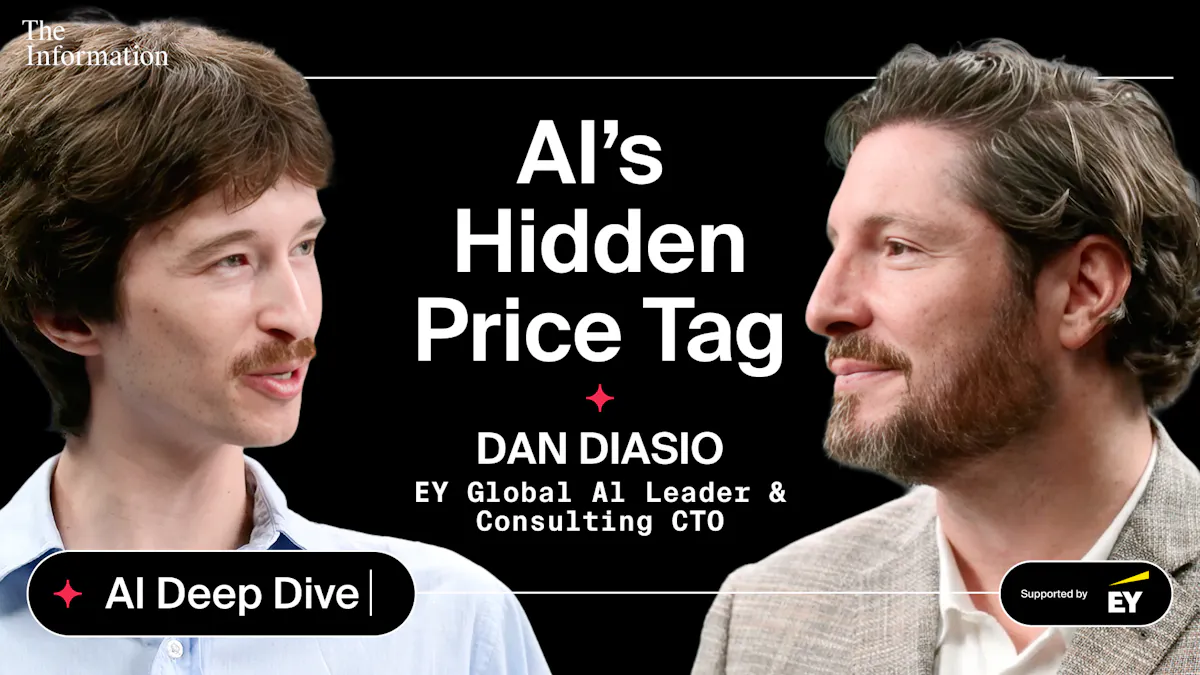
Check out the most recent episode of AI Deep Dive. A reported deep dive into how frontier AI actually gets built — the models, the money, and the people behind them.
| |
Popular articles
By Laura Bratton and Stephanie Palazzolo
By Aaron Holmes and Cory Weinberg
By Valida Pau, Jessica E. Lessin and Cory Weinberg
|
|
|
|
Opportunities
Empower your teams to stay ahead of market trends with the most trusted tech journalism.
Learn more
Reach The Information's influential audience with your message.
Connect with our team
|
|
|
|
|