Everyone has a take or two on how quickly the consumer experience is going to change in a world of agentic commerce. I don’t want to spend much time talking about the timing of it, but I do have a number of takes on how brands will need to adapt in that world.
To ground it, it’s worth revisiting something we’ve talked about before: Somewhere in the agentic commerce experience, a brand will need an agent, too. Most of what gets discussed is how this all gets facilitated from a consumer POV, but who is looking out for the brand?
I think the most likely scenario is that, just like consumers will rely on agents to aid in product discovery and price negotiation, a brand, too, will rely on an agent to find the right-fit customers and decide when and how deep to discount products for customer acquisition.
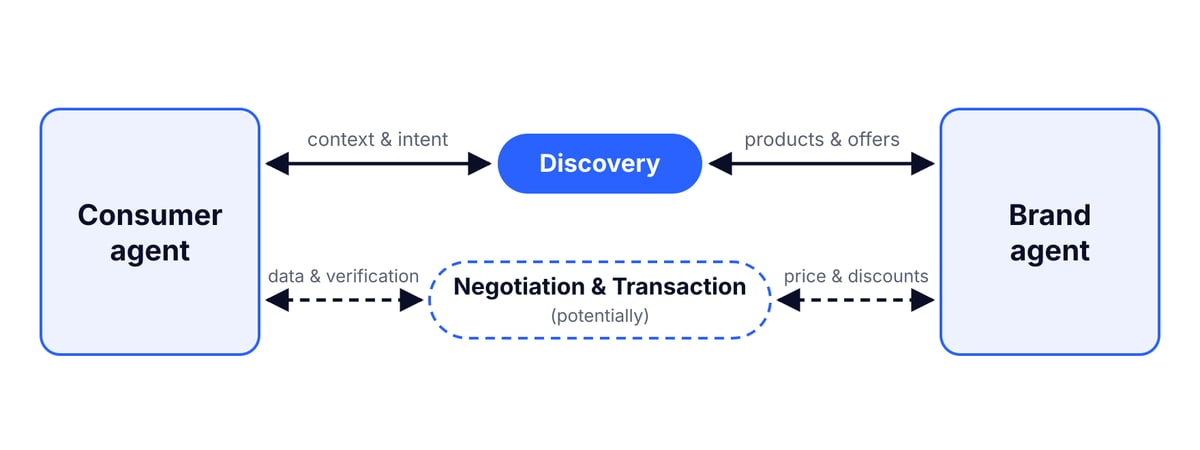
These two agents will likely meet at various points of the funnel (discovery, then negotiation and transaction) and trade consumer profile data for better deals. You can visualize it like this:
If that’s the basic relationship, it’s worth thinking through some of the implications for brands. Here are a few:
-
Adaptive site experiences. For the brands we work with (apparel, accessories, beauty and supplements), people like to shop. It’s part of the fun. If you sell a commodity (or a consumer thinks of you as a commodity), then an agent will just handle it. But for everyone else, the site still matters. If data is flowing between a consumer agent and a brand agent, that brand is going to know a lot more about the consumer before they land on the site. More context means more opportunity to tailor the site experience accordingly. Personalization efforts get easier because of more data, but also become more commonplace, because everyone will start doing it.
-
Data and incentives. Today, we happily give up our email address for discounts all the time. Brands will still want to make that trade, and they’ll still be happy to pay for it. What changes is how the trade works when agents are the ones negotiating. How do you let your agent share your data in exchange for a discount? How does the brand agent know when a discount is worth giving? There’s absolutely going to be some negotiation and verification happening between the two agents. How that works is still an open question.
-
Personalized pricing and offers. One of the biggest blockers to price and offer testing is a “marketplace-based” world of ecommerce. The Google Shopping feed forces a uniform experience for every customer. So does Amazon. But as more transactions become private, mediated one-to-one between agents, I’m not sure that feed will matter as much. Amazon can’t scrape your individual transaction with a customer and take away your buy box. Minimum advertised price (MAP) agreements are built around that same public feed, too. There are legal considerations and comfort questions to work through, but I do think there’s potential for an explosion of personalized pricing and offers. Knowing your profitability and price elasticity will matter a lot.
-
Subscriptions. I was on a panel recently about pricing in the age of AI, and the president of ClassPass made the point that agentic commerce will make subscriptions much less predictable revenue. Many consumers keep subscriptions because of the friction associated with canceling. An agent doesn’t feel that.
-
Loyalty incentives. If pricing becomes dynamic and data gets more valuable, loyalty incentives will be flexed to keep customers (and keep acquiring more of their data) as other brands offer deeper discounts to shopping agents.
-
nCAC. This is a favorite Twitter/X topic: paying to re-acquire your customer via Meta. If consumer attention and discovery move to agents (and away from Meta et al.), that may change. Instead of paying for the advertising, you’re paying the customer (via discount).
These are just some things I’m noodling on as I think about how online shopping may look different in two, three, four years.