Welcome back to AI, Tech & Money. I’m ADWEEK’s senior tech reporter, Kendra Barnett, writing from New York. It’s been a buzzy week following the midterms, in which Democrats swept both the House and the Senate (and political advertisers spent upwards of $11.4 billion in ad spend—more than the total spend in the 2024 presidential election cycle—along the way). Voters took their feelings about brazen AI expansion plans to the ballot box, too, rejecting 40 out of 41 total ballot measures on data center build-outs across the country. Undoubtedly licking his wounds this week is Elon Musk, the election cycle’s biggest donor, who shelled out $474 million, much of that in support of Republicans in Texas, where Musk is building a sprawling AI chip factory meant to supply Tesla, SpaceX, and xAI with the silicon behind his AI ambitions. Other tech leaders who spent the past few years kowtowing to the Trump administration may find themselves with fewer allies in Washington come January. The extent to which they’ll change their tune on issues like AI safety and regulation, data center permitting and energy costs, and antitrust enforcement remains to be seen. Meanwhile, the SaaS-pocalypse isn’t over yet. In the latest signal of hurt, Canva said this week it is reshuffling or laying off 22% of its staff, affecting over 1,200 people. (Other SaaS players including Dropbox, Squarespace, Airtable, and ServiceNow have also cut headcount in the last month). The shakeup at Canva cuts to the heart of one of the defining quandaries of the SaaS-pocalypse: pricing models. Sexy, I know! But as a case study, I think Canva could prove an especially interesting one here: Seats aren’t dying. Vendors are just putting meters on top of them. As a result, marketers are increasingly having to budget for costs they can’t fully predict. More on that in my feature below. As always, replies to this email go directly to my inbox, so feel free to share feedback or tips. Or reach me securely at kendra.16 on Signal. |
|
|
|
If you were forwarded this newsletter, you can sign up here. |
|
|
|
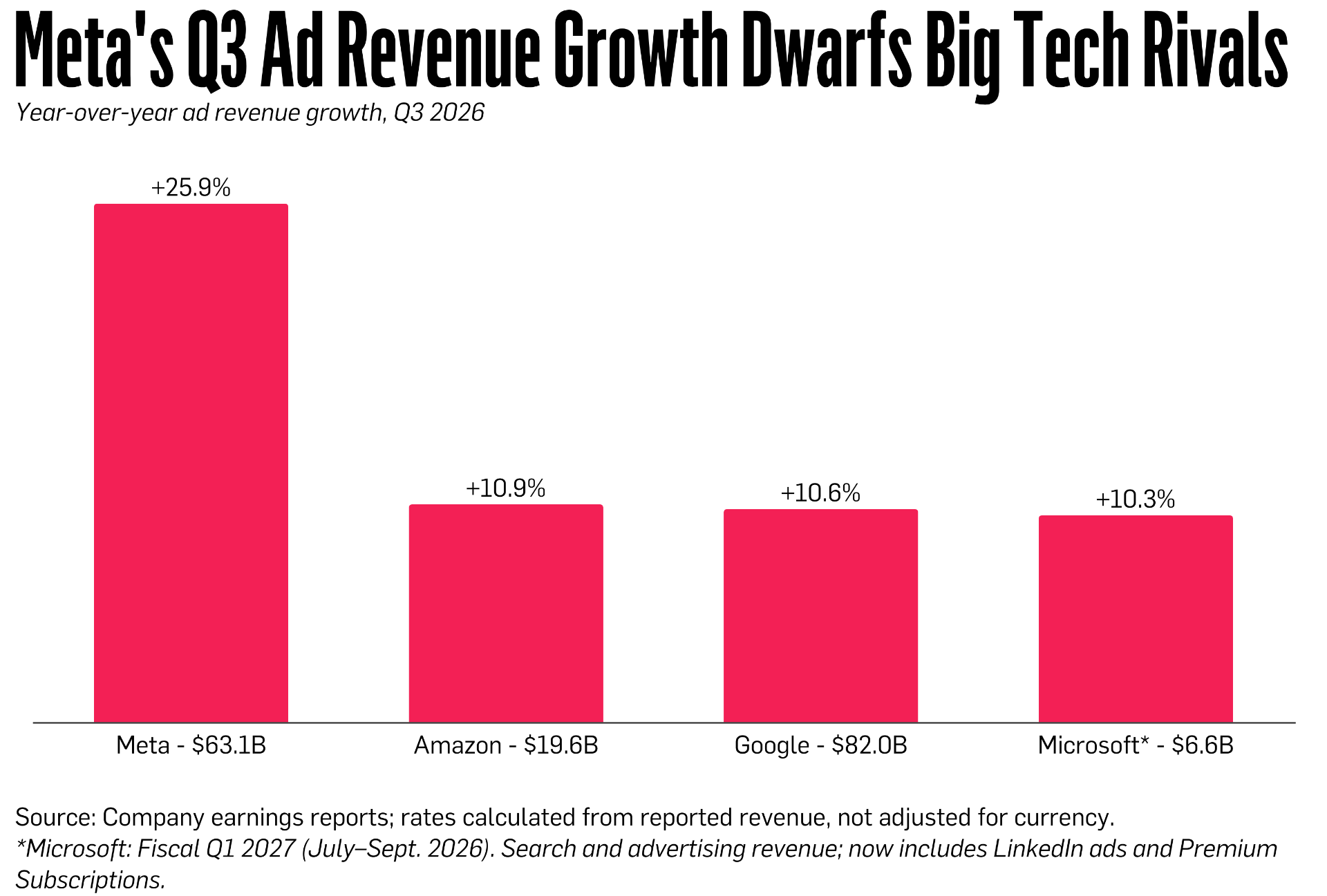
In the third quarter, Meta pulled ahead of the pack in ad revenue growth, surging at a rate that outpaced rivals by more than 2x. The company’s third-quarter ad revenue reached $63.1 billion, up 25.9% from the same period last year. It equates to an addition of roughly $13 billion in new ad revenue during the quarter, more than Amazon, Google, and Microsoft combined (about $10.4 billion). That said, prices did the heavy lifting, not volume; the average price per ad spiked 14%, and ad impressions rose 10%, according to the company’s third-quarter earnings report. It’s worth noting that rivals’ slowing growth rates have a variety of likely causes. For example, Amazon’s ad revenue growth, which fell to 11% from 22% a year earlier, was affected by Prime Day’s move to Q2, the company said. And despite Google’s slowdown, it remains by and large the biggest ad biz by dollars. Meta’s total ad revenue for the period is still 23% under Google’s. |
|
|
|
Canva’s Pricing Puzzle Is Every Marketer’s Problem |
Canva is undergoing a massive reorg, doling out layoffs, reassignments, or relocations to 22% of its staff, 1,271 people. Leadership at the design platform attributed the sweeping changes to slowing growth for the first time in a decade, surging AI development costs, and the need to improve organizational efficiency. But other factors, including intensifying pressure from both frontier labs and a new class of AI-native startups, are also threatening the company’s business, sources tell me. Signs that Canva had been feeling the economic strain of AI were there, too. The company’s CEO Melanie Perkins told investors in August that it was delaying the rollout of some AI features over ballooning compute costs.
There’s a problem baked into how Canva makes money. It sells subscriptions priced per person, like many SaaS companies. A paying user brings in the same revenue whether they generate one image or a thousand. But every one of those AI-generated creations costs Canva on compute. As usage climbs, so does the bill, while the revenue from each seat stays flat.
In a move appearing to help mitigate high compute costs in April, Canva capped its free plan at 200 basic AI uses, but in September trimmed that down to just 20 uses across its “Standard” and “Premium” AI tools. On paid plans, “Standard” tools are included, but Canva’s advanced “Premium” and “Ultra” AI tools count against a usage cap. The changes align with a wider pattern playing out across the software space: Pricing intelligence platform PricingSaaS counted 582 pricing changes toward usage-based metering across 324 companies over six months. At the same time, Canva’s standard seat-based pricing has also undergone some changes. Around the time Canva flagged compute costs to investors, it raised its annual Pro plan from $144 to $180, only to drop it back to $144 in mid-September. So, for Canva, the first squeeze is happening in the free funnel, where high compute costs appear to be pushing Canva to ration AI for its 234 million free users. The second squeeze is happening on the paid seats, where enterprise buyers may be questioning the need to pay for a standalone design software product like Canva when AI tools are making design workflows more accessible at a lower price point. As Nicole Greene, a vp analyst at Gartner, put it to me: “You've got CEOs, CFOs, CIOs all saying, ‘Why do we need a specific design and brand tool? Why can't we just use something we already have?’ We're very much in this interesting space where cost is being scrutinized, and pricing models are changing.” She added: “I cannot even begin to break down…the pricing complexity in this market right now. But maintaining healthy margins in an increasingly crowded space is going to be challenging.” The point, broadly, is that Canva is just one case. Its pricing woes are reflective of broader stressors across SaaS-land.
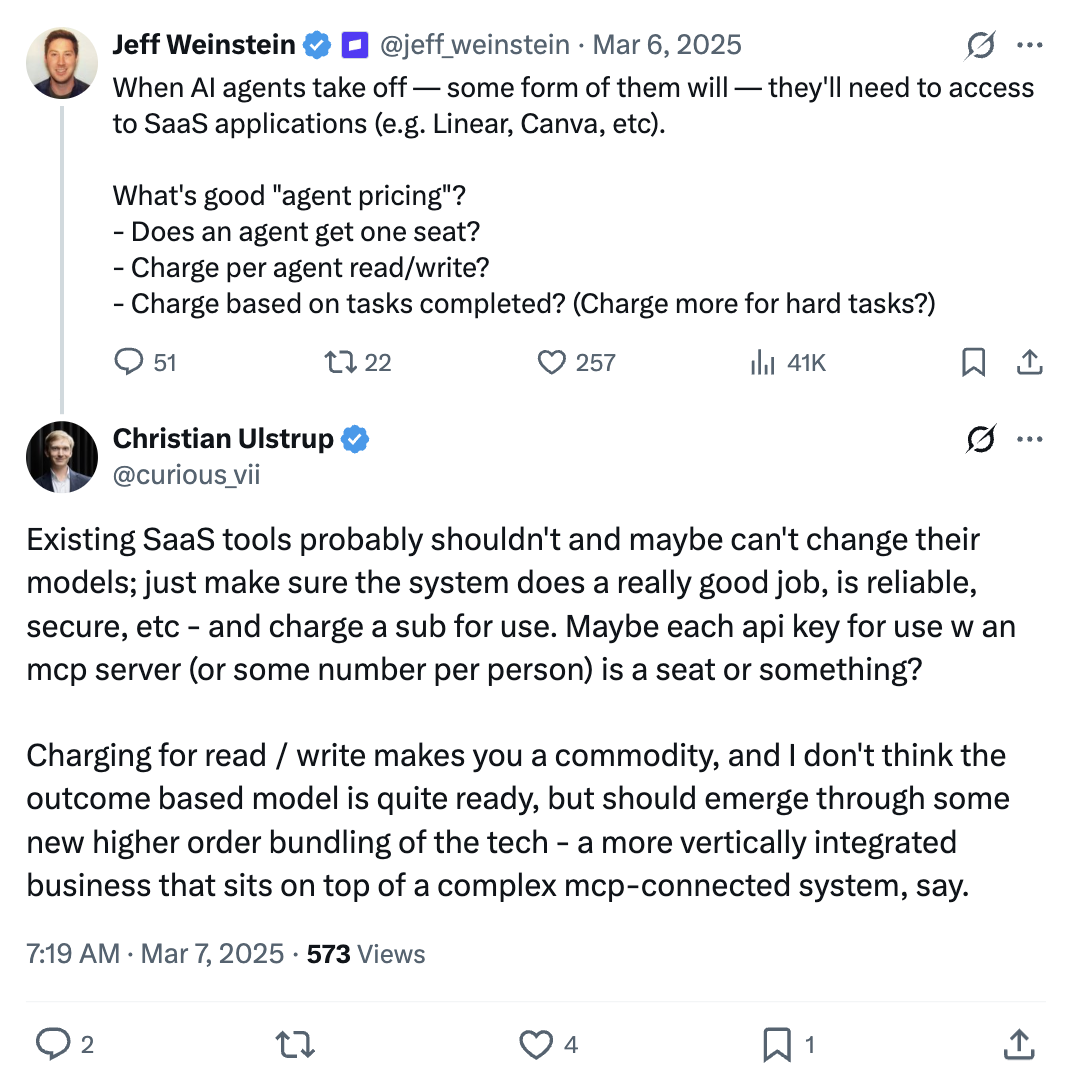
The seat-based model is under more scrutiny than ever. And with AI agents—tools designed to automate tasks on behalf of users—gaining traction in enterprise spending, the pressure only rises. Up to $234 billion in enterprise application software spending could be exposed to disruption from AI agents by 2030, representing roughly 20% of enterprise application SaaS spending, according to recent projections from Gartner. Agentic AI “breaks the link between user growth and revenue growth,” as Gartner’s managing vp George Brocklehurst put it.
Now, SaaS players are experimenting with different models. One is a seats-plus-credits approach; players like Adobe and Figma are trying this out. Another is outcome-based pricing (a turn of phrase that will sound familiar to brands and ad agencies, where the model is also gaining steam). In SaaS, outcomes-based pricing is a hot topic, but comes with its own challenges, in part because “a lot of marketing teams don’t really know what those outcomes should be,” Greene told me. But for Canva, she sees outcomes-based pricing as a potentially smart solution, where the company could help its customers figure out what those outcomes should be. Finally, some software companies are just going back to a standard seats model. Salesforce, for example, has changed how it charges for AI agents three times in about a year, going from a fee-per-customer-conversation approach to a fee-per-task model, and then largely back to a flat fee per user. Customers “pushed for more flexibility,” CEO Marc Benioff said. |
It’s clear that the industry is experimenting widely with pricing models. But buyers are often the ones paying for that experimentation. And marketers may be shouldering an outsized burden. Martech's share of the marketing budget is now under 20%, a five-year low, down from 26.6% in 2021, according to a Gartner CMO survey. (Meanwhile, paid media is up to 31.4%.) Within that shrinking slice, more money is flowing to pay-as-you-go tools, where the bill depends on how much a team uses instead of how many people have logins. More than half of CMOs (56%) shifted more of their martech budget toward these tools in the past year, per Gartner. But paying by consumption is creating headaches for marketers. Half of the organizations using these kinds of tools continually renegotiate contracts, and 41% have added or are adding ways to track usage in real time, per the report. And some costs can be particularly opaque; Adobe, for example, has “no admin-level view for per-user credit consumption,” an Adobe community manager confirmed in May. In theory, that means that a few designers churning out AI videos could rack up overage charges while the team as a whole thinks it’s within budget. Marketers are, of course, accustomed to paying by usage, as it’s often how they pay for media, per thousand impressions. But the world of advertising promises independent, unbiased verification, and comes with pacing tools, safeguards, and standard contractual terms between buyers and sellers. AI software, for the most part, has none of that. Today, a given SaaS vendor decides what counts as a billable unit, when a conversation is resolved, what constitutes a lead as handed off, and what “premium” AI versus “standard” AI looks like. And it grades its own homework.
Pricing headaches are becoming a bigger pain point as marketers contend with how to use AI tools, Greene told me. “Most of my clients right now,” she said, “are looking at contracts that are dramatically changing as a result of new AI models. So you have a lot of conversation around AI cost economics.” The reality is no doubt lighting a fire under SaaS vendors’ asses to retain their customers. In the near future, rate cards, usage caps on AI, and terms around overages in the era of sky-high AI compute might matter more than seat counts. Metered pricing only sharpens the question CEOs and CFOs are considering, as Greene flagged: If every AI output has a price tag, why pay for several tools that can basically do the same thing?
For a vendor like Canva, metered pricing could prove to be a double-edged sword. Yes, it could make every redundant tool in a marketer’s stack more expensive, but, on the other hand, it bolsters one of Canva’s core advantages. “The fact that Canva can replace multiple point solutions with a single governed platform is something that’s really appealing to enterprises,” Greene said. If marketers are going to consolidate, Canva wants to be the tool left standing. In the meantime, it has to figure out how to price that value prop. The company is planning a Wall Street debut within the coming couple of years. |
|
|
|
AI, Tech & Money covers the intersection of artificial intelligence, emerging technology, and the business forces shaping them — from groundbreaking research and infrastructure shifts to the investors, startups, and strategies driving the next wave of innovation. Each issue breaks down how new AI developments translate into real economic impact, market opportunities, and competitive advantage across industries. | |
|
|
|
|