What are some of the major dining trends you identified this year?
Brenna Houck: Taverns were very big this year, both Midwestern tavern food and British tavern food. We also saw quite a lot of hand rolls across the country. That feels like the next step in the United States’ love of sushi and Japanese food.
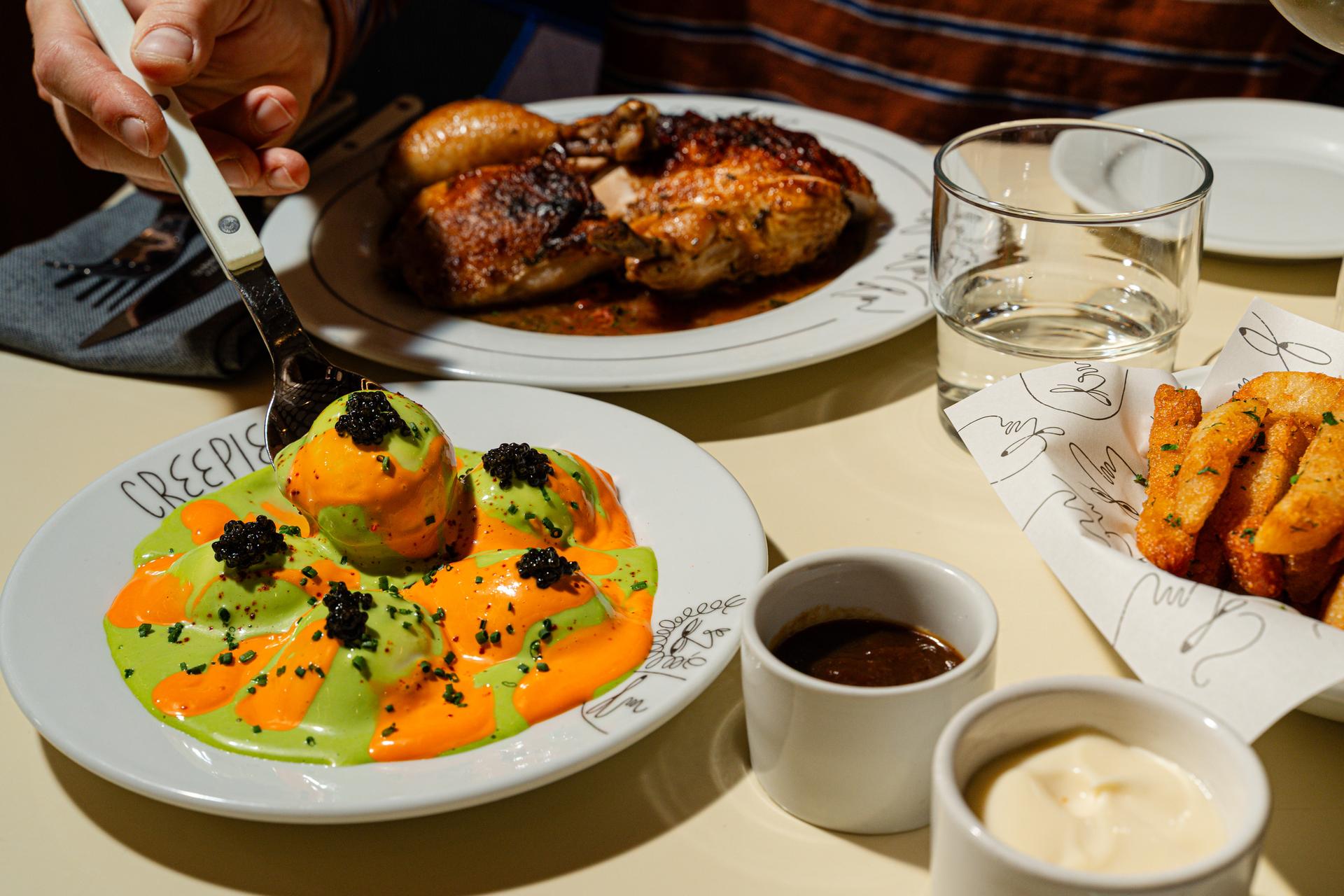
MF: I love that you mentioned the Midwest because we found so many exciting things in our travels to the Midwest, with really standout places in Milwaukee, Chicago, and Kansas City, Missouri. I liked seeing places treat Midwestern food as a cuisine of its own. You see this in particular at Creepies, where they’ve found a way to turn a tavern-style pizza into a tarte flambée. But Creepies is also a bistro, and this year, everything was a bistro.
Many of those places also had some version of roast chicken, and we were seeing roast chicken everywhere. There were a couple of different ways we saw that play out. We highlighted a place in New York City, Badaboom; the conversation in NYC was about ridiculously expensive roast chicken [at the wine bar Gigi’s, with its $40 half chicken], and this felt like the antidote to that. This place was charging a reasonable price and doing it very simply. We also saw very intentionally elaborate approaches to roast chicken. So. Fox in Atlanta has this chicken [of which] they only serve five a night. It’s an example of a simple dish, but with a more complicated and precise approach. I had an incredible roast chicken at Creepies, too, where they used liver as the earthy base for the sauce and I could not stop dipping my fries into that.
We also saw more tasting menus in the range of $150, $165. It’s telling that even the tasting menu, which is geared as a high-end experience, is taking into consideration how much of the conversation this year was about the high and rising costs of dining.
BH: Even some that were less expensive than that! I went to Bar Nouveau in Portland, Oregon, and you can get a full meal there — a whole table of food, with many, many dishes coming out — for $69, yet it feels so festive and fun.
What surprised you when it came to this year’s list?
MF: When I went to Kansas City, Missouri, I knew that it was a city that has not always had a stronghold of Japanese cuisine. When I talked to the chef at Akoya Omakase, he mirrored that to me. Over the past few years though, we’ve been seeing interesting things happen. I ended up visiting Akoya Omakase — one of those $165 tasting menus — and the chef is so connected to his sourcing in Tokyo. He can get the fish to Kansas City in around 26 hours. People might say, “Why go for sushi in Kansas City?” The sourcing [situation] has changed such that you can find exciting examples like this everywhere.
We have a whole category of bakeries. What made bakery culture interesting this year?
BH: The quality of bakeries has skyrocketed in the past few years. San Francisco in particular is having a real boom in pastry right now as well. They have Parachute, on our list this year, which is doing some really interesting, exciting things.
I was first introduced to the idea of Parachute by Dianne de Guzman, our editor at Eater San Francisco. It was [via] a Danish with clam chowder in it. You can go there and get an incredible chocolate croissant, or these impeccable, beautiful bowtie croissants. But then you can also get something really weird there. These one-offs that can feel a little bit like viral-for-Instagram work somehow, miraculously.
MF: I think there’s been a general raising of the bar of quality, where to be impressive, you have to have great bread and great pastry and also have really specific international expressions or draw on different cultural traditions. You can see that in the Afghan influence at Diljān, for example.
BH: I think this culture of the little treat being your pastry, or being willing to spend on a nicer pastry, or even being willing to wait in line, is a mindset change as other types of dining become less affordable, too. You’re more willing to wait in line for something that you know is going to be good.
What’s the overarching feeling you associate with this year in dining culture?
MF: I remember when you and the Eater Northeast team came back from Philly earlier this year. Bomb Bomb Bar was the first place that was on our radar really early. With the effusiveness [with which] you all were talking about the meal that you had there, and the feeling you got there, I couldn’t wait to get to Philly in a couple months and try it. I also was super charmed by it. I feel like that sense of discovery and delight permeated the year.
This interview has been edited and condensed for length and clarity.