Welcome back to AI, Tech & Money. I’m ADWEEK’s senior tech reporter, Kendra Barnett, writing from New York. This week, the absolute biggest news—and seemingly the only thing anyone is talking about on X and in my group chats—is the spectacular downfall of Nvidia CEO Jensen Huang following reports about not one but two extramarital affairs, including one with an alleged Chinese spy and one with a subordinat. Yikes! I won’t supply a fuller TL;DR as I’m sure you, too, have been willfully or unwillfully immersed in the story. I will say that the memes are fantastic. The question I’ve been pondering is how integral Huang truly is to the Trump administration’s AI policies, and the approach it’ll take with him and with the chipmaker moving forward. Only time will tell. I just wish my 401k was riding solely on Krispy Kreme stock. Looking ahead, next week will be a big one in tech. Nvidia (of Jensen Huang affair fame) is slated to report its Q3 earnings, on which a non-insignificant share of the global economy hinges (!!!!), on November 17. Meanwhile, Anthropic is targeting an eye-watering $1.4 trillion IPO on November 18.
In my corner of the world, I joined adtech and media nerds Monday at Luma Partners’ DMS for an energizing program that saw OpenAI monetization chief Benji Shomair opine on the development of the AI lab’s nascent ads business. Google’s managing director Marta Martinez discussed on stage the ways AI is changing consumer discovery, marketing, measurement, and agency roles. Then, on Tuesday, I popped into the Brand & AI Safety Summit in Manhattan, where X’s new head of safety Michael O’Herlihy teased designs for more explanatory content moderation labels on flagged content. You can see some mock-ups of those designs in my exclusive coverage of the news. Also this week, OpenAI launched Business Hub, which lets brands see how frequently they show up in conversations on ChatGPT. It follows a familiar Google playbook. It also represents the company’s first foray into the hot space of AI visibility and generative engine optimization, or GEO. In that realm, the platform has both advantages and limitations. Keep scrolling for more analysis in the Deep Learning section. Finally, a note to let you know that ADWEEK has just launched The Checkout, a newsletter that will bring you weekly news, scoops, and analysis from the world of retail and commerce. It’ll cover everything from shopping trends to the new wild west of agentic commerce. Sign up for free here to get it in your inbox every Tuesday.
As usual, replies to this email go directly to my inbox, so feel free to share feedback or tips. Or reach me securely at kendra.16 on Signal.
|
|
|
|
If you were forwarded this newsletter, you can sign up here. |
|
|
|
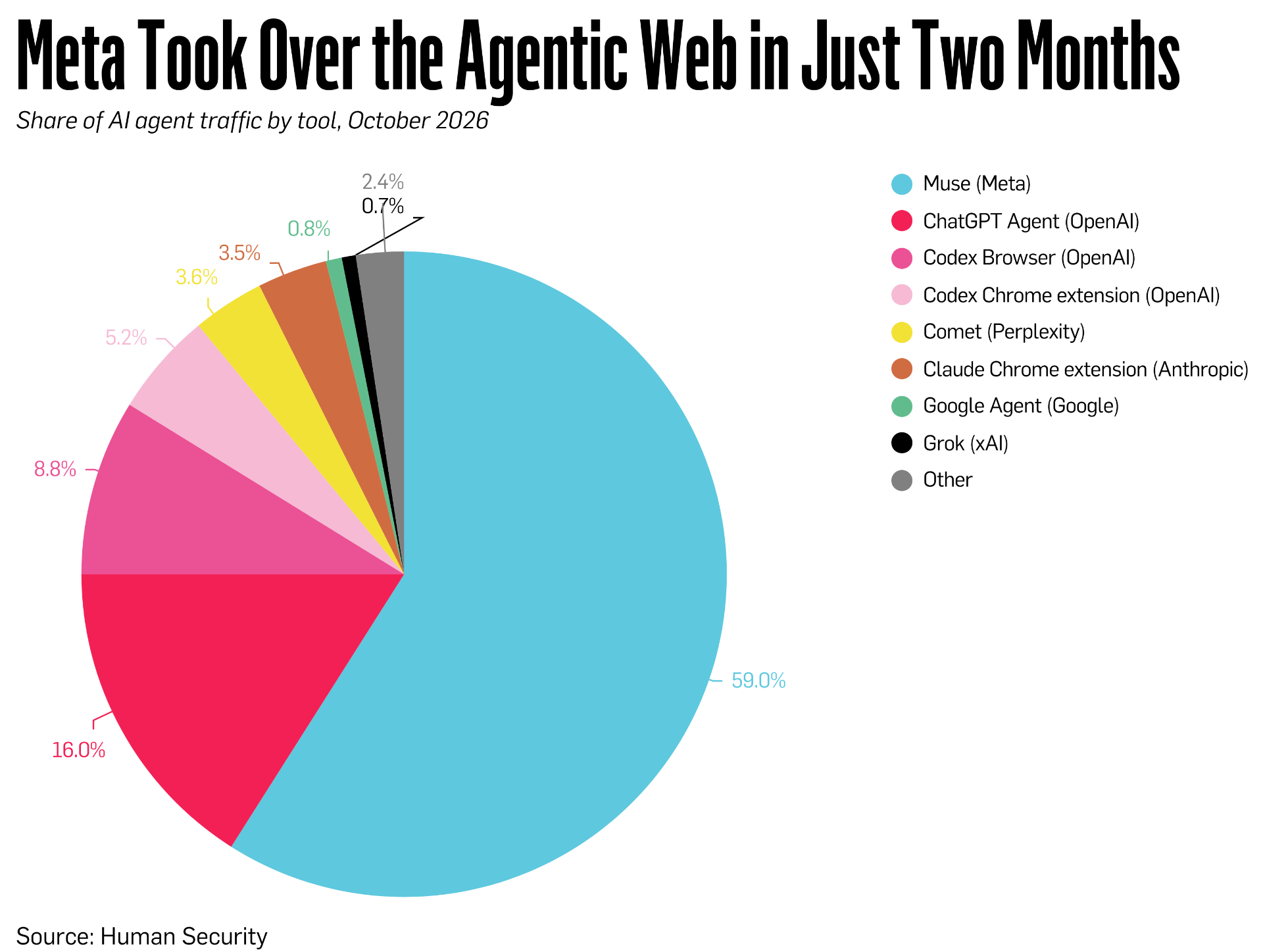
Since its September launch, Meta’s personal assistant-style AI agent Muse has blown up; in October, it drove 59% of agentic requests across sites monitored by Human Security, according to new data published by the company. OpenAI came in second place, with three of its agent products accounting for roughly 30% of traffic combined. ChatGPT Agent’s share fell from 28.5% in September to 15.9% in October as Muse surged, even though its total traffic popped 44%, while developer-focused Codex Browser nearly tripled its traffic. Agentic traffic is growing fast. It swelled 2.6x from September to October, and about 8x since August, after staying flat all summer, the research indicates. Where are agents going, you ask? Mostly browsing and shopping for products, it would appear. Ecommerce sites attracted nearly 60% of agents’ traffic, while travel sites grabbed 19.3% and media sites snagged 19.1%. |
|
|
|
Great benchmarks. Where's the revenue? |
AI labs chase benchmarks. Your board chases revenue. WRITER delivers agents built for marketing and revenue teams — not technical work. Enterprises are seeing 333% ROI, payback under six months. The frontier of enterprise growth is here. See how. | |
|
|
OpenAI Borrows Google’s Playbook and Crashes the GEO Party
|
This week, I saw OpenAI’s head of monetization Benji Shomair spell out the AI lab’s vision for its burgeoning advertising operation. The heart of Shomair’s positioning: Users come first. The company is wary of creating ad products that are overly disruptive to the user experience, contextually irrelevant, unhelpful, or, in a worst-case scenario, violative of users’ privacy. It’s a familiar refrain from the AI titan. At Cannes in June, then-CRO Denise Dresser pitched ChatGPT ads as being “about usefulness,” which she called “great for the consumer, great for the user.” In Shomair’s telling, OpenAI’s hierarchy of priorities in its ads biz looks like this: (1) user trust; (2) user value; (3) advertiser value. So the AI giant says advertisers come behind users. But with OpenAI’s launch this week of Business Hub, a self-service platform that enables brands to better control how consumers interact with their businesses and lets them see how they show up in ChatGPT conversations, OpenAI is standing up infrastructure to support its ambitious advertising plans (which, per Axios, includes a goal of scaling to $100 billion in ad revenue by 2030, a wildly fast clip), as it promotes paid reach and includes a customer-service and shopping agent that can double as an ad landing page.
Business Hub also, notably, mirrors some of the core features that transformed Google into the biggest ads business in the world. Five years after launching AdWords, later rebranded to Google Ads, the search giant debuted a platform for local businesses in 2005. It gave businesses free tools for claiming, verifying, and updating their listings. (Webmaster Tools, now Search Console, followed in 2006 to help sites understand how they showed up in Search.) Over the coming years, the platform folded in performance stats and advertising tools, and went through several name changes before eventually becoming Business Profile. Its features got businesses invested in managing how they showed up in search results, and also, critically, provided a new vehicle through which Google could peddle its ads products. OpenAI, it would appear, is running with that playbook, albeit at hyperspeed. It started with an ads product, and is now following up with controls for businesses, with a baked-in path to paying for more reach. One of the key components of the new Business Hub is the Business Agent, which brands can set up to field users’ questions about their products. When ChatGPT mentions a brand, users can open its profile and chat with its agent. But a brand can also pay to make that agent the landing spot for a ChatGPT ad. The question that naturally follows: Can the line between organic answers and paid placements in ChatGPT stay bright when the same product straddles both sides?
The company said that sponsored placements are “clearly labeled and separate” from conversations, and that agent chats are “distinct from ChatGPT’s independent answers.” Still (and also like Google historically), OpenAI will be both the player and the referee here.
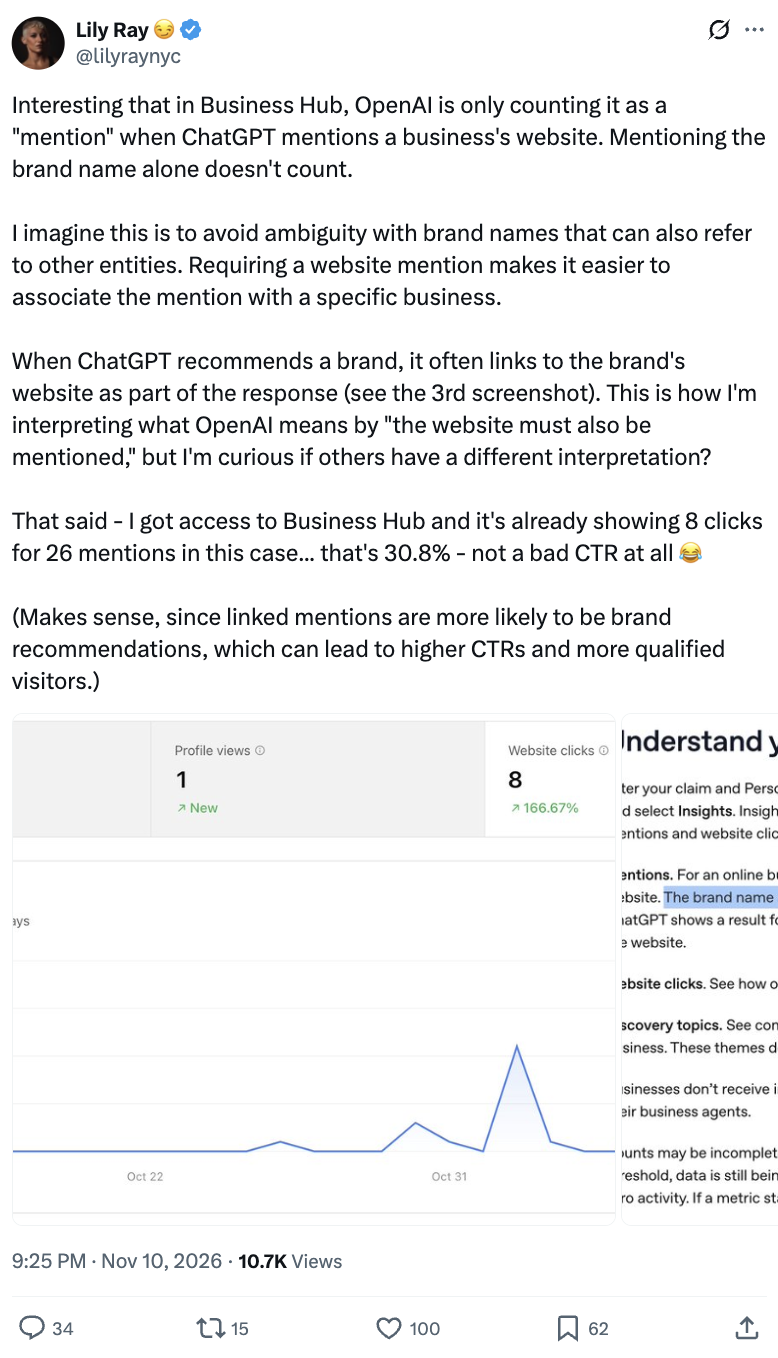
Not to mention it’s selling a scoreboard. Business Hub includes first-party data on how often ChatGPT mentions a brand and sends them clicks. |
Though it’s limited to ChatGPT, those features alone put Business Hub in direct competition with the many generative engine optimization, or GEO, vendors vying for dollars to show brands their visibility within various AI answer engines.
While Business Hub only provides a window into performance on ChatGPT, it does have a key advantage over third-party GEO providers: it has access to real usage data, not just simulated prompts. Most major GEO players today rely largely on simulated prompts and sampled AI responses, not actual user queries and AI responses.
That said, Business Hub, at least for now, doesn’t show brands prompt-level data, just aggregated “discovery topics.” More crucially, the platform doesn’t enable brands to see how they rank against rivals, which is what most GEO vendors sell.
Onstage in New York on Monday, Shomair predicted that in five years’ time OpenAI will have “created a new context for businesses and consumers to interact.” This week, it became clear that it’s already starting to build ways to charge for that context. |
|
|
|
AI, Tech & Money covers the intersection of artificial intelligence, emerging technology, and the business forces shaping them — from groundbreaking research and infrastructure shifts to the investors, startups, and strategies driving the next wave of innovation. Each issue breaks down how new AI developments translate into real economic impact, market opportunities, and competitive advantage across industries. | |
|
|
|
|