A few years ago, I was walking around the winding streets of Ridgewood, Queens, when I ran into a friend, local business owner, and keeper of much neighborhood lore. I asked if she knew anything about who would be taking over the old funeral home on Catalpa Avenue, which was then under construction. “I don’t know,” she said, “but someone told me that the construction workers keep quitting. They’re saying it's haunted.”
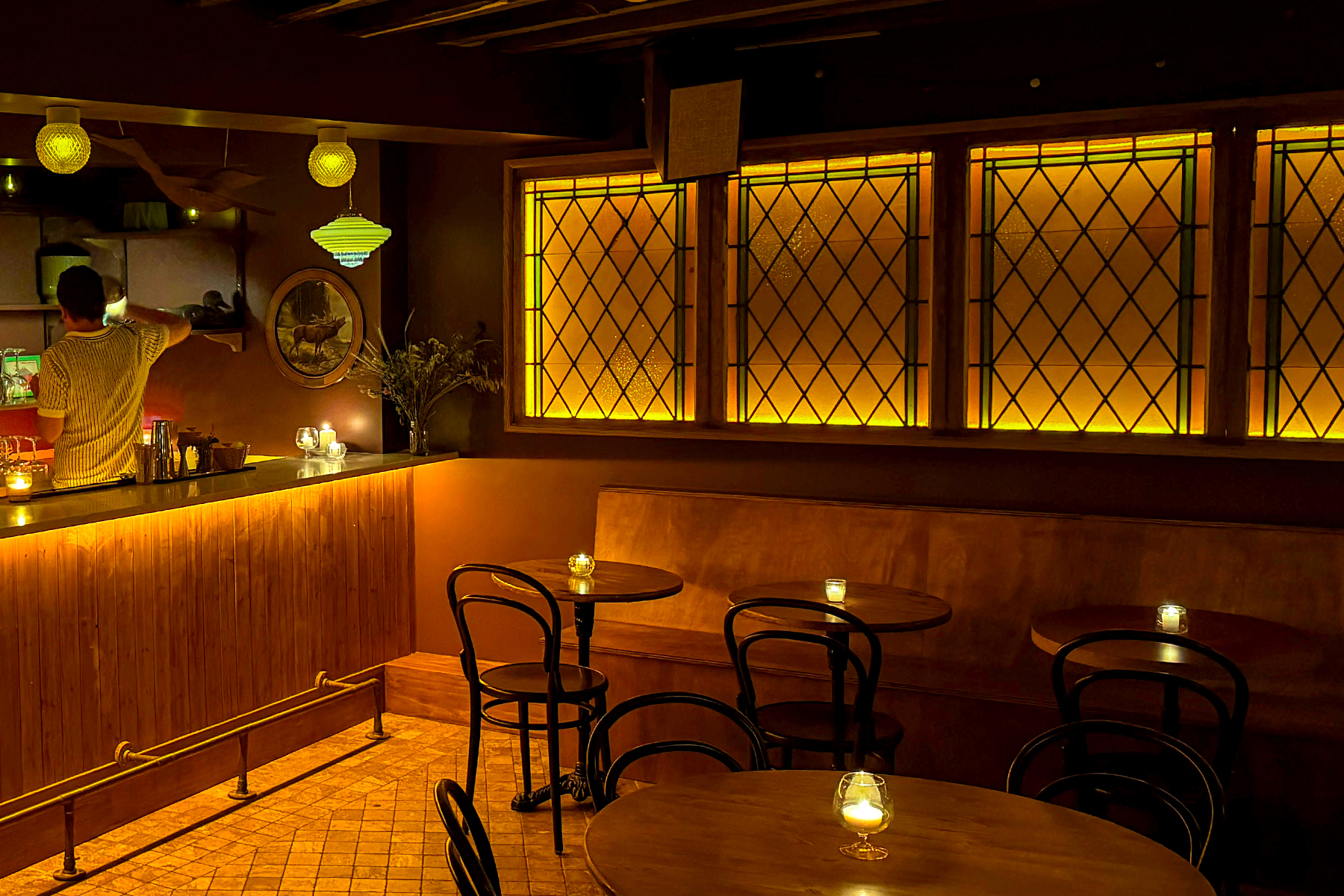
Ghosts be damned, the new business opened in fall 2025 — bestowing the historically Polish neighborhood with a restaurant called Pierogi Boys, which has been lovingly reinventing Polish comfort food since its founding in 2017 by Krzysztof Poluchowicz and Andrzej Kińczyk. “We looked at dozens of spaces and had almost given up,” writes Poluchowicz via email. I’ve written both him and his partner to talk more about how and why they landed on converting such a unique space into the second Pierogi Boys location (the first is at in the DeKalb Market Hall). Both owners reassure me that they have had no supernatural occurrences in the space, but that they have made a conscious effort to respect its past. “We had lived in Ridgewood since moving to the U.S. from Poland in 2005,” Kińczyk says, “[so] opening our first brick-and-mortar restaurant here made perfect sense.” The Catalpa Avenue location they landed was much larger than they anticipated, but the sweet corner spot and ample space inspired them to create a multi-hyphenate operation: a restaurant (with a private speakeasy room) and an adjoining grocery store. Applying for permits at the landmarked space took time, and they took care to preserve what was salvageable from the funeral home. “We cleaned [the original stained-glass windows], repaired the wood frames, and installed them in our semi-secret private dining room downstairs,” says Kińczyk.
Pierogi Boys is one of many restaurants across the United States that have taken over defunct funeral parlors. And while the funerary past of Pierogi Boys’ Ridgewood location may go unnoticed to the untrained eye, other parlor-turned-restaurant spaces more explicitly embrace a location’s history in their branding and menu. The Pine Box bar and restaurant in Seattle has fully embraced its building’s past as a funeral home, owner Ian Roberts tells me by email, although he initially passed on the space because it seemed like too much work. “But I couldn't stop thinking about it,” he told me. “Something drew me to it. It had an energy other spaces lacked.” The bartop and tables are made from 100-year-old tongue and groove boards that Roberts took from cabinets that once housed urns. The booth benches are upcycled church pews, and stone from the vaults sits atop the backbar. “When repairing the floors, we found that they had used horsehair and newspaper for insulation,” he says about unique space-conversion hiccups. “Who knew that was a thing?”
The Pine Box has been open for nearly 15 years, and Roberts believes his business is at peace with any resident spirits that may be lingering. “The first year we were open I bartended most nights,” he says, “Many nights, around midnight, I would hear my name whispered as if someone were standing right behind me. No one was ever there when I turned around.” After a year, the whispering stopped.
I vaguely remember going to a funeral in Santa Monica, California, with my family when I was a very young child. I was struck by the funeral home chapel’s Tudor Revival design — the pointed arches, the wood beams, and pitched roof; it felt romantic, yet stately given the singularity of its funerary function. In 2020, that same 1930s funeral home was converted into another location for Tartine, the popular San Francisco-based bakery. “The materials, colors, fenestration shapes and stucco finish details on the exterior of its Tudor Revival style remained unchanged,” says the Santa Monica Conservancy on its website, calling the project “sensitively rehabilitated.”
Is it strange to eat lunch in a building that was once full of bodies and coffins? Not necessarily. We used to have a closer, less othered connection to death and our loved ones in the United States; when the concept of cemeteries outside of places of worship was first introduced in the 19th century, graveyards were designed to double as enjoyable public parks. In the mid-1800s, it would be perfectly normal to picnic on your loved one’s grave in Green-Wood Cemetery, for example, with a flight of sausages and some fine bone china. (Today, its picnic regulations are much more restrictive.)
With spooky season upon us, there’s something moving about the ways in which these restaurants clearly respect and explore the work of their funerary predecessors, marrying the past with their own present and imbuing it all with, well, more life.