Hi there, and welcome back to On Background. This is ADWEEK senior media reporter Mark Stenberg, reporting to you live from deep within the bowels of Advertising Week New York. Although Advertising Week and ADWEEK are, confusingly, unrelated, both share a similar mission this week: gathering groups of shivering marketers in Midtown to talk about AI, creators, and incrementality. My dance card has been amply filled, moderating panels daily at ADWEEK House with executives from Google, Disney, and Digitas, among others. In addition to a packed slate of source meetings, on Wednesday I am hosting a private lunch at Le Pavillon in partnership with Realtor.com, and on Thursday I will be leading a panel on the AWNY mainstage about sports media and attending a private dinner at the Hawksmoor that evening. Still, despite the flurry of activity, the news cycle has been even busier—particularly in the world of dealmaking. In just the last week, I have reported exclusively on three separate acquisitions—mostly agencies looking to bolster their social and creator offerings—as well as venture investment in creators and the insolvency of a multibillion-dollar adtech firm backed by The New York Times. You can read more about all of those below. In my feature piece this week, I explored one of the more surprising topics of conversation at Advertising Week: digital-out-of-home and in-person advertising. As artificial intelligence continues to push people off the web, along with making its contents less trustworthy, the value of real-world advertising is growing among marketers. But there is a key catch: As more of the physical world becomes advertising inventory, consumers have fewer ways to opt out. A person can close a browser tab or delete an app, but they cannot close a subway platform. Relatedly, for Quote/Unquote this week, I spoke with Creativ Company cofounder and CEO Wes Morton, whose agency is helping brands build and manage advertising infrastructure in video games. The advent of programmatic advertising into the video game industry, while belated, represents the emergence of a potentially massive untapped market, Morton argues. And as always, at the bottom of the newsletter you will find my favorite stories from the week that was, including writing from New York Times Magazine, The Ringer, The New York Times, and Vanity Fair. Replies to this email go straight to my inbox, so feel free to reach out with tips, pitches, and feedback. You can reach me at mark.stenberg@adweek.com or on Signal at 210-705-3284. If you are not yet subscribed to On Background, you can click here to do so for free. |
|
|
If you were forwarded this newsletter, you can sign up here. |
|
|
Scripps Substack: The local broadcast company Sinclair, whose stations reach roughly 38% of U.S. households, is launching a national news brand on Substack, called The National Press, according to a Tuesday report from Axios. The outlet will feature reporting from across the Sinclair network, which encompasses around 1,200 journalists and 60 local newsrooms, per Sinclair president and CEO Chris Ripley. The rollout is an unusually experimental gambit from the otherwise staid news organization. Through the venture, which will have both free and paid tiers, Sinclair will be able to gauge the news appetite of the Substack ecosystem. Have any other national news organizations launched a flagship Substack? If you know, shoot me an email at mark.stenberg@adweek.com. Express Brew (EXCLUSIVE): On Monday, Morning Brew acquired the creator-led editorial brand Express Checkout in an all-cash transaction, Morning Brew CEO Robert Dippell told me. Express Checkout, a two-person operation cofounded by Nate Rosen and Jenna Movsowitz, covers the CPG industry through a mix of newsletters, podcasts, and short-form social video. Through the deal, Morning Brew will gain 100% IP ownership of Express Checkout, while Rosen and Movsowitz will join Morning Brew as employees, with incentives to grow the brand. While many publishers are talking about creators, few are working with them so actively as Morning Brew, whose “creator-focused monetization” is up more than 50% year over year, per Dippell. Skydance Rises: Have you heard? Warner Bros. Discovery is now Skydance, part of a David [First name] media empire that, as of just three years ago, did not even exist. Now it encompasses Paramount, Discovery, Warner Bros. Discovery, CNN, HBO, CBS, TNT, Nickelodeon, and many more. Also: $80 billion in debt. The company would appear to be a behemoth, and yet from a streaming perspective, it is still firmly just in fourth place. There is more to media than direct-to-consumer subscribers, but the entertainment Voltron will still face an uphill battle in convincing advertisers that its assemblage of sub-scale platforms is a must-buy. Uncensored Offering (EXCLUSIVE): If the success of the Express Checkout founders is one end of the creator spectrum, where relative unknowns can claw their way into relevance, Piers Morgan and his two-year-old Uncensored Media is the other. Morgan is one of a handful of highly recognizable news personalities to decamp to YouTube in recent years, where he has built a budding media empire out of various Uncensored franchises, which today cover topics including soccer, royals, and history. On Monday, the company shared with me its plan to launch individual $4.99 subscriptions for its franchises, part of a mandate from new CEO Rashida Jones to grow the bottom line by launching new sources of revenue. Jones, who joined in March from MSNBC, has also spearheaded efforts to grow its licensing and events businesses. When Morgan first left television for YouTube, I will admit, I thought that meant the twilight of his career had officially begun. Now, nearly three years later, it was perhaps the savviest move he could have made. OpenWeb Falters (EXCLUSIVE): The adtech firm OpenWeb, which helps premium publishers monetize their websites, requested insolvency protections in an Israeli court last week, as I reported on Friday. The financial strain is the result of a cascading series of events—Microsoft, a key client, stopped working with OpenWeb; a key lender worried that withdrawal posed a material threat to its business, then demanded its money—but the root cause is the ongoing contraction of the open internet, a byproduct of AI search. Just four years ago, OpenWeb was worth $1.5 billion, counted The New York Times as an investor, and had luminaries like Scott Galloway on its board. But a 2024 boardroom coup, coupled with ongoing headwinds to the open web advertising industry, have put the company on its back heel.
|
|
|
PRESENTED BY WALMART CONNECT |
Evolving Commerce Media to Spark Growth |
Advertising is getting more complex. Brands are reaching customers in more ways than ever before, from social to CTV to in-store and beyond. Marketers need a simpler way to bring planning, activation and measurement together. That’s where Walmart Connect comes in. We’re making it easier to connect media investments, understand what’s working and improve business outcomes. - Connect audiences, inventory and demand: Extend reach and unlock new growth opportunities across an expanding commerce media ecosystem.
- Bring media and commerce together: Connect brand and performance solutions through creative, automation and connected commerce experiences to simplify cross-channel activation.
- Enable cross-channel measurement: Use commerce signals and connected measurement to understand performance, optimize investment and demonstrate business impact.
More channels shouldn’t have to mean more complexity. See how Walmart Connect is evolving commerce media to spark growth. |
The world of video games is late to advertising, relatively speaking, but that is soon poised to change. In June, EA announced its first ad platform, while entertainment firms like Netflix and LG are investing heavily to convert streaming audiences into video game enthusiasts, which could dramatically increase the pool of potential gamers. Next month, two blockbuster franchises, Zelda and Grand Theft Auto, are set to release new highly anticipated offerings—a titanic occurrence in the gaming ecosystem. As a result, Wes Morton, the cofounder and CEO of Creativ Company, thinks that automated advertising will soon become ubiquitous within the game experience itself. If so, in-game programmatic advertising could be one of the biggest advertising mediums on the planet in the next five years, per Morton, a byproduct of improved technology, fewer barriers to entry, and a newly motivated group of industry entrants: streamers. This interview has been edited. Mark Stenberg: Why are so many game companies launching ad businesses now? Wes Morton: They're all looking for new ways to monetize their audiences. Publishers were always open to custom partnership deals, but now they're professionalizing. To put the audience in context, The Game Awards gets more viewership than the other major award shows combined. I think video games will become the biggest advertising medium in the next five years. Mark: It’s nearly 2027. Why has this taken so long? Wes: Measurement is more complicated. A website is a flat page that people look at. In a video game, the view is constantly rotating, which makes viewability much harder to measure. The IAB just came out with in-game advertising standards, which is a step forward. Mark: What still needs to happen before programmatic ads fully infiltrate video games? Wes: The pipes still need to be built. Right now, programmatic partners will let you buy across titles, but not studio by studio or publisher by publisher. No big names have emerged in programmatic gaming ads yet. Unity has a great shot at it, and Roblox is interesting. There are a lot of people trying to tap this audience. Mark: Entertainment companies outside gaming are moving in, too. What's driving that? Wes: Netflix and Amazon are spending a lot of money on gaming because they realize it is the next entertainment frontier. It's already beating TV and movies in revenue and time spent. Mark: What happens when the barrier to entry is just owning a TV? Wes: Ease of entry is hugely important. The mobile phone is already the biggest gaming device by revenue, bigger than consoles. A prediction I love to make is that we'll get high-fidelity games streamed directly to the TV, with your phone as the controller. The experience isn't there yet, but that's a technology constraint, not a desire constraint. Once it is, you can distribute entertainment in new and interesting ways, and that will be huge for the industry. |
|
|
THE LEDE: AI Is Pushing Advertising Back Into the Physical World As AI erodes trust and traffic online, marketers are rediscovering the value of out-of-home advertising—even as consumers have fewer ways to escape it |
|
|
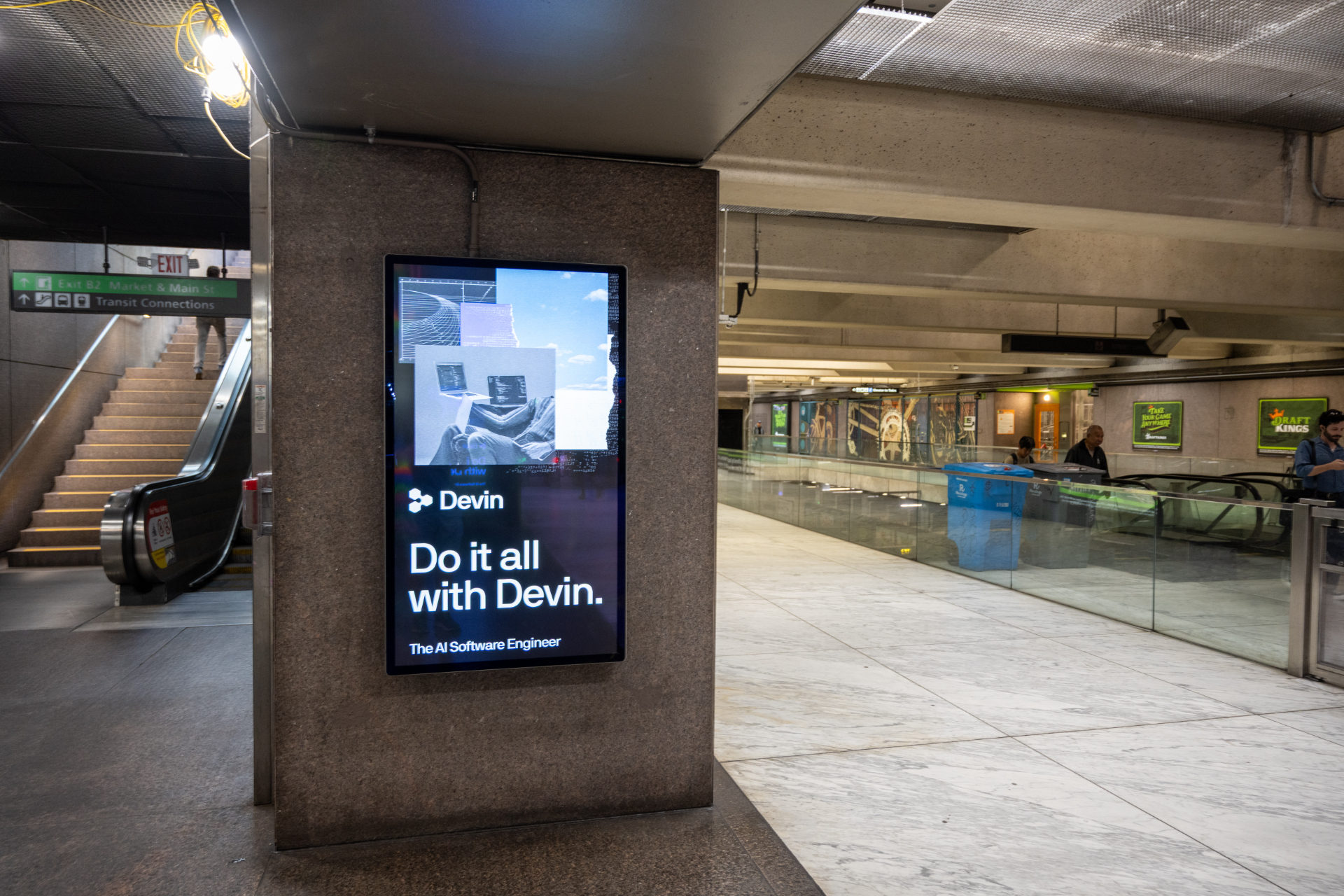
At Advertising Week, amid conversations about agents, creators, and combating fragmentation, an unusual topic kept coming up: out of home. The relatively fusty advertising channel has, in recent years, taken on renewed relevance. Out-of-home advertising, an industry catchall for media including billboards, wheatpastes, leaflets, and other in-person formats, has benefited from a surprising confluence of tailwinds. Its digital counterpart, somewhat unimaginatively called digital out-of-home media (DOOH), is increasingly seen as offering the best of both its digital and analog components: unskippable, yet targeted and programmable. The numbers reflect this renewed interest. U.S. out-of-home advertising revenue grew 10.7% year over year in the second quarter, reaching a record $3.16 billion, according to the Out of Home Advertising Association of America. Digital-out-of-home grew even faster, rising 18.5% and accounting for nearly 40% of the category’s revenue. Taken more broadly, the resurgence of out-of-home reflects a potentially more consequential shift in advertising: As the internet becomes less trustworthy, less trafficked, and increasingly mediated by artificial intelligence, physical space is becoming more valuable. Dedicated readers of On Background will recognize part of this dynamic. For media companies, in-person events have been one of the few consistent bright spots in an otherwise challenged advertising environment. Publishers from Condé Nast to Semafor to ADWEEK itself have invested significantly in their events businesses, which in some cases now make up more than half of their revenue. There are several explanations for that growth. The rise of remote work has created a more distributed workforce with fewer consistent opportunities for networking and convening. Events solve that problem neatly. More broadly, in-person media offers something increasingly scarce: a tangible, memorable experience, rather than the ephemeral one of scrolling past a display ad or skipping through an ad read. Now, a host of new factors are making that distinction even more meaningful. The rise of artificial intelligence has unleashed an onslaught of low-quality content—often referred to as slop—whose provenance will only become harder to discern as the technology improves. Consumers are already growing more skeptical of what they encounter online. According to a 2024 Adobe report, 87% of U.S. consumers said the rise of generative AI has made it harder to distinguish fact from fiction online. That erosion of trust was one of the reasons Mariano Jeger, the former executive creative director at Droga5, cited for his departure to Outfront Media when I spoke to him this past September. As digital and social content become easier to manufacture and harder to authenticate, brands have new reasons to reconsider the relative value of appearing in those environments. But AI is changing more than just what consumers encounter online. It is also changing whether they need to visit the open web at all. Answer engines such as ChatGPT, Claude, and Gemini increasingly answer questions without requiring users to visit the websites from which that information originated. For publishers, that threatens to reduce referral traffic, shrinking the audiences—and ultimately the advertising inventory—that the open web can offer. Agents could accelerate that shift. Products like Muse and Dots promise to accomplish tasks on behalf of consumers, potentially bypassing not just websites themselves but the advertising that subsidizes them. Last week, for instance, Amazon blocked Muse from crawling its website. Whatever the specific motivations behind the dispute, it highlights an existential problem for advertising-supported destinations: An agent can extract the utility of a website without ever seeing the ads that help pay for it. Taken together, these forces—the declining trust in online content, the growing ability to bypass websites, and the rise of intermediaries that don't consume advertising—could make parts of the digital ecosystem less valuable to marketers. At the same time, out-of-home advertising has become considerably more sophisticated. New, eye-catching creative can appear on digital screens programmatically, giving marketers some of the targeting and flexibility they have come to expect online while retaining a defining advantage of physical advertising: You cannot scroll past a DOOH display. And as more companies have embraced the logic of becoming media businesses, the opportunity has expanded further. Ride shares, airlines, grocery stores, retailers, and other businesses with physical footprints and captive audiences can increasingly turn those environments into advertising inventory. In a sense, the logic of retail media is escaping retail. Any company that controls a physical space where people spend time has the ingredients to become a media owner. But the same forces making physical space more valuable to advertisers risk making that space less pleasant for everyone else. In New York, the phenomenon can already feel like a scourge, as public spaces increasingly give way to kiosks and screens featuring a constant stream of advertising. In a recent episode of his podcast, New York Times journalist Ezra Klein bemoaned the situation. “A column I have wanted to write—and have not written, in part because I’ve been afraid of the reaction to it—is that as a newcomer to New York City (I moved here three years ago) I find the presence of the advertising on the New York City subway and on the buses really sad,” Klein said. The natural counterargument is that those advertisements help subsidize public transit, keeping it more accessible for riders. But the M.T.A. receives only about 1% of its operating revenue from advertising, according to Klein. He raises an intriguing question: Would transit users swallow a modest price increase in exchange for an ad-free subway system? The question points to a tension that will only grow more important if the out-of-home boom continues. In nearly every advertising channel, marketers must balance reach against frequency. Show someone an ad too many times and its effectiveness declines; eventually, familiarity becomes annoyance. Online, advertisers can use frequency caps to limit that exposure. And consumers retain an even simpler option: They can set down their phones, turn off the television, or put away the magazine. Out of home is different. As more of the physical world becomes advertising inventory, consumers have fewer ways to opt out. A person can close a browser tab or delete an app. They cannot close a subway platform. For two decades, advertising followed consumers from the physical world onto the internet. Artificial intelligence may now be helping push some of that value back in the other direction. The question is how much of the physical world consumers are willing to give it. |
|
|
"It would be more accurate to say that, through a series of by-now-unconscious reflexes engineered by large technology companies, this content just sort of happens to people, like a food-borne illness." |
— Writer Daniel Kolitz, on microdramas READ MORE |
|
|
"When Sherman was told that some war correspondents had been killed in battle, he said the correspondents would file from hell before breakfast." |
— The Ringer’s Bryan Curtis, on launching a media newsletter READ MORE |
|
|
"It’s like doing maintenance on a moving vehicle." |
— Media executive Jeff Bewkes, on Paramount servicing its $80 billion in debt READ MORE |
|
|
"I think you can have a very, very attractive, very profitable business that does not have to be an algorithm, sort of a mechanized panderer." |
— Lupa Systems CEO James Murdoch, on New York Magazine READ MORE |
|
|
Mark Stenberg is Adweek's senior media reporter covering the business of digital and print media and publishers, including their advertising, marketing and editorial strategies. Before joining Adweek Mark was a reporter for Business Insider. | |
|
|
|