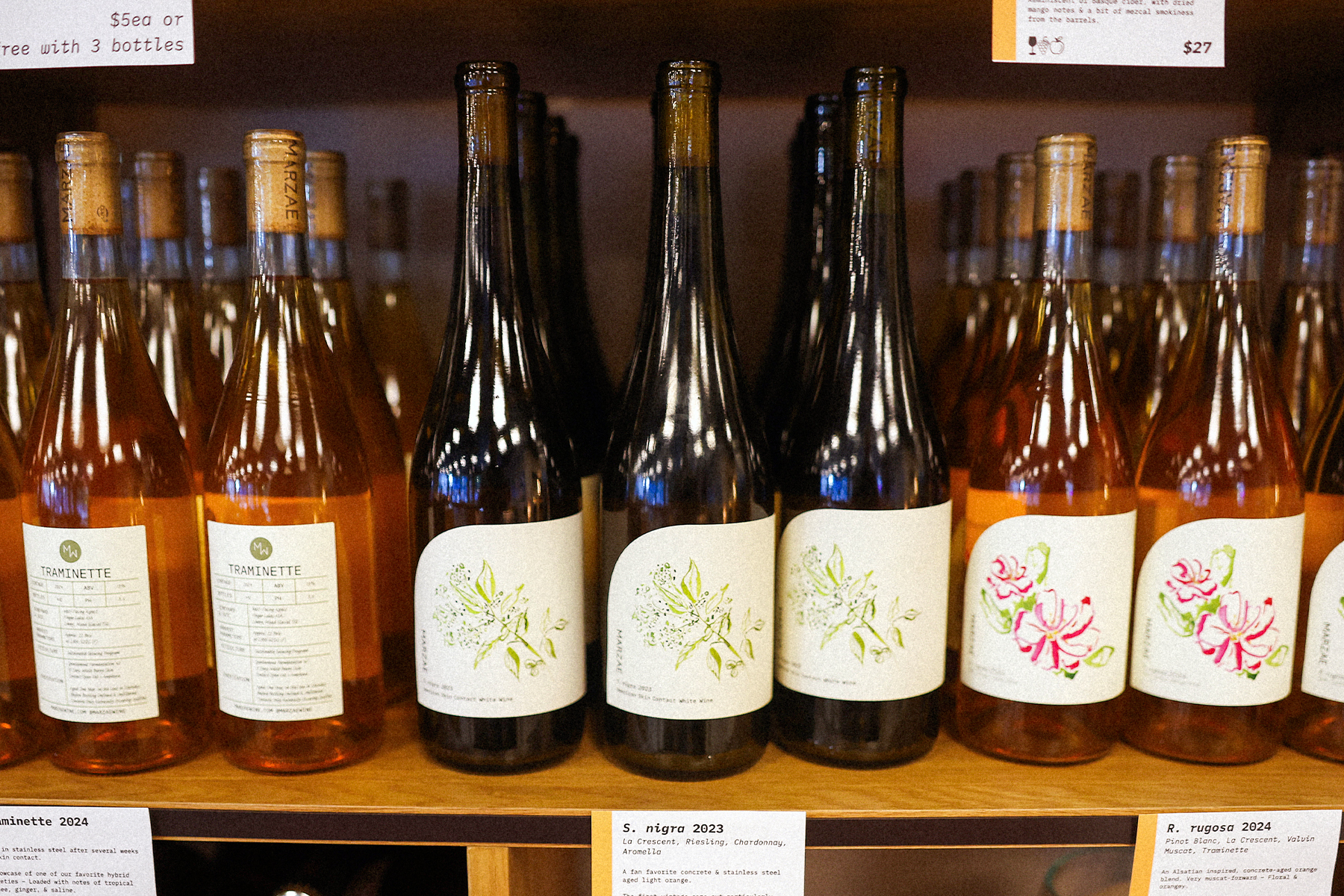
Let’s get one thing out of the way: I will take no orange wine slander. Even if it’s not your cup of tea, you have to applaud how funky skin-contact wine’s rise to ubiquity stateside has made drinking wine feel more fun and accessible for the casual, non-wine-obsessed aperitivo crowd. It checks many boxes for the millennial consumer, such as low-intervention production, versatility with food pairings, and the deep sense of storytelling often associated with small-scale producers.
Even so, the orange wine-lover memes have been nigh for a while, poking fun at the would-be elitism of its millennial demographic and often dubbing it a harbinger of gentrification (“If you spot any of these in your neighborhood, your rent is about to go up”). The other week, at a Brooklyn wine bar, I overheard a chic woman in Collina Strada begrudge her friend for suggesting that they “just get whatever orange” was on the menu. “Can we not?” she said. “Let’s not be basic.” Instead, they chatted with the server about what they called “more classic whites” and went for something from the Loire Valley.
This shift in orange wine’s hipper-than-thou factor was probably inevitable, says Scott Reiner, the wine consultant behind Eat, Drink and Be Happy, when we chat on the phone. “It’s interesting, because it’s one of the original forms of wine [from predominantly] Georgia and Northern Italy,” he says, “Then it sort of disappeared from the mainstream wine world for, you know, 2,000 years.” The natural wine movement changed that. “Now every major wine list in town, no matter how fancy it is, has an orange wine, if not [orange wine] section.”
But even orange wine’s antique pedigree can’t protect it from falling into the same, highly memeable trend cycles as Labubus and dot cakes. “When orange wine was super popular, it was the new kid on the block,” Reiner says. “Now it’s a slightly more mature market. A lot of people are going back to the ‘classics.’ If we’re talking about wines that sell, like, huge [numbers], Rombauer Chardonnay is still shockingly popular.” He also says chenin blanc is going through a “huge renaissance,” mostly thanks to Pascaline Lepeltier. “She’s one of the world’s greatest sommeliers, and a partner at Chambers restaurant in Tribeca, which has the best wine list in the country,” he adds.
“I think it’s really more a question of natural versus conventional wine,” says Michele Meltzer, the co-owner of the natural wine shop Irving Bottle in Brooklyn, when asked about what might deter folks from reaching for orange wines. Meltzer’s shop is located in Bushwick, aka the heart of the micronation of Tabi-wearing orange-wine guzzlers. “A lot of people come into the shop and use certain words to signify the thing they really want,” she says. “Orange wine equals natural wine and vice versa. Sancerre or Saumur equal traditional wine.” At the same time, she says that orange wine’s lack of codification, which you can find with those more “traditional” wines, can make it feel intimidating to shoppers.
“There’s an anxiety about choosing the ‘correct’ thing,” Meltzer says. “[Orange wine is] less likely to be verified by appellation names and Vivino, [so choosing ‘classics’] offers a greater sense of control between your expectations and results.” Parallel with the renewed interest in steakhouse culture and old-school, tavern-esque restaurant aesthetics, consumers seem to be swinging back toward familiar, nostalgic hallmarks — and in some cases, that may mean abandoning the funk of orange wine in favor of drinkable, juicy reds.
As a Californian, I grew up stealing oaky chardonnays from my friends’ parents liquor cabinets, and my then-forming frontal lobe supposed that this meant all white wines must be as drinkable as the Macy’s perfume aisle. (This was the era of the pinot grigio-pounding Real Housewives of New York City — no shade; I love you, Luanne — and the elitism discourse of Sideways.) It would take several more years of life experience, and friends who knew a lot more about wine, to grow beyond that misguided assumption. Orange wine was an essential stepping stone in that process: The first time I tried it, I felt like an elegant goblin (positive). It was during a heatwave in Paris in 2014, and the cool, sediment-filled glass made me realize that there was, in fact, a white wine for kids who grew up wrapping their Altoids Tangerine Sours (RIP) in weeds.
I’m never against a great meme. But when we cast stones at orange wine, may we also remember who is holding its glass in the first place. Often, it’s simply a greener version of ourselves.