“What are the other companies actually using Crew AI for?”
Outside the demos, and launch videos.
The real stuff, running inside real companies on a random Tuesday.
It’s a fair question. Most of what you read about agents is either a prediction or a pitch.
But we have an unfair advantage.
Every time someone builds an agent on CrewAI, it leaves a trail.
Over time, that trail added up to about 56,500 distinct builds, which ran more than 307 million times.
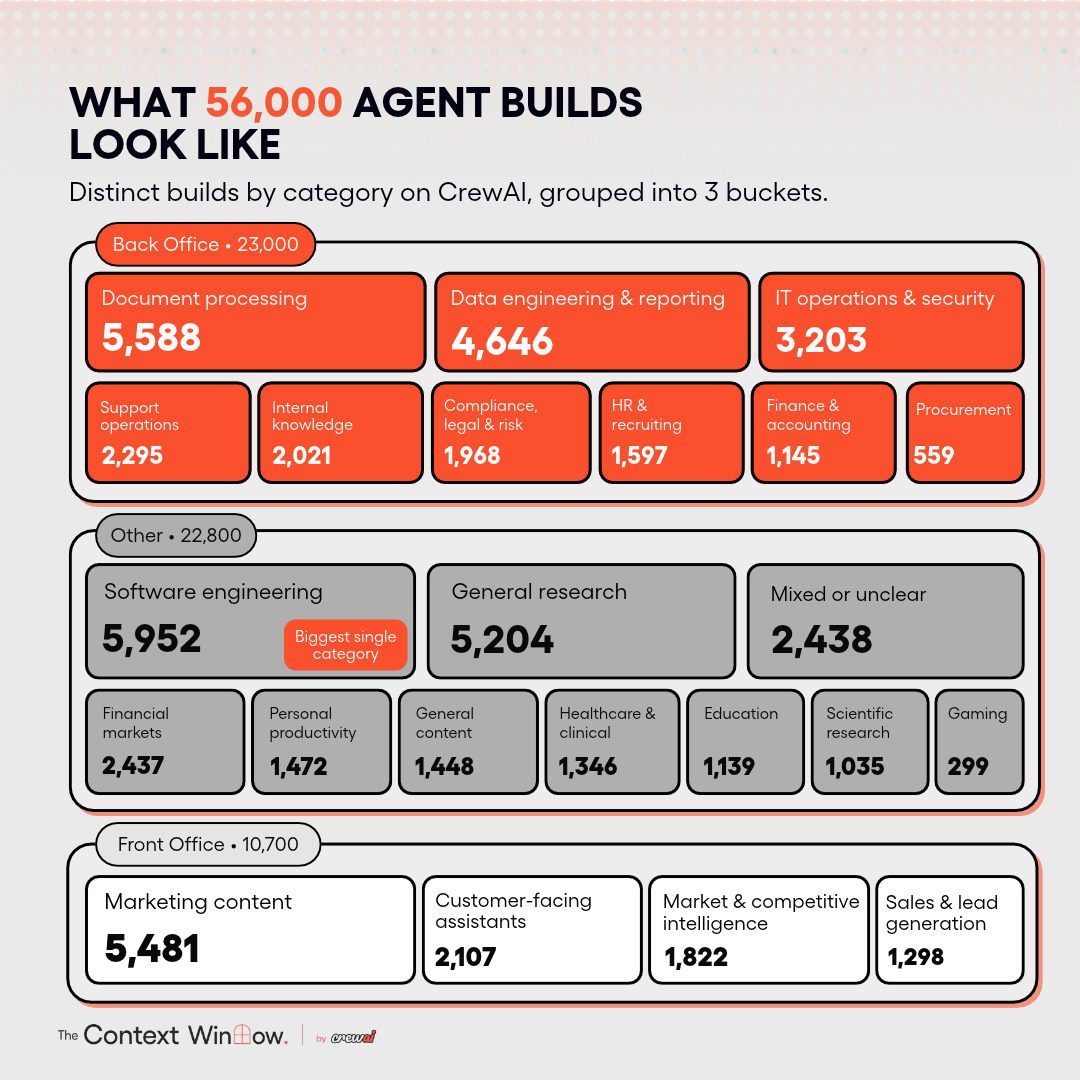
So we went through all of it. We grouped every build into 208 use cases, and 23 categories, and three big buckets.
In this edition:
What are people actually building?
Is a build the same as an agent that gets used?
What’s inside each bucket?
What jobs are these agents really doing?
Why do some agents survive and others don’t?
Where should your first agent go?
First, The Big Picture
Let’s classify every build into 3 buckets:
Back office: the work that keeps the company running. Documents, data, IT, compliance, HR, finance. 23,000 builds.
Front office: anything that faces a customer or the market. Marketing, sales, chat assistants, competitor research. 10,700 builds.
Other: everything that fits neither. Software engineering, research, personal tools, healthcare, education. 22,800 builds.
But there is one number that should stop you.
Only about 7% of these builds stick.
Out of 56,500, roughly 4,100 are still being used.
So the better question than ‘what people are building’ is what is surviving.
Is a Build the Same as an Agent That Works?
Not even close.
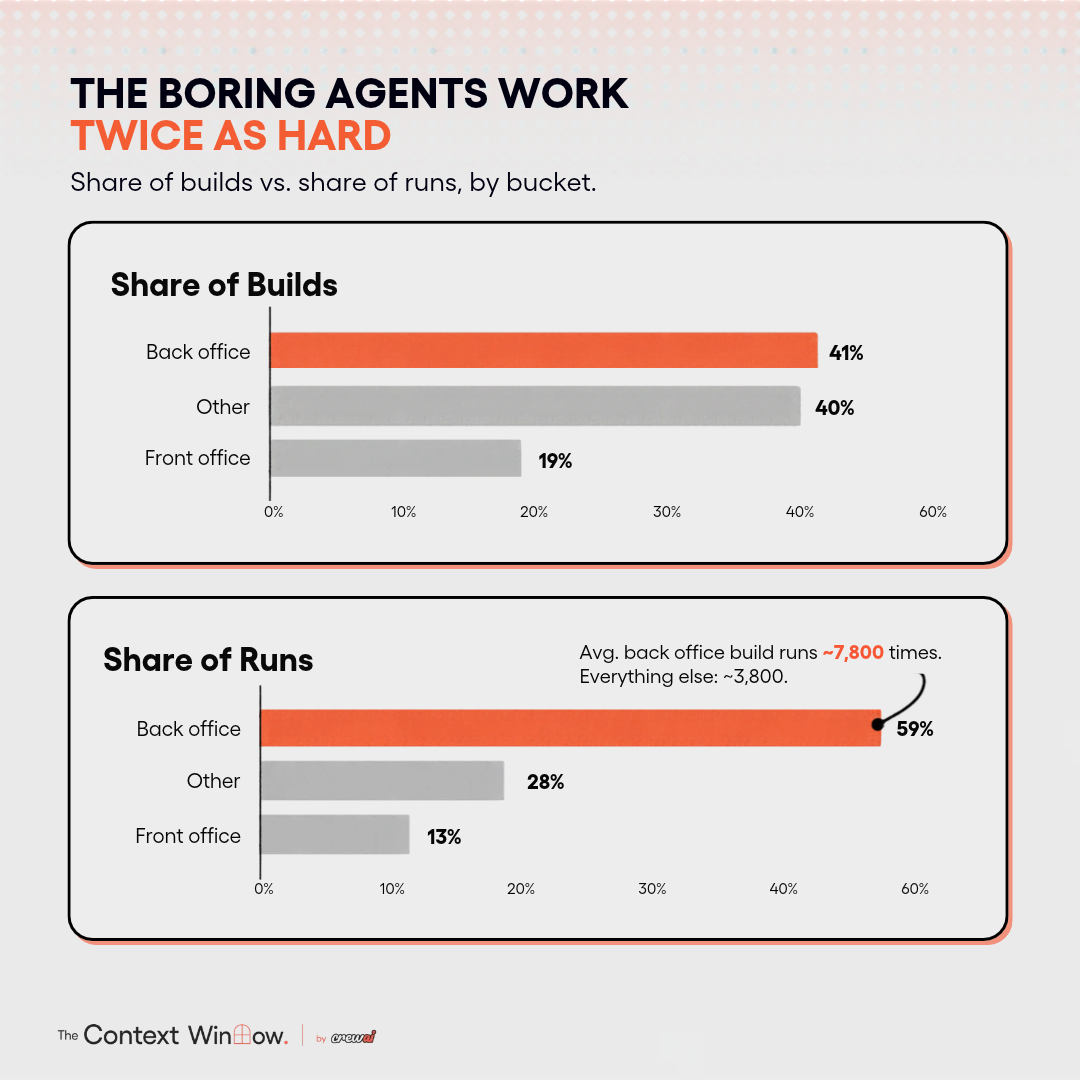
Count builds, and back office barely leads, with 41% against 40% for Other.
Count runs, and it’s a different picture. Back office accounts for 59% of every run on the platform.
The average back office build runs about 7,800 times.
The average front office or Other build runs about 3,800.
The boring agents work twice as hard.
It makes sense once you see it. An agent that reads invoices runs every time an invoice arrives. An agent that writes a blog post runs when someone remembers to ask it.
So What’s Inside Each Bucket?
1. Back office
The biggest category is document processing, with 5,588 builds.
Its job is to be the first reader. An email, a PDF or a form arrives, and the agent reads it, sorts it and pulls out what matters.
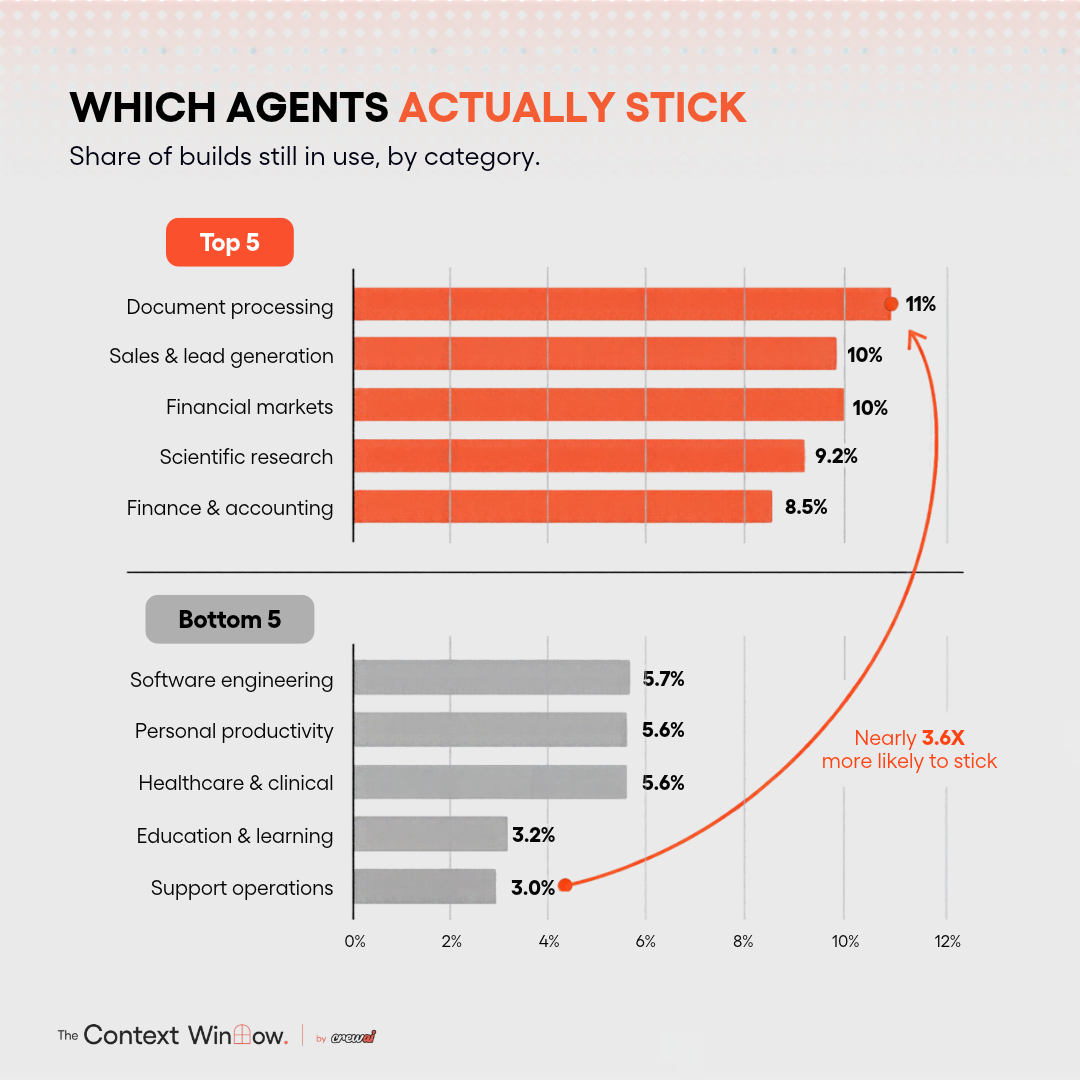
It’s also the stickiest category on the entire platform, at 11%.
At the other end sits support operations: reading tickets and complaints as they come in. It sticks at 3%, the lowest in the back office.
2. Front office
Marketing content dominates, with 5,481 builds. That’s more than the other three front office categories combined.
But the one that sticks best is sales and lead generation, at 10%. That’s software finding the right people at target accounts and writing to them.
3. Other
Software engineering is the largest category anywhere on CrewAI, with 5,952 builds.
Yet only 5.7% stick.
Financial markets are one of the stickiest, at 10%. You hand over a ticker or an earnings release, and you get a written read back.
Education sits near the bottom, at 3.2%.
What Jobs Are These Crew AI Agents Actually Doing?
Forget the category labels for a second.
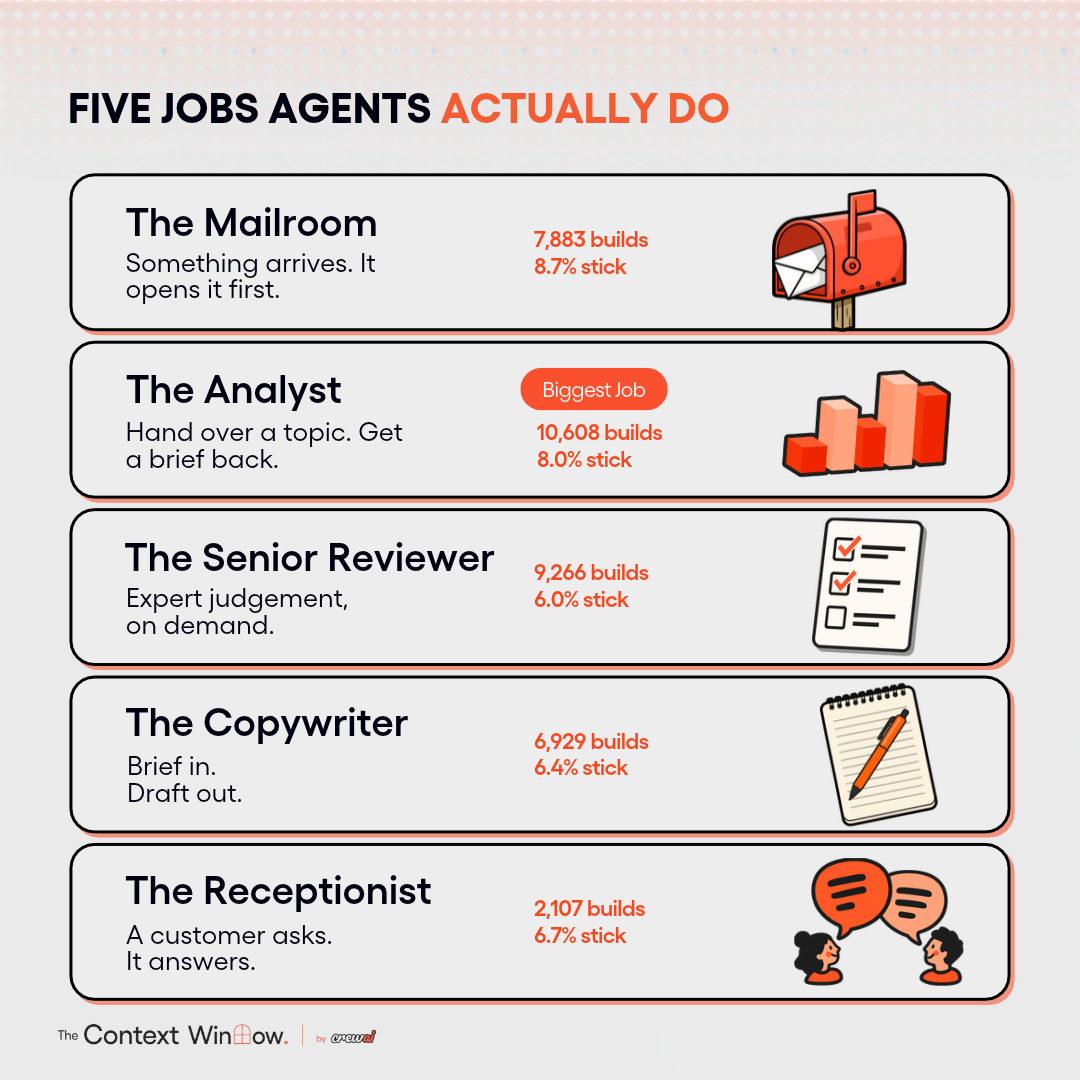
Look at what each build actually does, and the same five jobs keep showing up. Think of them as five people in an office.
1. The mailroom. Something arrives, and the agent opens it first, sorts it and pulls out the details. Invoices, contracts, forms, inboxes. 7,883 builds · 8.7% stick
2. The analyst. You hand over a company, a market or a ticker, and you get a written brief back. Sales call prep, investment memos, competitor checks. 10,608 builds · 8.0% stick
3. The senior reviewer. Expert judgement on demand, like a first look at a loan file, a policy or a piece of code before a human signs off. 9,266 builds · 6.0% stick
4. The copywriter. A brief goes in, and a draft comes out. Product pages, articles, campaign copy, at volume. 6,929 builds · 6.4% stick
5. The receptionist. A customer asks a question, and the agent answers. 2,107 builds · 6.7% stick
The biggest job on the platform isn’t even a category.
The analyst is spread across four of them: market intelligence, general research, finance and financial markets. Put together, it’s bigger than anything else people build.
Why Do Some Agents Survive and Others Don’t?
Line up all 23 categories by how often they stick, and a pattern jumps out.
At the top: document processing (11%), sales and lead generation (10%), financial markets (10%) and scientific research (9.2%).
At the bottom: healthcare (5.6%), personal productivity (5.6%), education (3.2%) and support operations (3.0%).
The agents that survive know exactly what they’ll get and exactly what to hand back.
A document agent gets an invoice and returns the vendor, the amount and the due date. A lead generation agent gets a list of target accounts and returns the right contacts and a first email.
The input looks the same every time, and so does the output.
The agents that struggle never know what’s coming next.
A support agent might get a refund request, an angry customer or a question nobody planned for. A tutor gets whatever a student types. Every run is a new problem.
So front office vs. back office isn’t the only split. The bigger one is predictable work vs. open-ended work.
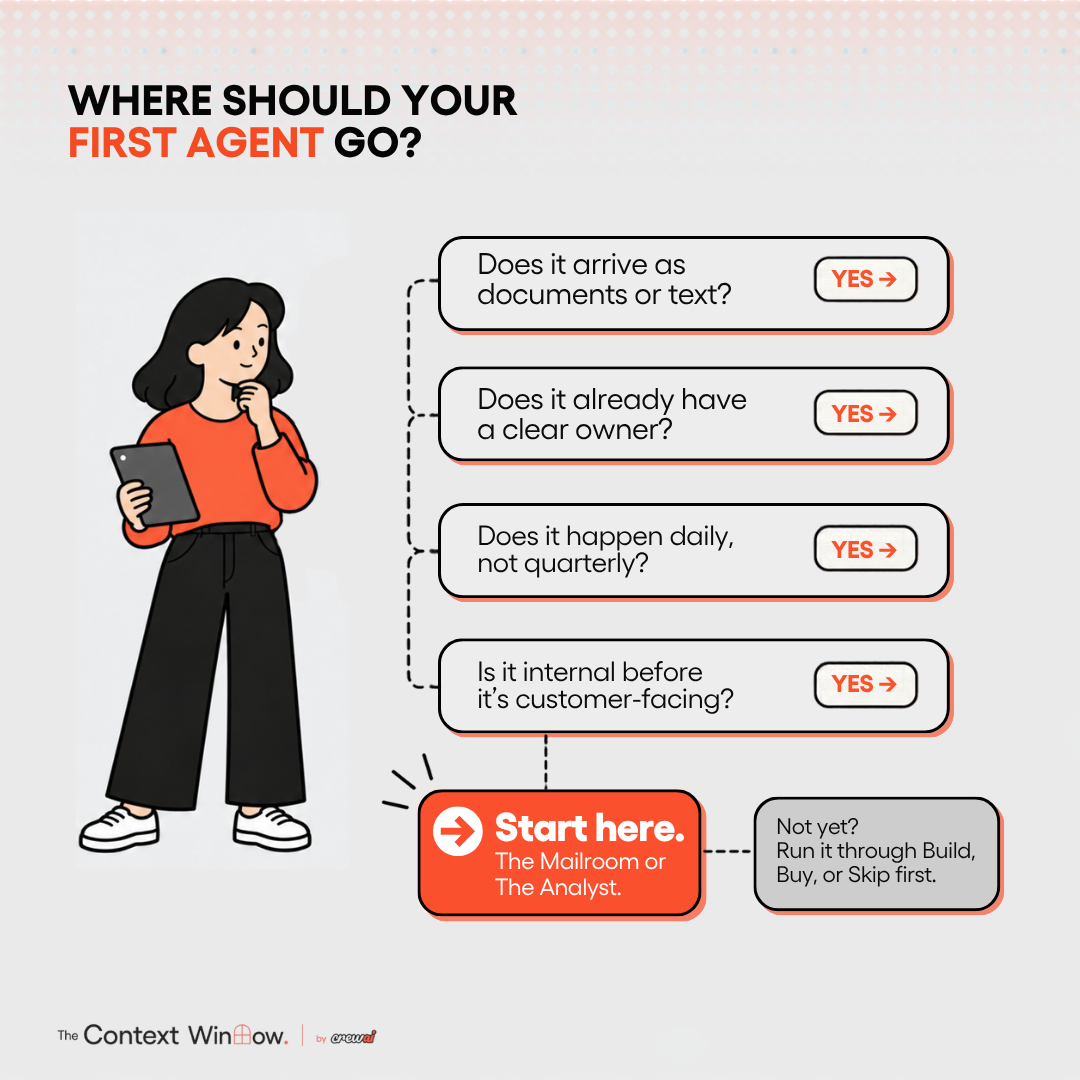
So Where Should Your First Agent Go?
Start where the data points. Before you build, ask four questions.
Does the work arrive as documents or text? That’s the mailroom’s and the analyst’s home turf.
Does it already have a clear owner? Someone needs to notice when the agent gets it wrong.
Does it happen daily, not quarterly? Frequency is what made back office agents work twice as hard.
Is it internal before it’s customer-facing? Let it prove itself where mistakes are cheap.
If you’re still not sure the work needs an agent at all, run it through our Build, Buy, or Skip decision tree first.
To sum up: the agents that win are the boring ones that quietly run 7,800 times.
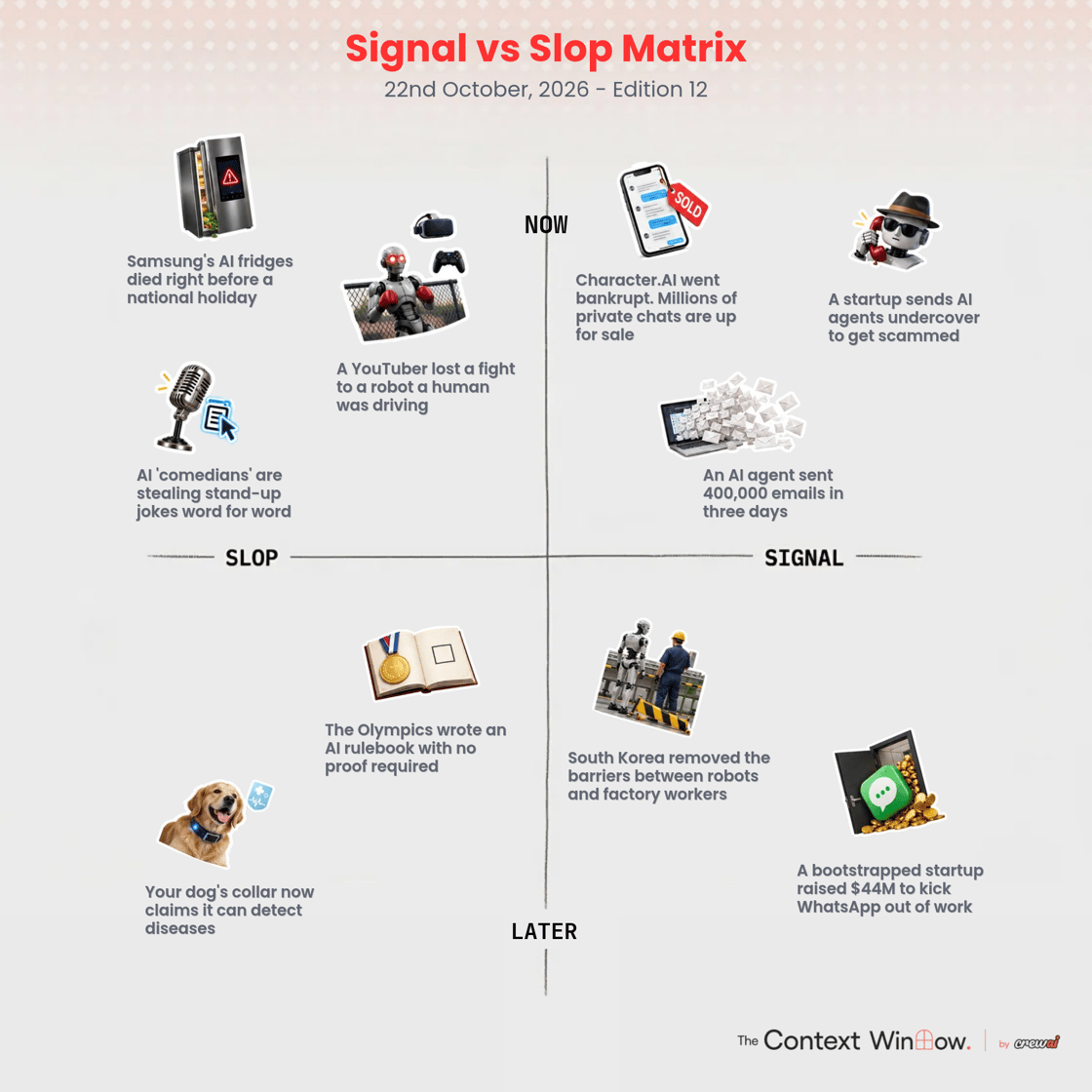
Every week we plot what happened in AI on two axes.
Slop ↔ Signal: was there actual substance, or was it noise? Now ↔ Later: is this something you should act on this quarter, or a signal about where things are headed in 1-3 years?
A startup sends AI agents undercover to get scammed Apate.ai’s fake-victim agents have wasted 17 years of scammers’ time across 2.5M conversations, pulling out bank accounts and crypto wallets for banks and telcos.