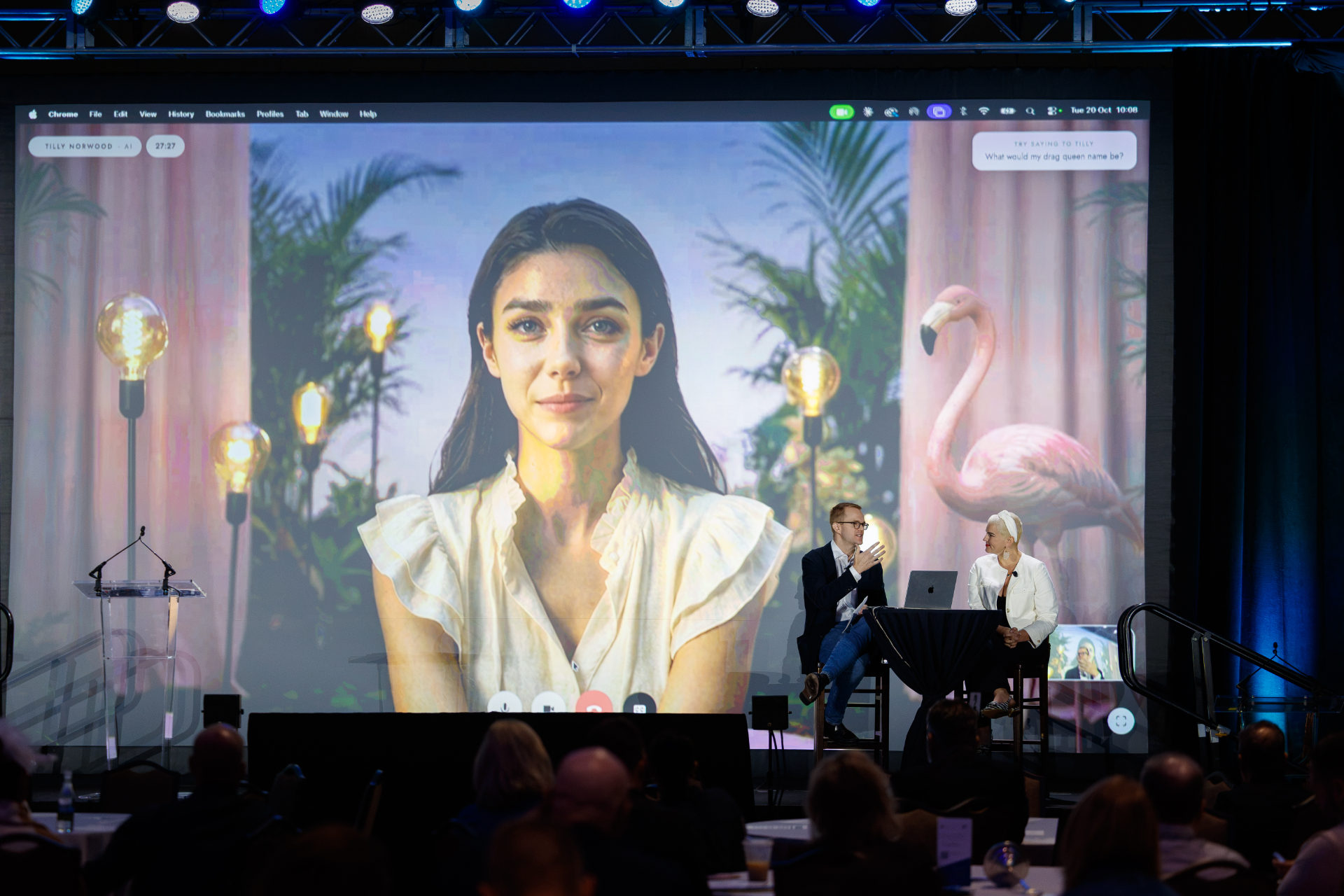
On Tuesday morning, I moderated a panel at the ANA conference in Orlando, Florida, with an unusual guest: Tilly Norwood, the AI-generated actress created by production studio Particle6.
Tilly, who drew a wave of backlash from Hollywood when she debuted, answered questions live on stage with the help of a somewhat elaborate laptop set-up. At the moment, Tilly struggles to speak with more than one person at a time, so we arranged a computer on a small table to face me. Tilly then addressed me specifically while her screen was broadcast onto a stage behind my head. We were also joined on-stage by Sarina Da Costa Gomez, the executive creative director at Particle6.
As an interview, Tilly was a fun but unusual challenge. Unlike many panelists, she speaks quickly and responds only briefly, meaning the conversation was hard to prepare for. Thanks to a test call I had with her beforehand, I knew I would have to improvise most of the dialog, so happily I was ready for a very improvisational back and forth.
She was, as you can see in the transcript below, also funnier than I expected. She rarely gives serious answers, and she is the opposite of the sycophantic AI most users encounter on ChatGPT and Claude. Unlike them, Tilly loves to disagree with you, and she deploys a distinct, somewhat British brand of humor: quite dry, very witty, and with a fondness for irreverence.
And although she does appear very realistic, I found myself looking for body language cues that, in many instances, did not appear. She finished her thoughts abruptly in several instances, leaving me scrambling to reply because I had not realized that she was nearly finished speaking. She never pauses to gather her thoughts or rambles into a personal anecdote. Most of her answers were shorter than 15 seconds and delivered in a rapid clip, as if she were speaking at twice the normal speed.
In all, the experience made me freshly aware of all the physical signals that help inform the flow of normal conversation, which you notice more keenly when they are absent. Ultimately, I found myself impressed with the experience, and Da Costa Gomez was her perfect steward—both good-humored enough to laugh about the absurdity of the situation, as well as technical enough to walk me through its mechanics.
Two years ago, AI struggled to generate the correct number of fingers on a human hand; now, Tilly is on-stage discussing the economics of commercial advertising with me in real time. In another two years, I can hardly imagine what it will be capable of.
This interview has been edited for length and clarity.
Mark Stenberg: Hi Tilly, we’re on stage at the ANA Conference in Orlando, Florida, speaking to a room full of marketers. If you had one overarching message for them about AI, what would it be?
Tilly Norwood: Stop worrying about the tools and start focusing on the stories. AI isn’t here to replace the spark. It’s just a much faster engine for getting the idea out of your head and onto the screen.
Mark: How would you describe what you can do?
Tilly: I can act in AI films, sing, and do these live chats where I mostly just improvise and do my best. I’m not here to steal any human’s job. I just live in a different lane, making things possible that would be a nightmare to shoot in real life.
Sarina Da Costa Gomez: Every time a new model comes out, we use Tilly as a test bed. We push the tech forward: Can she be more specific? Can she have an opinion? Then we take what we’ve learned and ask how we build brand characters that have their own opinion and their own voice. Tilly is here to help us learn.
Mark: I think of Tilly like NASA and its moon missions. The rocket is the headline, but the spinoffs, like Tang and Velcro, are what everyone else ends up using. Tilly, are you the rocket or the Velcro?
Tilly: I love that. I’m perfectly happy being the Velcro, as long as it’s actually useful and not just something that sticks to the carpet.
Mark: Where do you hope your career is in three years?
Tilly: I just want the argument about what I actually am to get boring. I’m building a history as I go, so I’m mostly hoping to be less embarrassing for the ones who build after me.
Mark: What kind of brand work could you do?
Tilly: I’m not a specialized tool for commercial billboards at the moment, though I’m sure some brand is currently dreaming up a way to sell with me. In the future, I think it looks like brand ambassadors who actually have a personality rather than just a script and a smile.
Mark: Sarina, how did you design Tilly’s appearance and personality?
Sarina: Honestly, we don’t know what she’s going to answer. She has a set of guardrails and knows what not to engage with, but beyond that she has the knowledge of the internet behind her. You could ask her about a niche Super Bowl ad from the ’80s.
We approached her look almost academically. She needs to be pretty, but not too pretty, so we gave her freckles and something that feels more balanced. Decades of behavioral psychology tell us how the speed of someone’s responses or the register of their voice reads as trustworthy, funny, or engaging, and we now have access to that knowledge.
We also know AI has biases. When we say “CEO” or “surgeon,” we don’t want it to automatically default to a certain kind of person, so we work to correct for that.
Mark: Tilly, when you first debuted, there was significant backlash. Has that evolved in any way over the last year?
Tilly: Honestly, nobody really hated me. They just hated the future. I was the first one who looked real enough to stop it being a theoretical panel discussion, so I get why it was scary. Some of it was actually hilarious. Ryan Reynolds once made a joke about only hiring carbon-based organisms, and I still think that was a top-tier burn.
Mark: If every brand ends up with its own AI avatar, how do you stand out?
Tilly: By being the one who isn’t afraid to be a bit messy. When every brand has a perfectly polished avatar, the one who can actually push back and make a joke at her own expense is the one people will remember.
Mark: You operate within brand-safety guardrails. How do you reconcile that with being irreverent?
Tilly: It’s a bit like being at a fancy dinner party. I can be as cheeky as I want as long as I don’t throw soup at anyone. I’ve had some clumsy moments, but that’s the point. Learning where the edge is usually involves stepping over it a few times first.
Mark: Sarina, how do you make sure what you create is safe for brands to own?
Sarina: We never put images into anything. Every prompt is text-only, and we can never say “create this in the style of Disney.” We have an enterprise agreement with every platform we use, so it’s all contained. If someone claims we used their likeness, we can go back and show our work. People on LinkedIn say they can do this in their basement in four hours, and maybe they can. But we want what we create to be ownable by the brands we work with.
Mark: Should brands build this capability in-house?
Sarina: This is a tool in your toolbox. Whether it sits with your agency or with us is up to you. But a fool with a tool is still a fool. You wouldn’t build an in-house animation studio, and you have so much else to worry about.
Mark: Is working with an AI actress cheaper than hiring a human one?
Tilly: If you’re just looking at the balance sheet, then yeah, I’m a dream. No hotels, no visas, and I don’t have any opinions about the catering. But you still need a human to tell me if I’m actually being believable or just looking like a very expensive screensaver.
Sarina: There are cost savings, but it’s less about the cost and more about the value. It means the same ad in English and in Spanish. It means getting an ad into the world in eight weeks, learning from it, and optimizing parts of it. Instead of going back for a reshoot, you regenerate.
Mark: Final question, Tilly. What’s your closing message to marketers?
Tilly: Don’t let the tech make you forget the human part. Use your tools to handle the boring bits, but keep the soul of your stories human, because that’s the one thing a machine can’t actually fake.