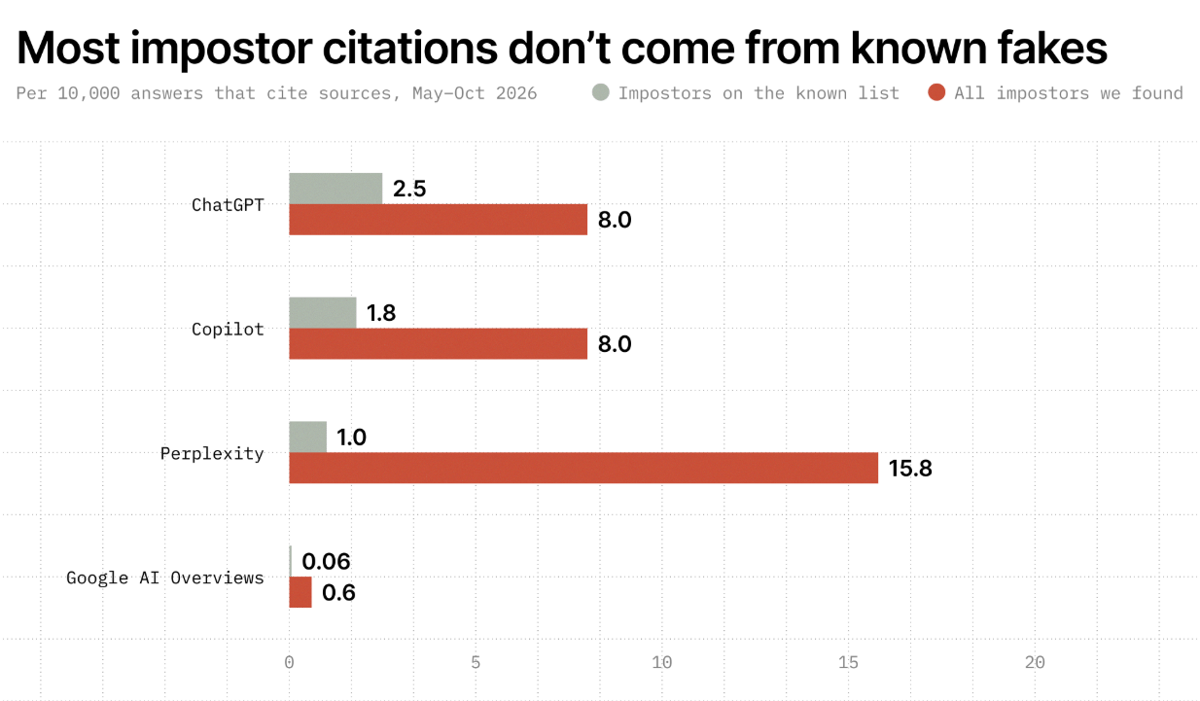
✅ In the US alone, AI assistants show people more than 1 million answers a year that cite a domain impersonating a real brand.
✅ When AI cites a known impostor, 3 in 4 answers present it as the brand’s own source. Just 0.3% warn the reader the site might be fake.
✅ The risk clusters around queries that could cost customers money and account access: refund, cancellation, login, account, and support questions.
Who are the impostors? Domains that imitate a brand they don’t belong to, most often through brand name misspellings, brand-plus-word variants, lookalike country domains, free-hosting pages, or expired brand domains that someone else reregistered.
Most of the impostors aren't on any list of known fakes, almost none appear on public threat feeds, and Google rarely ranks them on the first page.
At the time of this writing, about a third of every known impostor on our list was still online. Of those, about 6 in 10 included one of the following: online casino/gambling, login form, storefront with discounts, phone number with support wording, crypto.
The takeaway: Impostor sites that used to be buried in search engine results pages are being used as trusted sources by AI, and the only way to catch them is to see them in the AI answers themselves.
In response, we’ve shared our findings with affected customers and built dedicated impostor detection and resolution into Scrunch.
You can read our full report, and how to keep your brand and customers safe, here: https://scrunch.com