It reads each invoice, matches it to the purchase order, checks the vendor and prepares the payment. It gets 98% of cases right.
Your finance team loves the demo. Your CTO wants to ship it. Then your CFO asks one question:
“What happens when it gets the other 2% wrong?”
Suddenly, nobody wants to launch.
This isn’t just a hypothetical. A global beverage manufacturer we work with ran into exactly this question, and found a way past it. We’ll show you how at the end.
First, why are so many teams stuck here?
The technology is good enough to get people excited. The harder part is getting a business comfortable handing it real systems: money, customer records, operational decisions.
And the numbers show how wide the gap is.
Deloitte found only 25% of organizations had moved 40% or more of their AI pilots into production. Cisco found 85% were experimenting with AI agents, but only 5% had them in broad production.
That’s half the picture.
About 400 million agent executions run on CrewAI every month.
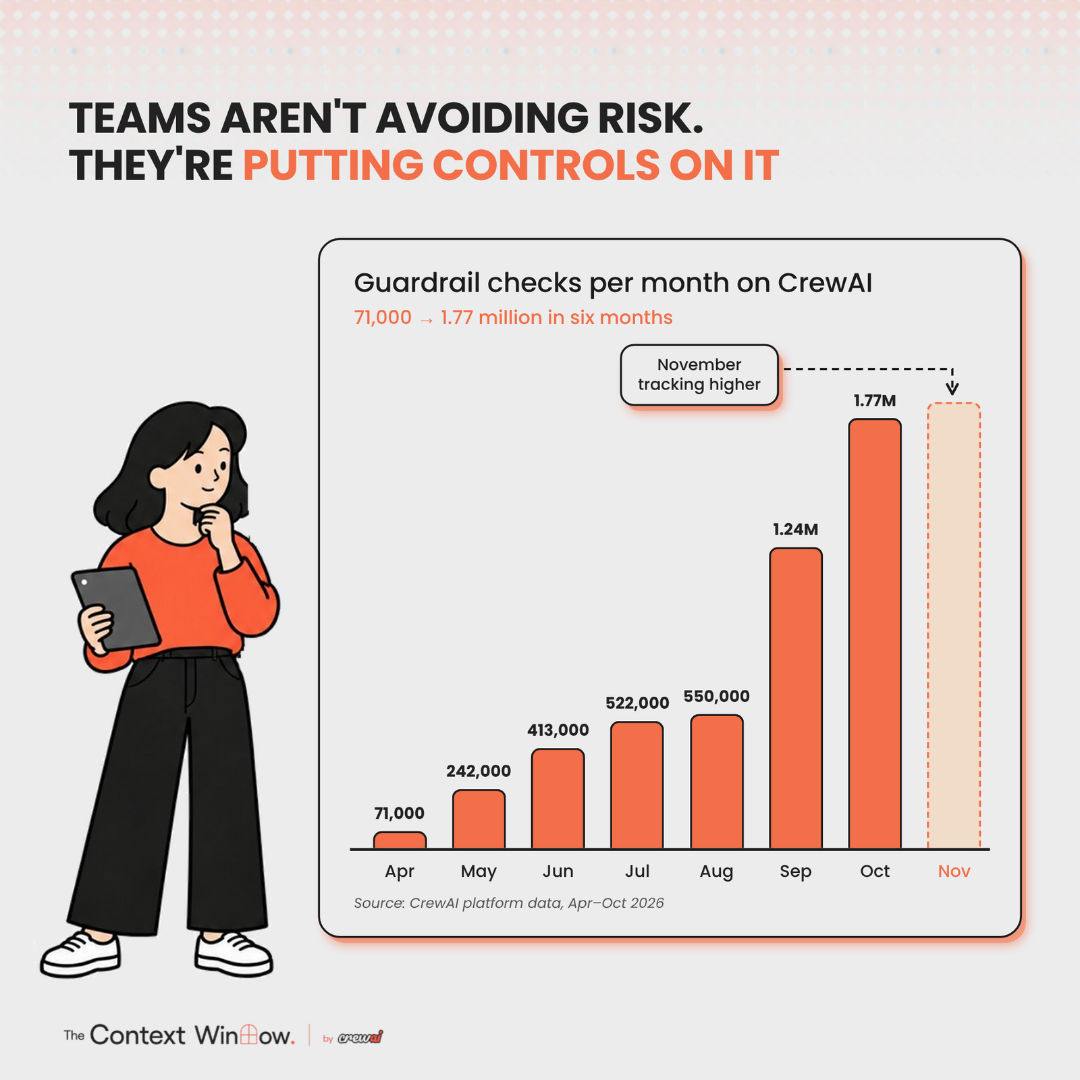
The #2 use case, right behind research, is document-heavy finance and compliance work. And guardrail checks jumped from 71,000 in April to 1.77 million in October, with November tracking higher.
Teams aren’t avoiding risk. They’re putting controls on it so they can ship.
Let’s unpack how.
A demo and a production system are two very different animals
On a typical AI pilot, a small team picks a use case, cleans up a dataset, connects a model to a few tools and creates an isolated environment.
The agent performs a task. It gets the answer right.
Everyone claps.
Then someone asks to connect it to the actual ERP, CRM or financial system.
And two questions come up fast:
Can we see exactly what it did?
Can we stop it before a mistake travels downstream?
Both have good answers. The pilot proved the agent can do the job. Production is about showing it can do the job in a way the business can see, control and correct.
That’s how teams close the trust gap, and it comes down to two layers.
The two missing layers: Trust and technology
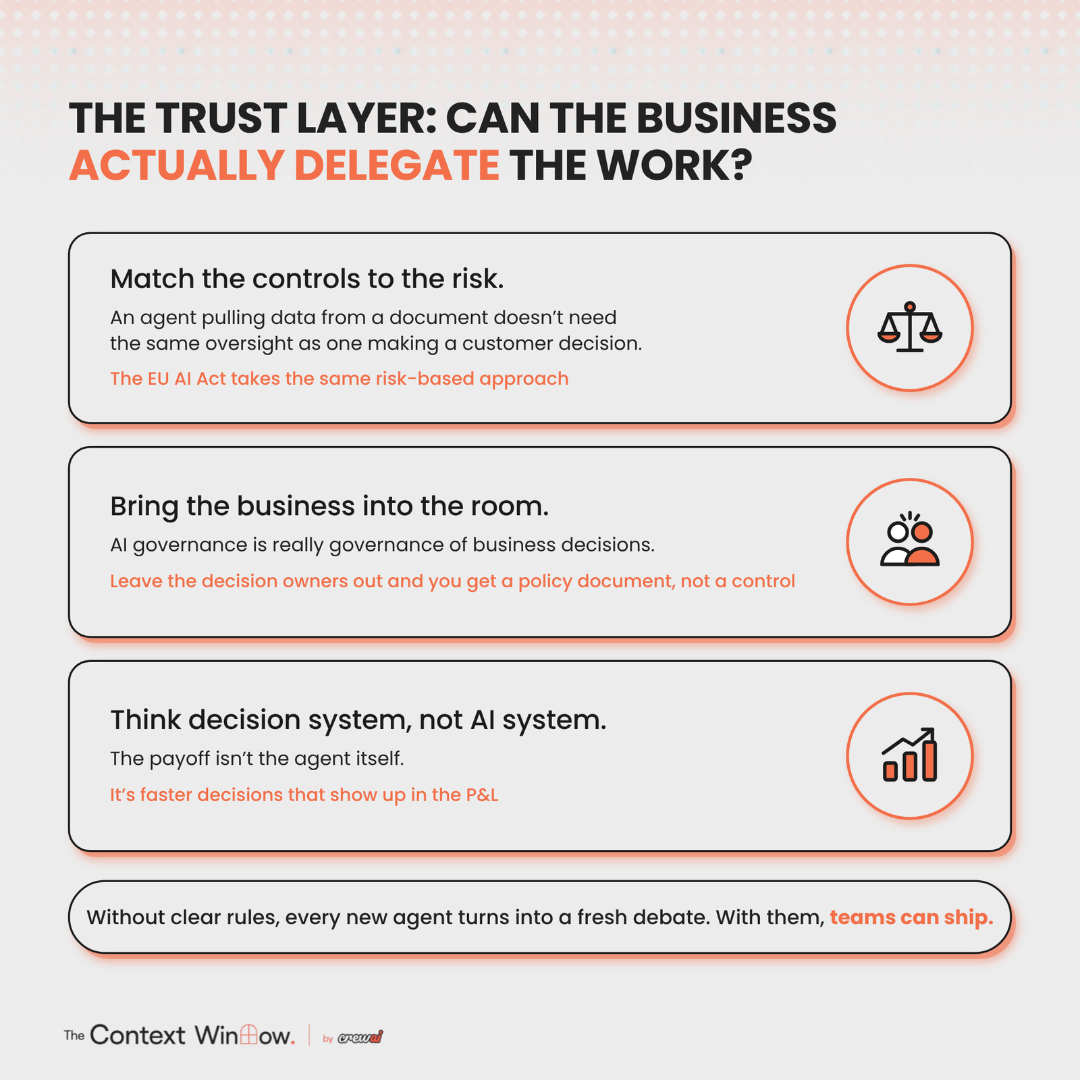
1. Trust: Can the business actually delegate the work?
Most teams treat governance as the thing that slows AI down.
Arindam Choudhury, who leads Insights & Data for Financial Services at Capgemini, argued the opposite on our webinar last week: what slows you down is not having it. Without clear rules, every new agent turns into a fresh debate. With them, teams can ship.
Here’s what that looks like in practice.
Match the controls to the risk. A document-reading agent doesn’t need the oversight of one making customer decisions.
Bring the business into the room. Without the decision owners involved, you get a policy document, not a control.
Think decision system, not AI system. The payoff is faster decisions that show up in the P&L.
2. Technology: Can the infrastructure actually support delegation?
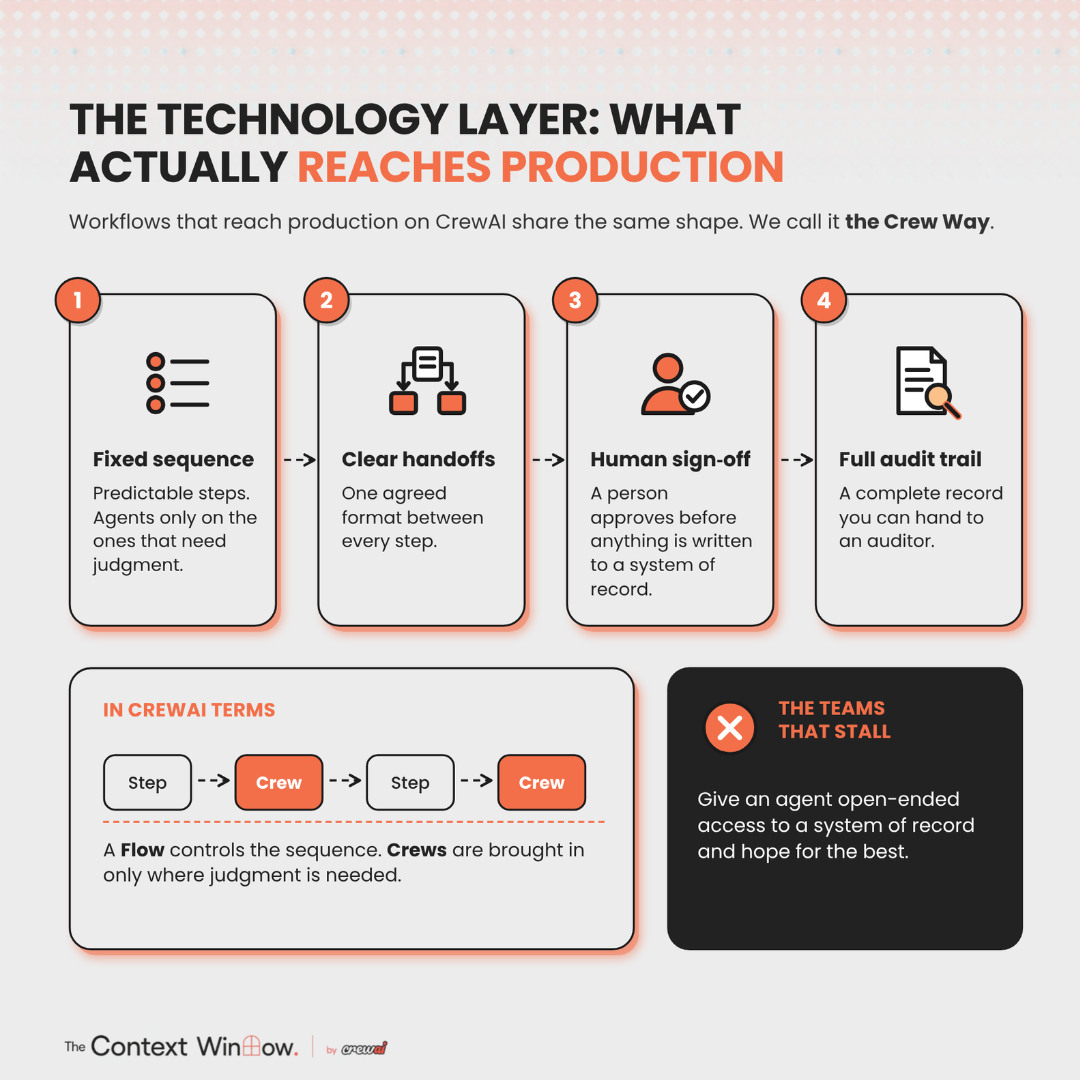
The workflows that reach production on CrewAI share the same shape. We call it the Crew Way:
Fixed sequence. Agents work only on the steps that need judgment.
Clear handoffs. Every step passes work on in an agreed format.
Human sign-off. A person approves before anything is written to a system of record.
Full audit trail. Every run leaves a record you can hand to an auditor.
The teams that stall give an agent open-ended access to a system of record and hope for the best.
One consumer finance firm requires human review for any contract over $50K or any price increase over 5%. When the business can read the rules, it will actually enforce them.
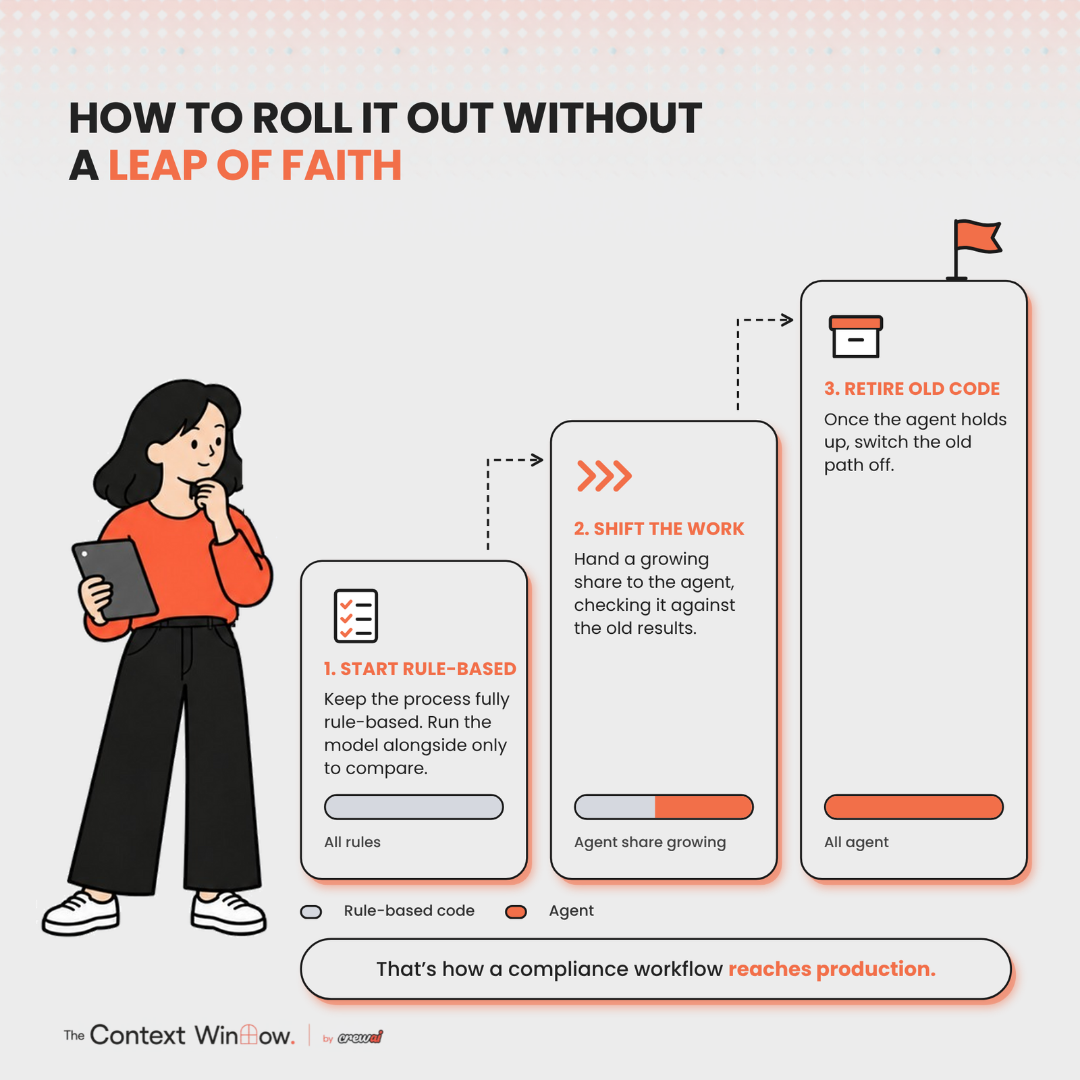
How to roll it out without a leap of faith
Start fully rule-based, shift work to the agent while checking it against the old results, then retire the old code once it holds up.
What we're doing at CrewAI
Last week Joao Moura, CrewAI’s CEO, sat down with Arindam Choudhury, who leads data and AI for financial services at Capgemini, to walk one approved loan from “yes” to “funded,” live.
One thing stuck with me:
In the demo, an agent flagged a deal where the borrower was “Bluewater Logistics” in one system and “Bluewater Logistics Holdings” in the agreement. That kind of mismatch can sit on a desk for days… or weeks.
So how did the beverage manufacturer answer the CFO?
They didn’t try to make the agent perfect. They made it predictable and checkable. The agent reconciles invoices against fixed validation rules, so it can’t improvise on what counts as a match, and every correction is recorded so finance can trace what changed and why.
The targets: about 420 manual hours a month removed, and exception handling cut from 24 hours to under 15 minutes.
Those are still targets. For a measured result from the same company: their refund agent took processing from 3 days to 10 minutes, as we covered in the last issue.
One question for your next AI strategy meeting
What would it take to let this agent run tomorrow morning?
Four answers:
You can see exactly what it did. Every step, decision and correction is in a record you can hand to an auditor.
You know what it was allowed to touch. It follows a fixed sequence, with agents only on the judgment steps. Nothing is written to a system of record until a person signs off.
You can fix a mistake once. Every decision runs on a written rule, like “review any contract over $50K.” When something goes wrong, you change the rule, and the fix covers every case after it.
You’ve already seen it work. It ran alongside your old process until its results matched.
If you can answer all four, your agent is ready to run. If you can’t, you don’t have a model problem. What’s missing is the structure around it.
The next generation of enterprise AI won’t be won by whoever builds the smartest agent. It’ll be won by whoever figures out how to safely put that agent to work.
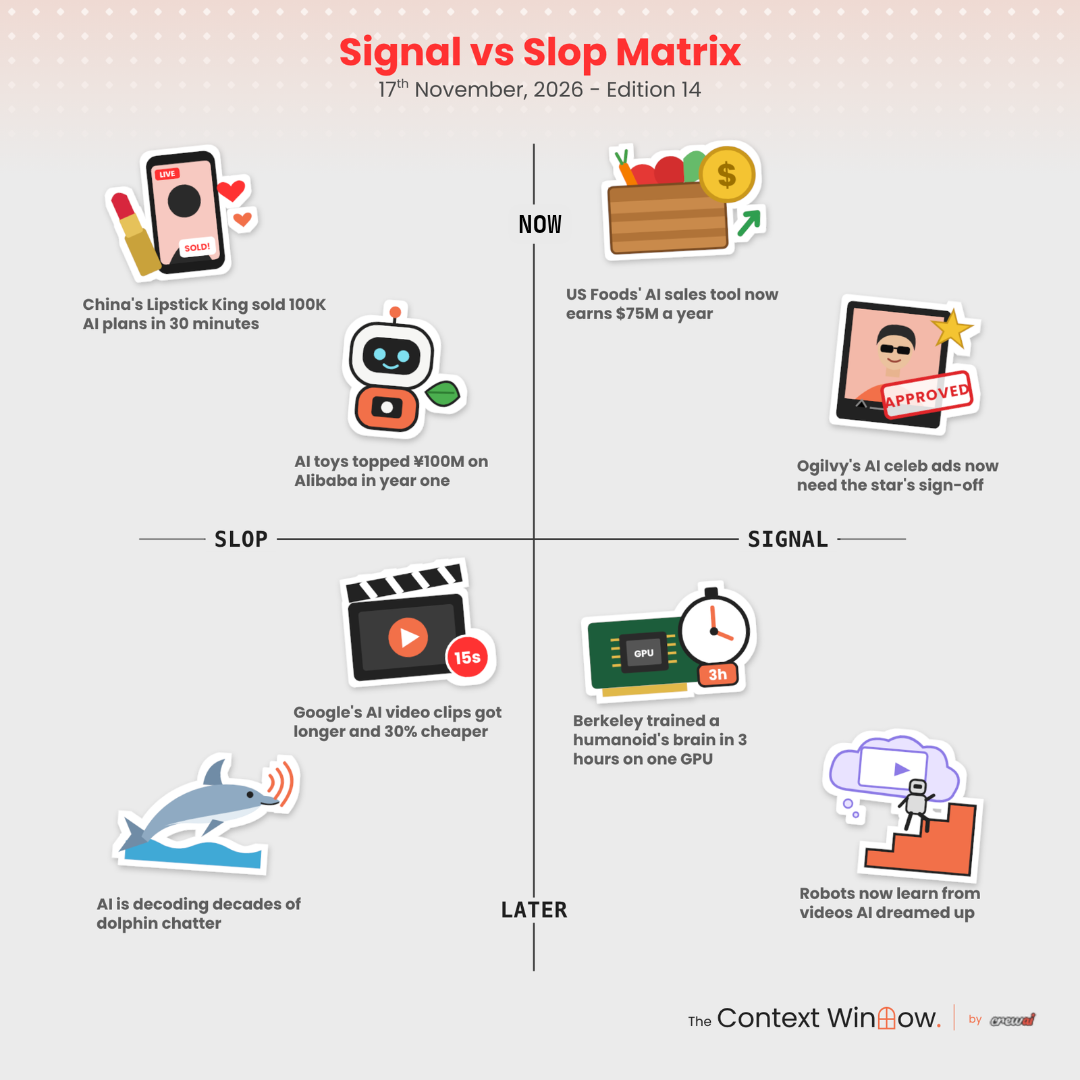
Twice a month, we plot what happened in AI on two axes.
Slop ↔ Signal: was there actual substance, or was it noise? Now ↔ Later: is this something you should act on this quarter, or a signal about where things are headed in 1-3 years?
Let's see what happened:
NOW / SIGNAL
US Foods’ AI sales tool now earns $75M a year US Foods CEO Dave Flitman told investors that the company’s AI tool reads each customer’s purchase history and menu, then tells the sales rep what to pitch. It is delivering more than $75 million a year in benefits. The company expects AI’s contribution to top $110 million in 2027, and accounts that get its suggestions grow case sales 10% faster.
Ogilvy’s AI celebrity ads now need the star’s sign-off Ogilvy’s new ECHO platform turns one celebrity shoot into 30 to 50 AI-generated ads instead of the usual 8 to 10. Talent must approve every asset before publication, and each approved asset carries a watermark reading “[Talent Name] Approved | Recreated with AI.” In Ogilvy’s survey of more than 1,200 people, over 76% said talent approval made the ads more appealing.
NOW / SLOP
China’s Lipstick King sold 100K AI plans in 30 minutes During Singles’ Day, top livestreamer Li Jiaqi, best known for selling lipstick, sold about 100,000 monthly memberships in half an hour. Each cost 0.01 yuan (a fraction of a US cent), versus the usual 28 yuan. The product was Alibaba’s QwenWork. The real test is whether anyone renews at full price.
AI toys topped $14 million on Alibaba in their first year AI toys surpassed 100-million yuan (about $14 million) in sales on Alibaba’s platforms within one year of launching as a new category, and AI companion robot sales rose nearly fivefold year on year in late October. One hit is Dr. Look’s camera, which lets kids snap a leaf or an insect and then explains what it is.
LATER / SIGNAL
Berkeley trained a humanoid’s brain in 3 hours on one GPU SuperMimic, from Pieter Abbeel’s group at UC Berkeley, won Best Paper at CoRL 2026. It trained a humanoid whole-body controller in 3 hours on 1 H100 GPU. NVIDIA’s SONIC took about 21,000 GPU-hours on 128 L40s.
Robots now learn from videos AI dreamed up GRAIL, from NVIDIA and UCLA, uses a video model to create humanoid training data, with no human demonstrations or motion capture. A real Unitree G1 trained only on video-model data succeeded at 84% of object pick-ups and 90% of stair climbs.
LATER / SLOP
Google’s AI video clips got longer and 30% cheaper Google’s Gemini Omni 1.2 Flash now creates clips up to 15 seconds (up from 10), supports follow-up edits, and costs 30% less at $0.07 per second for 720p.
AI is decoding decades of dolphin chatter Denise Herzing, who founded the Wild Dolphin Project, says scientists are now using AI to search decades of dolphin recordings for sound patterns. The team has tried underwater devices that play specific sounds, but no genuine two-way conversation has been demonstrated yet.
To our US readers: have a restful Thanksgiving next week.