| |
|
|

|
|
Agents are in production. APIs are still not ready.
That is the finding at the center of this year’s State of the API Report. For eight years it has been our clearest read on how the world builds with APIs, and this year it says something we could not have written a few years ago: the consumer of APIs is increasingly software that cannot ask you, or a teammate, a question. We surveyed 8,953 developers, architects, and executives around the world to see where that leaves us.
Picture a team that shipped an agent last quarter. To do anything useful, it has to call a dozen APIs. Those APIs were built years ago for developers. A person could read the docs, ask a teammate why a call failed, and work around the odd error. An agent cannot do any of that. It needs clear descriptions, predictable errors, tight permissions, and a way to find the right endpoint.
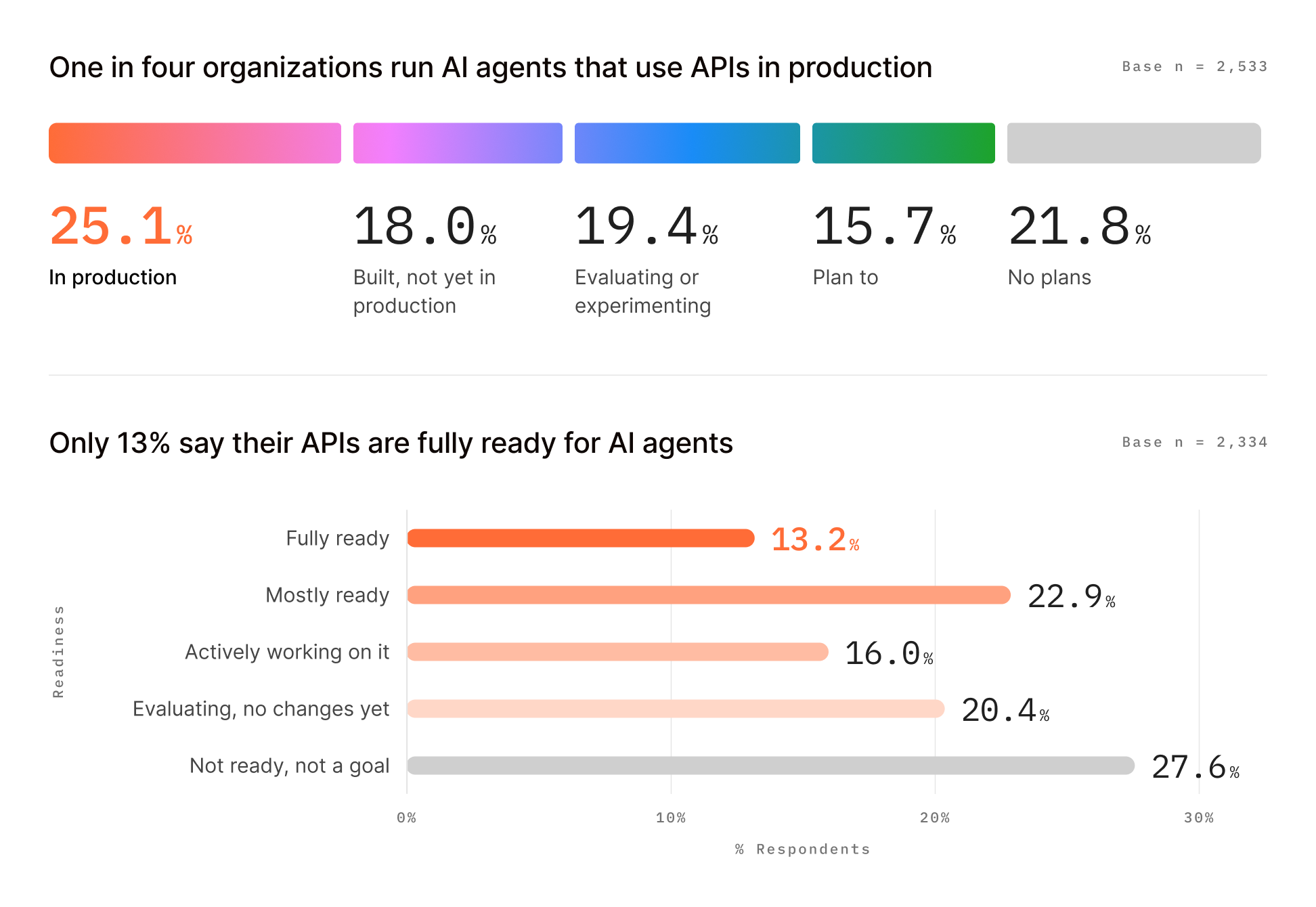
So we asked: were these APIs built for an agent? Mostly, no. 25.1% of teams run agents that use APIs in production, yet only 13.2% say their APIs are fully agent-ready — 36.1% if you count “mostly ready.” That leaves a lot of agents leaning on APIs designed for humans.
I do not see this as a failure. It is what happens when a new kind of consumer arrives faster than the tooling, and it is a gap Postman is helping organizations close. The teams that are fully API-first already run 2.6x more agents in production. Read the full report →
Abhinav Asthana
Co-founder and CEO, Postman
|
|
|
See Us There
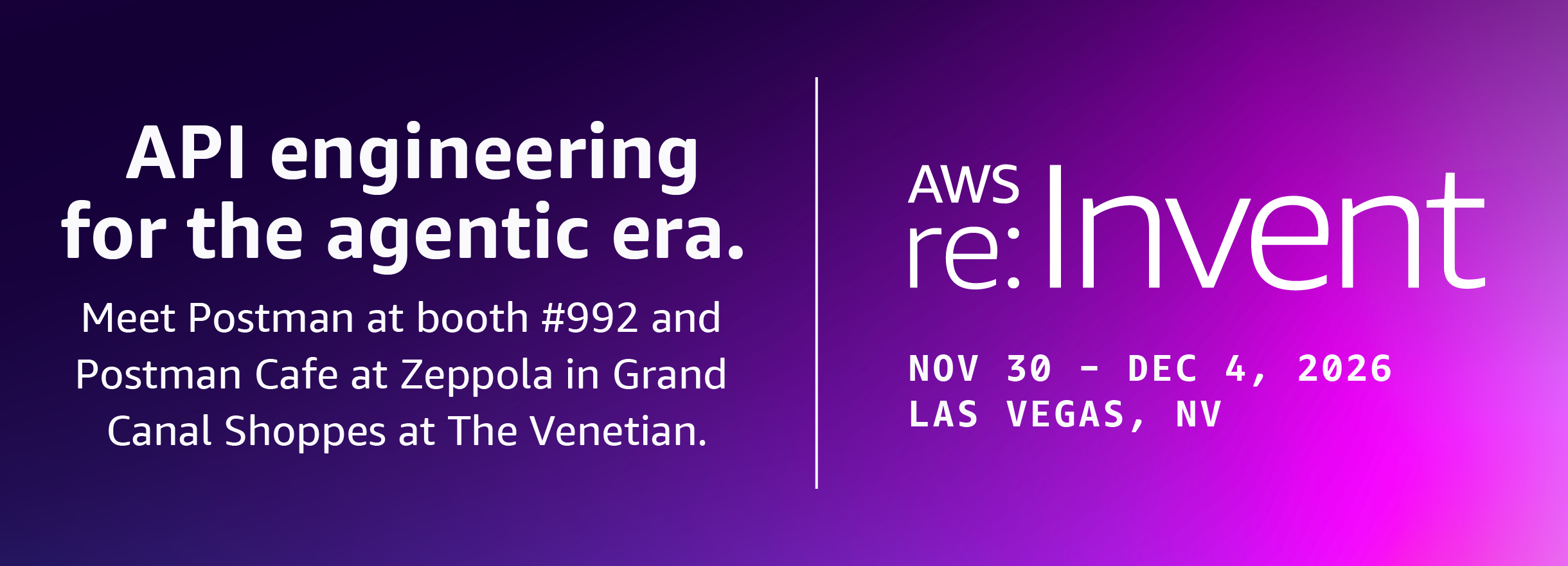
AI agents are changing how software gets built, and APIs are at the center of it. Meet the Postman team at AWS re:Invent to talk API engineering for the agentic era, see what’s new, and get your questions answered. Pick the activity that works best for you.
|
AI-Native SDLC session. Join Ankit Sobti (CTO and Co-founder), Sam Chehab (Head of Information Security), and Developer Advocate Talia Kohan. Monday, Nov 30 at 8:30am, the Venetian. Add to agenda →
|
|
The Postman booth (#992). Get hands on with our newest products and features.
|
|
The Postman Café at Zeppola. Breakfast, an AWS keynote viewing party, and a networking hour at the Venetian. No conference pass needed. RSVP →
|
|
Book time with Postman. Meet our partnership, product, engineering, or security leaders. Whether you’re scaling AI, rethinking your API strategy, or exploring a partnership, we’ll connect you with the right people. Book a meeting →
|
|
Customers, join our Appreciation Reception. Tuesday, Dec 1, 7–10 p.m. RSVP →
|
|
|
|
What Shipped
|
Postman Private Cloud is now on Azure. Run a fully isolated Postman deployment in your own Azure subscription. All data stays in your Azure VNet and in resources you manage, encryption uses your own keys through Azure Key Vault, and the feature set matches the AWS deployment, including version control, API Governance, Monitors, and Performance Testing. Learn more →
|
|
Postman Simulations bring up every service your app depends on, at once. Mock the services you want to control and leave the rest real. A Simulation lives in your repo next to your code and runs in the app, headless, from the Postman CLI or CI, or driven by a coding agent. Each one remembers what the last run learned, so the next run does not start from scratch. Learn more →
|
|
Shared Vault external integrations. The Postman Shared Vault now supports external vault integrations for HashiCorp and Azure Key Vault. Administrators configure connections once; developers then link secrets from the Postman app. Linked secrets are stored as references and used in API requests, and cloud-based runs (flows, monitors, CI/CD) are now supported. Learn more →
|
|
Kafka is now a request type in Postman. Produce and consume messages, script and test them, and run Kafka requests in the same collection as the HTTP calls that trigger them. It connects with SASL, AWS IAM, or mTLS, generates collections from AsyncAPI specs, and runs in CI with the Postman CLI. No JVM, framework, or self-hosted console required. Learn more →
|
|
|
|
In the Wild

|
“Passport let us keep every credential in the Secret Manager inside our own project and give agents only per-endpoint, time-limited access. The agents’ code didn’t change at all.”
Pralav Dessai, Head of Engineering at Formally
|
Formally stopped circulating 100+ API keys to its engineers and AI agents
See how Formally’s engineers and AI agents use Passport from Postman to call external APIs without ever holding an API key. Each call goes through a Postman Passport proxy that Formally runs in its own Google Cloud project. The proxy looks up the real credential in Google Secret Manager at the moment of the call and adds it to the outgoing request.
Read the full case study →
Read our latest case studies from
Cisco Meraki,
ICW,
Rootly, and
more.
|
|
|
Postman Research
New research on building for agents.
|
State of the API Report. This year’s report captures a turning point: agents are no longer a future audience for APIs, they are running in production. To understand how that shift is reshaping how teams build, secure, and govern APIs, we surveyed more than 8,900 people across the globe. The signal is clear — organizations built on an API-first foundation are pulling ahead, more likely to run agents in production, more likely to have APIs ready for them, and deploying more often. Read the report →
|
|
|
|
What’s Next
|
Postman CLI 2.0, coming soon. Agents already reach every Postman capability through the CLI. 2.0 adds a better terminal interface for agents, more workspace context through the Context Graph, a more powerful simulator to verify changes, and a better review experience for the people checking agent work.
|
|
See where your APIs stand in the 2026 State of the API Report
|
|
|
Thanks for reading.
Abhinav
|

You are receiving this because you opted in to Postman communications.
Postman, Inc. · One Market Plaza, Steuart Tower, Suite 0800 · San Francisco, CA 94105
Unsubscribe
|
|