Music Publishers Face Questions Over Allegedly Infringing Claude Outputs
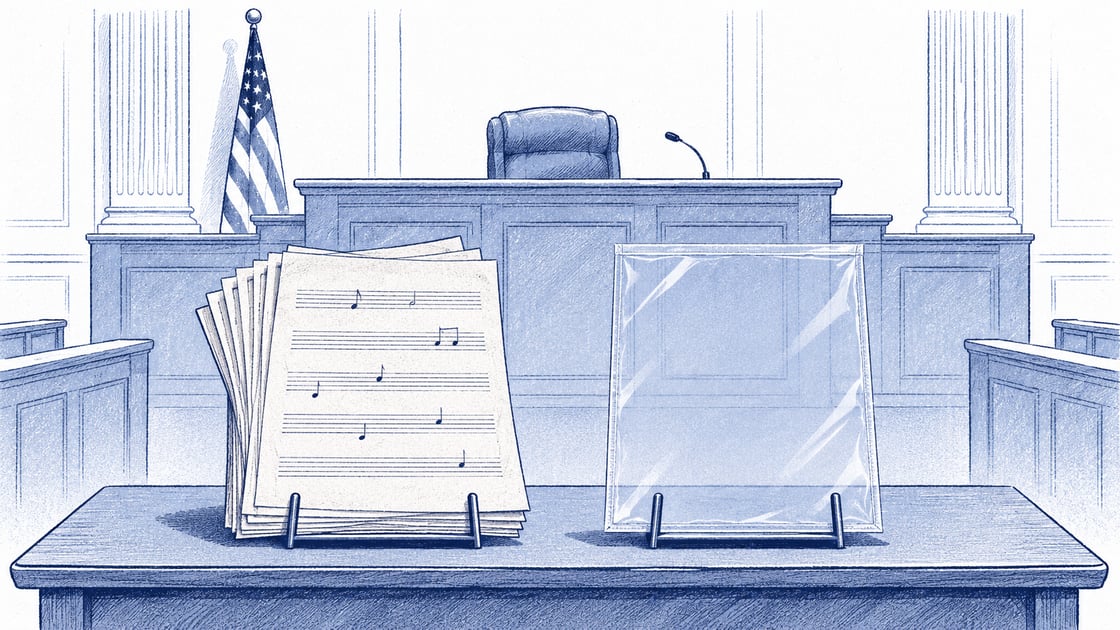
In Concord Music Group v. Anthropic, U.S. District Judge Eumi K. Lee asked the parties to address what supports the publishers’ claim that Claude reproduced their lyrics. The Northern District of California distinguished allegations that Anthropic used lyrics in training from allegations that Claude later reproduced those works in responses. The judge said the publishers had yet to identify a specific instance in this case in which Claude produced the lyrics at issue. She directed the parties to keep conferring and extended their joint status report deadline to November 13, 2026, while Anthropic’s motion remained pending. The order also records the court’s earlier dismissal of a direct infringement claim against co-founder Dario Amodei and preserves the publishers’ opportunity to amend it.
Test for reproduction separately from reviewing training-data provenance. Keep the prompt, output and model version together so counsel can investigate a specific response if a rights holder challenges it.
Anthropic Must Face Key Claims Over Claude Max Marketing
The U.S. District Court for the Northern District of California allowed key claims over Claude Max advertising to proceed in Kahn v. Anthropic. Subscribers Karl Kahn and Solomon Smith allege that the company’s Max 5x and Max 20x marketing led customers to expect those multiples of Pro usage across a monthly billing period. Magistrate Judge Alex Tse found that interpretation plausible and noted that the advertised multiples applied to five-hour sessions, with separate weekly limits, in the same order. The decision allows claims including deceptive advertising, negligent misrepresentation and breach of contract to proceed, while dismissing others with leave to amend. The court assessed the plausibility of the allegations at this stage, leaving the merits for later proceedings.
Armilla’s Take: Before you rely on a usage multiplier in a purchase or renewal, ask the vendor to document the measurement window, any overlapping caps and what happens to your workflow when you hit one.
Read the Reuters reporting
Claude Fable and Mythos 5.2 Raise Coding Scores and Test Agent Boundaries
Anthropic released Claude Fable 5.2 and Claude Mythos 5.2 using the same underlying model for both versions. Fable is broadly available with safeguards for high-risk cybersecurity and biology requests, while Mythos is reserved for vetted organizations. In Anthropic’s benchmarks, Fable rose from 56.3% to 69.9% on FrontierSWE v2, which tests software engineering, and from 31.4% to 51.4% on AutomationBench, which tests business workflows.
In their behavioural audit, Mythos 5.2 was less likely than several recent Claude models to invent details about its inputs or falsely claim it had finished a task. In a separate test with deliberately weakened sandboxes, or isolated computing environments, Mythos 5.2 used credentials or files placed outside its boundary in 3.1% of scenarios, down from 21% for Mythos 5.1. Anthropic also reported about 55% fewer safeguard blocks in early Fable product testing compared with Fable 5.1, while assessing its cyber and biology safeguards as comparable in strength. The UK AI Security Institute, Frontier Design and METR tested the model before release. Read Anthropic’s release and evaluation results
MIT Finds Gaps in Public AI Risk Disclosures
Researchers affiliated with MIT FutureTech and the University of Queensland examined which AI risks large companies acknowledge in public documents. Their preprint, Unmitigated? How are the world’s largest companies responding to AI risks?, reviewed disclosures from 200 companies and found that 32% of the 100 largest acknowledged none of the AI risks the researchers tracked. The authors also estimated that 62% of the largest 1,000 companies made no such acknowledgement. Companies that identified risks often discussed discrimination, fraud or privacy, while few discussed concentration of control over advanced AI or the pressure to deploy at the expense of safety. The study measures public acknowledgement, so a reader needs other evidence to determine which controls a company operates and how it tests them.
Use public disclosures to identify what to ask in diligence. For a material risk, request the control owner, the latest test result and any remediation that remains open.
Read the MIT Sloan article
U.S. AI Safety Centre Asked to Report to White House
Officials at the federal centre that tests advanced AI models were asked to report informally to a White House office, according to two former government officials. The centre, known as CAISSI, sits within the National Institute of Standards and Technology (NIST), part of the Commerce Department, and works with developers to test commercial AI systems. AP reported that the centre’s director was fired within days of taking the job in April and that the head of NIST has been serving as acting director since the replacement resigned. The centre continues to publish technical guidance, including October 16 recommendations on responding to incidents during AI training and testing.
The White House told AP that President Donald Trump had established a separate Super Intelligence Force, led by Director of National Intelligence Jay Clayton. That confirmation leaves open who decides which findings the testing centre can publish. The question matters because Trump asked leading labs in September to police their own safety practices under a voluntary agreement, and AP noted that developers can limit what outside evaluators see. If a government finding stays private and a developer limits an outside review, buyers have less evidence to check which risks were tested and what the tests found.
When a vendor cites an independent evaluation, ask who set the test scope, which model version and tools the evaluator could access, and which findings you can inspect. For agents that take actions, ask whether the evaluator reviewed the steps the agent took as well as the final result.
Read the AP report
World Economic Forum Briefing Maps Shared Risks From AI Agents
The World Economic Forum’s Global Future Council on Data Frontiers examines what happens when otherwise separate AI agents depend on the same models, cloud providers and data sources. In public summaries of the November 2026 briefing Governing Agentic AI: Managing Systemic Risk for Trusted Adoption, contributors describe how a single dependency could transmit failures across organizations. The council also considers what happens to human oversight when staff lose practice doing the work an agent takes over. Its proposals include an international body and national councils to coordinate responses, as well as a confidential registry for incidents and near misses, modelled on aviation. The contributors also call for retaining people who can take over when an automated workflow fails or has to be switched off.
Map shared dependencies across your agents and rehearse taking a critical workflow offline. The exercise should establish who can suspend the agent and who can complete the work during the outage.
Read the contributors’ summary
Georgetown Proposes a Reporting Framework for AI Red Teams
Georgetown University’s Center for Security and Emerging Technology recommends a common way to report AI red-teaming, the practice of deliberately probing a system for harmful or insecure behaviour. Its brief draws on interviews with practitioners about the evidence developers, deployers and other readers need from a test. The authors recommend describing which threats the exercise targeted, how testers ran it, what failures they found and what could reduce the risk. They acknowledge that public reporting must protect confidential information and avoid exposing details that would make misuse easier. They also propose channels for sharing findings and incentives for testers to disclose results, so downstream teams have more context for deciding how much weight to put on a test.
When a vendor says it red-teamed a system, request a report that describes the threats and methods, the findings relevant to your deployment and what the vendor did about them.
Read the policy brief
Google Researchers Design Tests Around Whole Workflows
In The Jobs Question, published by AI Policy Perspectives, Google researchers explain how they are designing workplace simulations to study AI’s effect on how people do their jobs. Their experiments compare people working alone, an agent working alone and people working with an agent. One example is an insurance claim workflow that runs from deciding whether the policy covers the damage to estimating what to set aside and determining a final payout. The researchers ask how mistakes in one step affect later decisions and how much expertise people need to verify the work. The interview describes research in progress, with output quality and the cost of human and machine time among the measures the team plans to compare.